How to Register Your Sole Proprietorship Online
Learn How to Register Your Sole Proprietorship Online in India. A step-by-step business startup guide by CAs to streamline registration process.
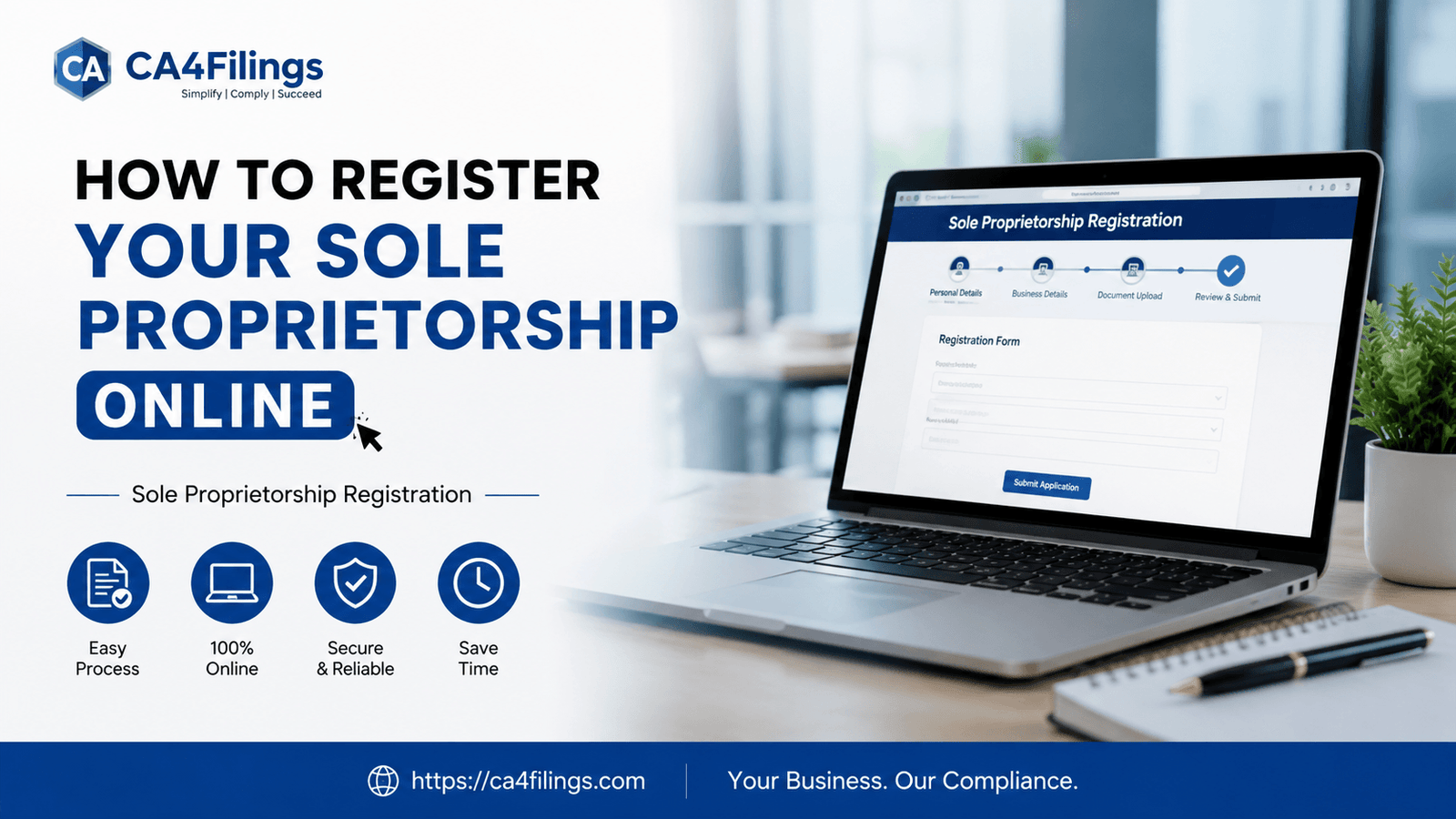
Starting a new business venture in India is an incredibly exciting journey, but it frequently brings up an initial hurdle: understanding corporate legalities. If you are an individual entrepreneur looking to launch your business with minimal compliance and maximum control, a sole proprietorship is your best option. Many budding founders approach us asking How to Register Your Sole Proprietorship Online without getting trapped in endless government paperwork. Fortunately, the digital ecosystem in India has evolved rapidly, making it entirely feasible to manage your online business registration directly from your desk.
At CA4Filings, we understand that navigating multiple tax and licensing portals can feel overwhelming when you are trying to focus on building your brand. Securing a legal identity through formal Sole Proprietorship Registration is the foundational step that transforms your business idea into a legitimate corporate entity, enabling you to legally open bank accounts, sign commercial contracts, and build long-term trust with your clients. This comprehensive business startup guide will walk you through the practical, legal, and operational nuances required to start sole proprietorship online smoothly and securely.
Demystifying the Sole Proprietorship Setup
Unlike a Private Limited Company or an LLP, a sole proprietorship is not legally distinct from its owner. From a legal standpoint, you and your business are the same entity. This structural simplicity is exactly why it remains the most popular choice for freelancers, local consultants, independent retail traders, and e-commerce micro-entrepreneurs across India.
However, a common misconception exists: many founders assume there is a single, centralized "Sole Proprietorship Act" or a master certificate issued by the Ministry of Corporate Affairs (MCA). In reality, a sole proprietorship setup is recognized by accumulating specific tax registrations and local government licenses that prove you are actively conducting business under a specific trade name. If you want to register business online, your primary objective is to obtain at least two official registrations to satisfy the Reserve Bank of India’s (RBI) Know Your Customer (KYC) guidelines for opening a business current bank account.
Essential Prerequisites for Small Business Registration Online
Before you dive into the portals to register sole proprietorship online, gathering your foundational documentation is crucial. Having these verified files ready will significantly streamline registration process timelines and prevent unnecessary multi-day portal rejections:
Identity Proof: PAN Card and Aadhaar Card of the proprietor (ensure your mobile number is linked to Aadhaar for OTP authentications).
Address Proof for Business Location: If the property is rented, you require a signed lease agreement alongside a recent utility bill (Electricity bill or Gas bill) and a No Objection Certificate (NOC) from the property owner. If you are operating from your own residential property, a utility bill in the owner's name is sufficient.
Active Bank Credentials: A personal savings account statement or a cancelled cheque to verify initial banking footprints.
How to Register Your Sole Proprietorship Online: Step-by-Step Guide
To successfully execute an online sole proprietorship registration, you have a few structural paths. As a professional firm, we recommend reviewing which specific combination of licenses best aligns with your industry sector. Here is the operational, sole proprietorship step by step guide to establish your corporate presence:
Step 1: Obtain the Udyam Registration (MSME Certificate)
The Udyam portal run by the Ministry of Micro, Small, and Medium Enterprises is an excellent mechanism to formalize your setup. This digital-only certification is entirely paperless and heavily integrated with the income tax and GST networks. By entering your personal PAN and Aadhaar, you can declare your business name and address to generate a lifetime validity certificate. This serves as a primary legal document for your firm and unlocks various government subsidy benefits.
Step 2: Secure a Shop and Establishment Act License
If you operate a physical commercial premises, a retail shop, or even a dedicated home office, you must secure a license under your respective state's Shop and Establishment Act. Most Indian states have fully digitized this process via municipal corporate portals. You upload your commercial address proof, pay a nominal state-specific statutory fee, and receive a digital registration certificate that validates your local operations.
Step 3: Register for Goods and Services Tax (GST)
Applying for GST is often the absolute fastest way to establish an indisputable legal identity for your business. While the law mandates GST only when an e-commerce operation is launched or regular annual turnover crosses specified thresholds (₹20 Lakhs for services / ₹40 Lakhs for goods), opting for voluntary registration is a strategic choice. A GSTIN serves as an ironclad proof of business entity, allowing you to seamlessly clear vendors and onboard national corporate B2B clients.
Critical Business Registration Tips from a CA
While discovering how to register your sole proprietorship online is relatively straightforward, maintaining the entity demands careful operational focus. Here are a few vital business registration tips that our accounting team emphasizes to new startup founders:
Never Mix Personal and Business Capital: The moment you secure your business licenses, visit your bank and open a dedicated current account. Depositing business revenues into a personal savings account distorts income tax tracking and raises critical audit red flags during scrutiny.
Validate Your Trademarks Early: Registering a business name on the Udyam or GST portal does not grant you intellectual property ownership over that name. Run a thorough check on the IP India public portal to ensure your desired brand name isn't infringing on an already registered corporate trademark.
Track Your Monthly Compliance Obligations: If you select GST as a registration route, remember that you must file regular monthly or quarterly returns (like GSTR-1 and GSTR-3B), even if your business records absolute zero sales during the initial operational months.
Frequently Asked Questions
Q1: Can I start business online as a sole proprietor using my home address?
Yes, absolutely. A significant percentage of Indian digital businesses, freelancers, and consultants operate initially out of a residential space. You simply need an NOC from the family member or owner listed on the property's utility bill to successfully complete your registration portals.
Q2: How much time does it take to register sole proprietorship online?
If your documentation is immaculate, digital certifications like Udyam Registration can be generated within a single working day. Structural tax portals like GST registration or state municipal licenses generally take anywhere from 3 to 7 working days to undergo departmental review and approval.
Q3: Is a corporate PAN card required for a sole proprietorship setup?
No, it is not. Because the firm does not possess an independent legal identity away from you, all business transactions, tax liabilities, and bank accounts run directly on your personal PAN card. There is no separate structural assessment path for a proprietorship PAN.
Q4: Can I convert my proprietorship into a Private Limited Company later?
Yes. As your business operations scale up, your revenues expand, or you seek external venture capital investments, you can comfortably transition your sole proprietorship into a Private Limited Company or LLP through formal legal conversion and asset transfer protocols.
Take the Stress Out of Your Corporate Launch
Learning How to Register Your Sole Proprietorship Online is the perfect foundational stepping stone toward real financial independence and entrepreneurial growth. By selecting the correct blend of government licenses, you shield your operations from local compliance friction and position your brand for corporate success. While the digital pathways have significantly simplified individual application steps, dealing with structural formatting, unexpected portal errors, and choosing accurate HSN/SAC codes can still consume your valuable time.
Let the Experts Handle Your Licensing While You Build Your Business!
At CA4Filings, we streamline your legal onboarding by managing the entire documentation, application, and compliance cycle on your behalf. Avoid regulatory missteps and speed up your bank current account setups. Reach out to our professional CA consultancy team today, and let us securely launch your entrepreneurial vision into reality!
Latest Updates
ca4filings.com Services
























-registration.png)