Pvt Ltd vs. OPC: Choosing the Right Route for Company Registration
Compare Pvt Ltd vs OPC for company registration in India. Understand eligibility, compliance, liability, costs, and choose the right business structure.
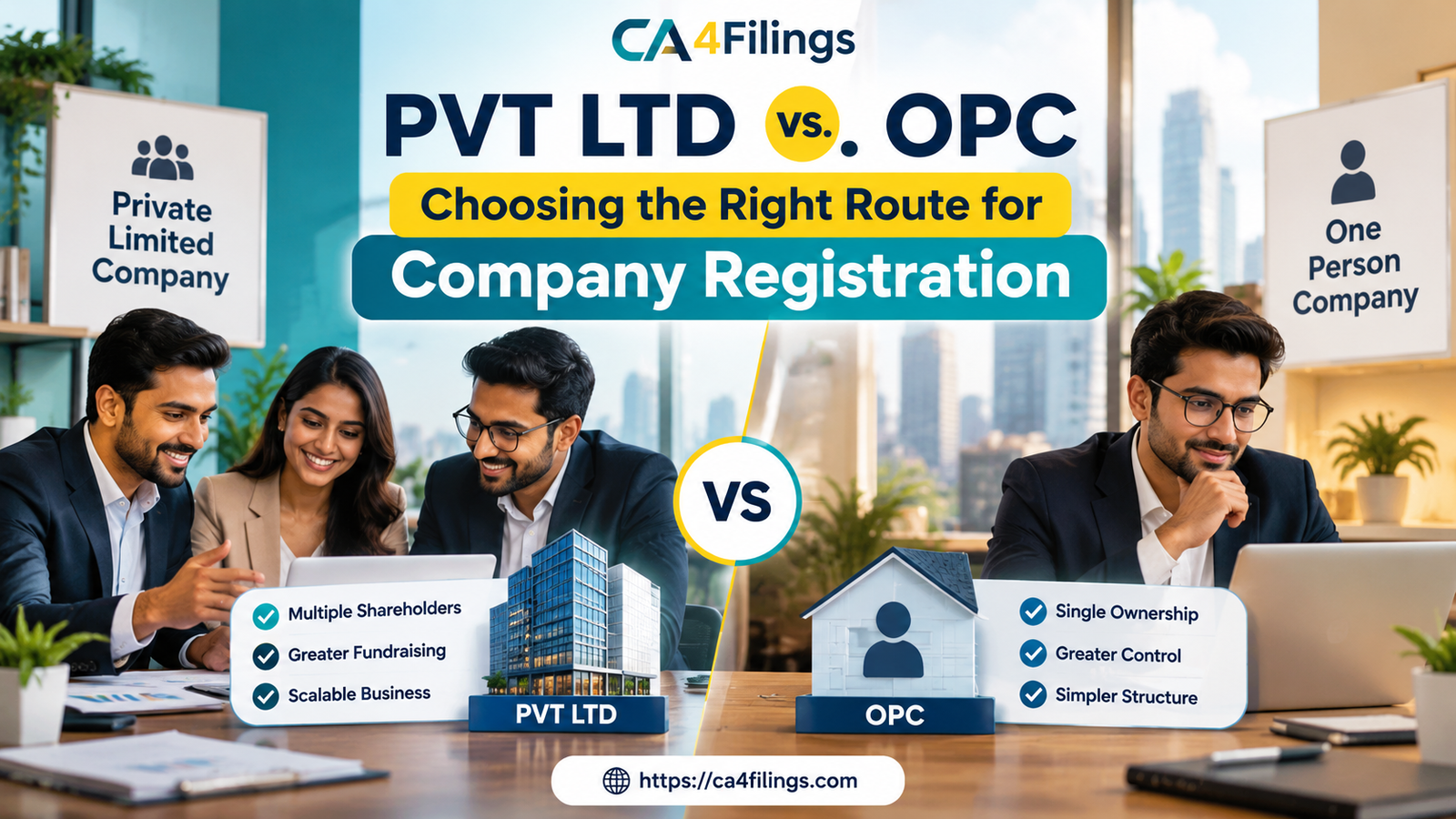
Starting a business is exciting, but choosing the right legal structure is one of the first important decisions an entrepreneur must make. During company registration, many founders face a common question: should they choose a Private Limited Company or a One Person Company (OPC)?
Both structures provide a separate legal identity and limited liability protection, making them attractive options for entrepreneurs in India. However, they differ in ownership, compliance requirements, fundraising opportunities, and long-term growth potential. The right choice depends on your business goals, available resources, and future expansion plans.
At CA4Filings, we help entrepreneurs understand these differences before taking the next step. Our Company Registration services are designed to help business owners choose a suitable structure and complete the incorporation process with greater confidence.
Let's explore how these two options compare and which one may work better for your business.
What Is a Private Limited Company?
A Private Limited Company is a separate legal entity registered under the Companies Act, 2013. It is a popular choice for startups, growing businesses, and entrepreneurs who want to build a scalable organisation.
A private company generally requires at least two members and two directors. The same individuals may hold both roles, provided they meet the applicable legal requirements. A private company can have up to 200 members, subject to statutory conditions.
Key Features of a Private Limited Company
Separate legal identity: The company can own assets, enter contracts, and conduct business in its own name.
Limited liability: Shareholders' liability is generally limited to the unpaid amount on their shares, subject to applicable legal exceptions.
Fundraising opportunities: The company can issue shares privately and bring in eligible investors.
Business continuity: Its existence is not ordinarily affected by a shareholder's death or departure.
Ownership flexibility: Shares can be transferred subject to the restrictions applicable to private companies.
For example, imagine two founders planning to launch a technology startup. One handles product development, while the other manages sales. A Private Limited Company allows them to define their ownership percentages, responsibilities, and decision-making arrangements through an appropriate corporate structure.
For businesses planning to recruit employees, attract investors, or expand into new markets, this structure often provides greater flexibility.
What Is a One Person Company (OPC)?
A One Person Company is a type of company that allows a single individual to operate through a corporate entity. Introduced under the Companies Act, 2013, it is particularly useful for entrepreneurs who want to run a formal business without bringing in another shareholder.
An OPC has one member and must nominate another individual as a nominee, subject to applicable statutory requirements. The nominee is intended to take the member's place in specified circumstances, such as the member's death or incapacity.
Under current Indian company law, an OPC can generally be incorporated by an eligible natural person who is an Indian citizen, whether resident in India or otherwise, subject to the applicable rules.
Key Features of an OPC
Single ownership: Only one person holds the membership.
Limited liability: The owner's personal assets are generally protected from company liabilities, subject to legal exceptions.
Separate legal identity: The company operates independently of its member.
Greater ownership control: The sole member can make business decisions without coordinating with other shareholders.
Formal business recognition: The company can enter contracts and maintain its own financial records.
Consider a freelance consultant who earns a stable income and wants to build a professional consulting brand. An OPC may provide the advantages of incorporation while allowing the consultant to retain complete ownership.
However, the owner should assess ongoing compliance expenses and administrative responsibilities before deciding whether an OPC is worthwhile.
Company Registration: Pvt Ltd vs OPC at a Glance
Understanding the main differences makes company registration easier to approach.
| Comparison Factor | Private Limited Company | One Person Company |
|---|---|---|
| Minimum members | 2 | 1 |
| Minimum directors | 2 | 1 |
| Maximum members | 200 | 1 |
| Nominee requirement | Not applicable as an OPC nominee | Mandatory |
| Limited liability | Yes, subject to legal exceptions | Yes, subject to legal exceptions |
| Fundraising | Better suited to multiple shareholders and equity investors | Cannot have additional members unless converted into another eligible structure |
| Ownership | Multiple shareholders permitted | Single member |
| Compliance | Generally higher administrative complexity | Often simpler in certain respects, but statutory compliance remains necessary |
| Business expansion | Well suited to multi-founder and investor-backed growth | Suitable for a business initially controlled by one owner |
The important point is that an OPC is not free from statutory obligations. Both structures must follow applicable requirements concerning accounting, annual filings, financial statements, and taxation.
Key Factors to Consider Before Company Registration
Choosing between these structures requires more than comparing incorporation fees. Your long-term business objectives should guide the decision.
1. Ownership and Decision-Making
If you want to retain sole ownership and make decisions independently, an OPC may be suitable. It offers a clear ownership arrangement without requiring another shareholder.
On the other hand, if you are starting a business with a partner, a Private Limited Company is generally more appropriate. It allows you to allocate shares according to each founder's contribution, responsibilities, and agreed investment.
2. Fundraising and Future Expansion
Businesses that expect to raise equity capital should carefully consider a Private Limited Company.
Investors generally prefer a structure that allows them to acquire shares and establish clear ownership rights. A private company can accommodate multiple shareholders and different investment arrangements, subject to company law.
An OPC may be suitable for a self-funded business, but it cannot admit another member while retaining its OPC status. A change in structure may therefore become necessary before bringing in a co-owner or equity investor.
3. Compliance Scale and Administrative Costs
Your compliance scale should match the size and ambitions of your business.
Both OPCs and Private Limited Companies must comply with applicable provisions of the Companies Act, 2013. Depending on the circumstances, obligations can include maintaining books of account, conducting statutory audits, filing annual returns, and submitting financial statements.
An OPC benefits from certain procedural relaxations under the law, but these do not eliminate all compliance responsibilities.
Before proceeding with company registration, consider the recurring costs of accounting, audit, professional assistance, and annual statutory filings, rather than focusing only on the initial incorporation fee.
4. Director Liability and Legal Protection
Both structures generally protect shareholders from personal liability for company debts beyond their legal obligations. However, limited liability does not mean that every personal risk disappears.
Directors may face personal consequences for statutory violations, fraud, personal guarantees, or other conduct that creates liability under applicable law.
For instance, if a director personally guarantees a business loan, the lender may pursue the director under the guarantee's terms. Choosing either structure does not automatically protect the director from that obligation.
5. Long-Term Business Goals
Ask yourself where you want the business to be in the next three to five years.
Planning to build a startup with multiple founders? Consider a Private Limited Company.
Intending to attract angel investors or institutional funding? A Private Limited Company is generally more suitable.
Operating independently as a consultant or professional entrepreneur? An OPC may be worth considering.
Planning to introduce business partners later? Evaluate whether starting as a Private Limited Company would avoid a future restructuring exercise.
The best decision is the one that supports your growth without creating unnecessary administrative burdens.
Step-by-Step Guide to Company Registration in India
Once you select the appropriate structure, the incorporation process generally involves the following steps.
Step 1: Check eligibility and select the structure. Confirm whether you meet the requirements for an OPC or whether a Private Limited Company better suits your ownership plans.
Step 2: Obtain Digital Signature Certificates (DSCs). The relevant proposed directors and subscribers need digital signatures for filing incorporation documents electronically, as applicable.
Step 3: Apply for name approval. Choose a unique name that complies with the Ministry of Corporate Affairs' naming requirements.
Step 4: Prepare incorporation documents. Collect identity and address proofs, registered office documents, consent forms, and the required constitutional documents.
Step 5: File the incorporation application. Submit the applicable forms and attachments through the MCA's prescribed electronic incorporation process.
Step 6: Receive the Certificate of Incorporation. Once the application is approved, the Registrar of Companies issues the certificate. PAN and TAN are generally allotted through the integrated incorporation process, subject to the applicable procedure.
Step 7: Complete post-incorporation formalities. Depending on the circumstances, these may include opening a bank account, depositing subscribed capital, filing the commencement-of-business declaration, appointing an auditor, and arranging statutory records.
Professional guidance can help minimise documentation errors and avoidable delays.
Latest Updates
ca4filings.com Services