Avoiding Rejection: Common Mistakes in Your Startup India Registration Pitch Deck
Avoid startup india registration rejection with a clear, compliant pitch deck. Learn common mistakes, DPIIT criteria, and expert tips from CA4Filings.
Why Your Startup India Registration Pitch Deck Matters
Getting recognised under the Startup India initiative can open doors to government support, networking opportunities, and eligible tax benefits. However, a promising business idea alone may not be enough. During startup india registration, your pitch deck must clearly demonstrate what your business does, how it solves a real problem, and why its approach qualifies as innovative or significantly improved.
At CA4Filings, we often advise founders to treat their pitch deck as more than a presentation. It is an opportunity to explain the business's commercial potential through credible information and supporting evidence. If you are setting up a new venture, completing Company Registration correctly is also an important foundation for your compliance journey.
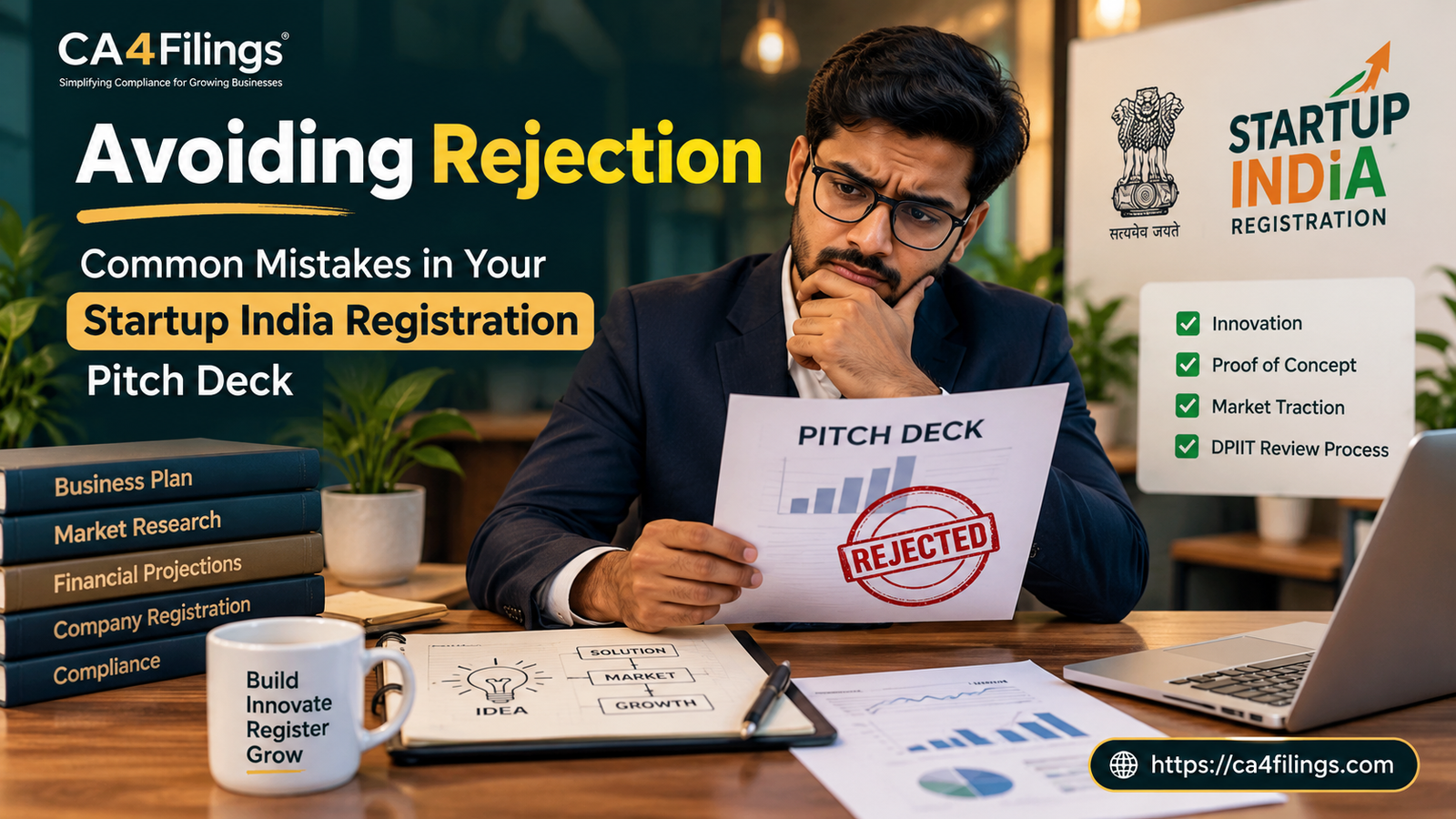
Many applications face difficulties because founders overlook basic documentation, make unsupported claims, or fail to explain their innovation. Understanding these common mistakes can help you prepare a stronger application and navigate the DPIIT review process with greater confidence.
1. Failing to Explain the Innovation Criteria
One of the most important aspects of startup india registration is demonstrating how your business meets the applicable eligibility requirements. Founders sometimes describe their product as revolutionary without explaining what makes it different.
For example, opening another online grocery store does not automatically demonstrate innovation. However, developing a technology-driven inventory system that substantially reduces food wastage or improves supply-chain efficiency may provide a stronger explanation of the business's innovative contribution.
Your pitch deck should clearly establish:
The problem your startup addresses.
The limitations of existing solutions.
Your product's unique features or improvements.
The technology, process, or business model that differentiates your offering.
The measurable benefits for customers or the industry.
CA4Filings tip: Avoid using words such as "unique," "disruptive," and "first of its kind" without evidence. Explain the actual improvement and support it with examples, product demonstrations, or relevant data.
2. Presenting a Weak Problem Statement and Solution
A pitch deck can lose credibility when it describes a broad problem without identifying the specific customers affected by it.
For instance, stating that "small businesses need better accounting" is too general. A stronger statement would explain that small retailers struggle to reconcile daily digital payments with inventory records, leading to accounting errors and wasted time.
For startup india registration, the connection between the identified problem and your proposed solution should be easy to understand.
Follow these steps:
Identify your target customers and their specific challenges.
Explain why existing alternatives are insufficient.
Describe how your product or service addresses the problem.
Show the practical benefits, such as lower costs, faster processes, or improved accuracy.
Support your explanation with customer feedback, research, or product results wherever available.
A clear problem-solution narrative helps reviewers understand the business without having to guess what the startup actually does.
3. Making Unsupported Claims About Market Traction
Another common mistake is presenting ambitious projections as though they were actual business achievements. Statements such as "10,000 potential customers" or "₹1 crore expected revenue" do not establish market traction unless the underlying figures are explained accurately.
Market traction refers to evidence that customers are showing interest in, adopting, or paying for your offering.
Depending on your business stage, useful indicators may include:
Number of active users or paying customers.
Monthly sales and revenue growth.
Repeat purchases or customer retention.
Signed pilot agreements or genuine letters of intent.
Product usage statistics and customer feedback.
Partnerships that have actually been established.
If your startup is pre-revenue, do not worry about inventing impressive figures. Explain your proof of concept, prototype development, pilot testing, or early customer interviews instead.
During startup india registration, consistency matters. Your pitch deck, financial projections, application details, and supporting documents should present the same underlying business facts.
4. Ignoring the Proof of Concept
A business idea may sound promising on paper, but reviewers need to understand how it can work in practice.
A proof of concept demonstrates whether the proposed solution is technically or operationally feasible. Depending on the nature of your startup, it could be a working prototype, a software demonstration, a tested manufacturing process, or documented results from a pilot project.
Your presentation should explain:
What has already been developed.
Which features have been tested.
What the testing demonstrated.
What remains under development.
How the next development stage will be funded.
For example, a startup developing an agricultural monitoring device could include photographs of its prototype, sensor readings from field trials, and feedback from participating farmers.
For an early-stage venture, a credible development roadmap is often more persuasive than exaggerated claims about a fully developed product.
5. Using Unrealistic Financial Projections
Financial projections are important, but unsupported forecasts can weaken an otherwise promising application.
Founders sometimes project rapid revenue growth without explaining customer acquisition costs, pricing, operational expenses, or the resources required to serve additional customers.
To avoid this problem, include a reasonable financial overview covering:
Current revenue, where applicable.
Expected revenue over the next two to three years.
Major operating expenses.
Proposed funding requirements.
Revenue assumptions and expected growth drivers.
For example, if you forecast 500 paying customers in the first year, explain your pricing model, sales strategy, and expected conversion rates.
The purpose is not to guarantee future performance. It is to demonstrate that you understand your business economics and have a realistic plan for growth.
6. Overlooking Eligibility and Documentation Requirements
Even a well-designed pitch deck cannot compensate for an application that fails to meet the applicable eligibility conditions.
Before applying for startup india registration, check whether your entity type, incorporation details, age, turnover, and business activities satisfy the requirements applicable to your application.
Also ensure that the documents you submit are accurate, legible, and consistent.
Common documentation mistakes include:
Incorrect incorporation dates or entity details.
Mismatches between the application and pitch deck.
Missing or outdated supporting documents.
Unclear descriptions of the product or service.
Incomplete information about founders or business activities.
Claims that cannot be substantiated when requested.
Review the latest official DPIIT recognition guidelines before submission because eligibility conditions and procedural requirements can change.
7. Making the Pitch Deck Too Complicated
A pitch deck should communicate the business clearly, not overwhelm the reviewer with technical terminology and unnecessary information.
Long paragraphs, crowded slides, decorative graphics, and unexplained abbreviations can make it difficult to identify the startup's core value.
A practical pitch deck structure includes:
Business overview: Name, sector, and core offering.
Problem statement: The customer challenge you address.
Proposed solution: How your product or service works.
Innovation: Your differentiation and improvements over existing alternatives.
Target market: Customer segments and market opportunity.
Proof of concept and traction: Product progress and supporting evidence.
Business model: How the startup generates revenue.
Growth strategy: Customer acquisition and expansion plans.
Financial outlook: Realistic projections and funding requirements.
Supporting evidence: Relevant demonstrations, research, and other documentation.
Keep each slide focused on one main message. Use charts and product screenshots where they communicate information more effectively than paragraphs.
8. Misunderstanding the DPIIT Review Process
Submitting an application does not automatically guarantee recognition. The DPIIT review process considers the applicable eligibility conditions and information provided by the applicant.
Founders sometimes assume that startup india registration depends only on having an innovative idea or that using a particular presentation template will guarantee approval. Neither assumption is reliable.
A better approach is to:
Read the current official application instructions carefully.
Ensure your business description is specific and consistent.
Explain how the venture meets the applicable recognition criteria.
Keep supporting evidence available.
Respond accurately to requests for clarification or additional information.
Avoid submitting generic pitch decks copied from other startups. Your presentation should reflect your actual business, its development stage, and its specific value proposition.
9. Final Checklist Before Startup India Registration
Before submitting your application, review the following checklist:
The entity meets the current eligibility requirements.
The business problem and proposed solution are clearly explained.
Innovation or significant improvement is demonstrated with relevant details.
Market traction figures are accurate and verifiable.
Proof of concept and development progress are described honestly.
Financial projections are supported by reasonable assumptions.
Incorporation and application details are consistent.
The pitch deck is concise, readable, and professionally presented.
All required supporting information has been reviewed.
The application reflects the latest official DPIIT instructions.
This final review can help you identify avoidable errors before submission.
Latest Updates
ca4filings.com Services