How to Company Registration Data Breaches: Keeping Corporate Records Private
Learn how to company registration securely, protect corporate records from data breaches, and maintain business privacy with expert tips from CA4Filings.
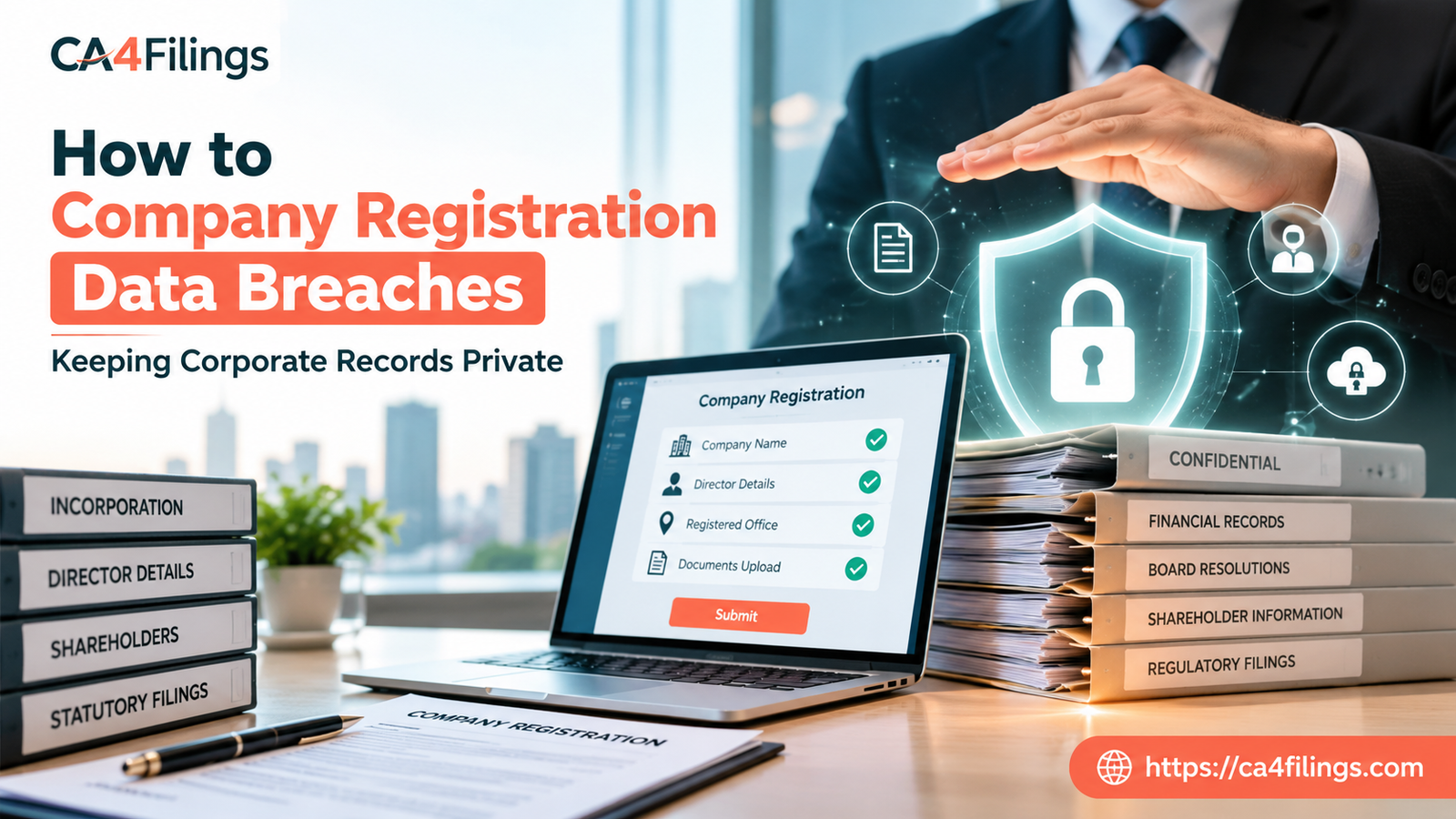
Understanding how to company registration securely is essential for entrepreneurs who want to build a business while protecting sensitive corporate information. In India, registering a company involves submitting important documents, including identity proofs, residential addresses, director details, and registered office information. Although these records support legal compliance and business transparency, improper handling can expose businesses to data breaches, identity theft, and financial fraud.
At CA4Filings, we believe that starting a business should not mean compromising your privacy. Whether you are launching a startup or expanding an existing enterprise, understanding the risks associated with corporate filings is an important first step. Our Company Registration services help entrepreneurs navigate the registration process while recognising the importance of accurate documentation and responsible information handling.
The key is to understand which information becomes publicly accessible, which documents require additional protection, and how to work with reliable professionals throughout the registration process.
Understanding How to Company Registration Can Expose Business Data
Company registration in India is governed by the Companies Act, 2013, and the Ministry of Corporate Affairs (MCA) oversees the relevant filing and corporate information systems.
Certain corporate details are publicly accessible to promote transparency and accountability. However, this does not mean every document should be freely distributed or carelessly stored.
What Information May Become Public?
Depending on the applicable filing requirements and disclosure rules, corporate information may include:
Company name, Corporate Identification Number (CIN), and incorporation date.
Names and certain particulars of directors.
Registered office address and other statutory details.
Information contained in publicly accessible statutory filings.
Details of authorised share capital and other corporate disclosures.
Documents submitted during incorporation may contain personal information. The extent of public access depends on the document, applicable law, and the MCA's access arrangements.
For example, an entrepreneur registering a private limited company may need to submit identity and address documents for verification. If these documents are circulated unnecessarily through email or messaging applications, sensitive information could reach unauthorised individuals.
Why Data Breaches Happen
Common causes include weak passwords, compromised email accounts, unsecured document storage, careless sharing of attachments, and fraudulent websites imitating official portals.
Understanding how to company registration safely means identifying these risks before submitting documents rather than waiting for a problem to occur.
Common Data Privacy Risks During Company Incorporation
Protecting corporate records requires more than completing statutory forms correctly. Businesses must also understand how information can be misused.
1. Identity Theft and Document Misuse
Identity documents and personal details may be misused to impersonate directors, attempt fraudulent transactions, or support unauthorised applications.
Practical example: A founder sends PAN and Aadhaar copies to an unverified intermediary through a messaging application. The intermediary's account is later compromised, exposing the documents to unknown individuals.
To reduce this risk, verify the recipient, share documents only when necessary, and use secure transfer methods.
2. Corporate Phishing Scams
Corporate phishing scams often involve emails or messages pretending to come from government departments, banks, or professional service providers. They may demand immediate payment, request OTPs, or direct users to counterfeit websites.
Warning signs include:
Unexpected demands for urgent payments.
Links to suspicious domains that imitate official portals.
Requests for passwords, OTPs, or banking credentials.
Attachments claiming that incorporation documents need immediate correction.
Always verify notices independently through official channels. Never share an OTP or password with someone claiming to be an MCA representative.
3. Insecure Document Storage
Saving incorporation documents on shared computers, public cloud folders, or personal devices without adequate protection can increase the likelihood of unauthorised access.
Businesses should implement controlled access, secure backups, and appropriate retention policies from the beginning.
How to Company Registration Securely: Practical Steps for Indian Businesses
Following a structured process can significantly reduce the risk of exposing sensitive corporate information.
Step 1: Choose a Verified Professional
Before engaging a consultant or filing intermediary, verify their identity, professional credentials where applicable, and business contact details.
Ask how they collect, store, transfer, and eventually dispose of client documents. A responsible professional should be able to explain these practices clearly.
Step 2: Use Secure Filing Platforms
Use official government portals and reputable professional service providers with appropriate security controls. Check the website address carefully before uploading documents or entering payment details.
Secure filing platforms should ideally provide:
Encrypted data transmission.
Access restrictions for confidential documents.
Secure authentication procedures.
Clear privacy policies and data-handling practices.
Appropriate backups and incident-response arrangements.
A padlock symbol in the browser alone does not prove that a website or service provider is trustworthy.
Step 3: Share Only Necessary Information
Provide documents required for the relevant statutory filing, identity verification, or professional service. Avoid sending unrelated personal or financial records.
Where legally permitted and accepted by the recipient, consider watermarking copies with the intended purpose and date. Never obscure information required by law or alter documents in a way that affects their validity.
Step 4: Strengthen Account Security
Cybersecurity should be part of the incorporation process, not an afterthought.
Follow these measures:
Use unique, strong passwords for important accounts.
Enable multifactor authentication wherever available.
Restrict access to incorporation files to authorised personnel.
Keep devices, browsers, and security software updated.
Avoid accessing confidential accounts through public Wi-Fi without suitable protection.
Never share login credentials with employees or outside consultants.
Step 5: Review Documents Before Submission
Check forms and attachments carefully before filing. Incorrect or unnecessary disclosures can create compliance issues and increase exposure to sensitive information.
Confirm that the company name, director particulars, registered office details, and supporting documents are accurate and consistent.
Step 6: Maintain Secure Records After Incorporation
Registration is only the beginning of your company's compliance responsibilities. Store certificates, statutory registers, resolutions, and filing acknowledgements in a controlled environment.
Maintain a clear record of who can access these documents and review permissions whenever employees or service providers leave.
The Role of Cybersecurity and Entity Management Software
As a business grows, managing corporate records manually becomes increasingly difficult. Entity management software can help organisations maintain statutory records, monitor filing deadlines, manage approvals, and restrict access to confidential information.
Useful features may include:
Role-based access controls.
Document version tracking.
Audit logs showing who accessed or changed records.
Automated reminders for statutory deadlines.
Secure document repositories and backup options.
However, software alone cannot eliminate risk. Businesses should assess the provider's security practices, data hosting arrangements, backup procedures, and incident-response capabilities before selecting a platform.
At CA4Filings, we recommend choosing technology that supports both operational efficiency and responsible data privacy in business filing.
Legal and Compliance Considerations for Corporate Data Privacy
Indian businesses must consider their obligations under applicable corporate, information technology, and data protection laws.
The Companies Act, 2013, establishes corporate disclosure and recordkeeping requirements. Businesses should not withhold information that must legally be filed merely because it contains sensitive details.
The Digital Personal Data Protection Act, 2023, and applicable rules and commencement notifications are also relevant to personal data processing. The provisions applicable to a particular organisation depend on the current legal framework, implementation timelines, and the nature of the processing.
Businesses should therefore:
Understand their legal obligations when collecting personal information.
Inform individuals about relevant data-handling practices where required.
Limit access to personal information to authorised purposes.
Establish appropriate security safeguards.
Follow applicable retention, deletion, and breach-response requirements.
Important: Corporate transparency and personal privacy must be balanced. Not every corporate record is confidential, and not every document submitted to a regulator is necessarily available to the public in full.
What to Do If Your Corporate Records Are Exposed
Even organisations with strong safeguards can experience security incidents. Acting quickly can limit the damage.
Identify the incident: Determine which documents, accounts, or personal details may have been exposed.
Secure affected accounts: Change compromised passwords, revoke suspicious sessions, and strengthen authentication.
Preserve evidence: Retain relevant emails, access logs, messages, and transaction records.
Notify the appropriate parties: Contact affected individuals, relevant service providers, and competent authorities where required by applicable law.
Assess the legal implications: Seek professional advice regarding notification obligations and potential liability.
Prevent recurrence: Review the incident, close security gaps, and update internal procedures.
If financial fraud or identity misuse is suspected, contact the relevant bank or service provider promptly and report the incident through appropriate official channels.
Latest Updates
ca4filings.com Services