The Impact of Registration on NGO Credibility and Funding Opportunities
Discover The Impact of Registration on NGO Credibility and Funding Opportunities. Learn how formal status drives growth and trust with CA4Filings.
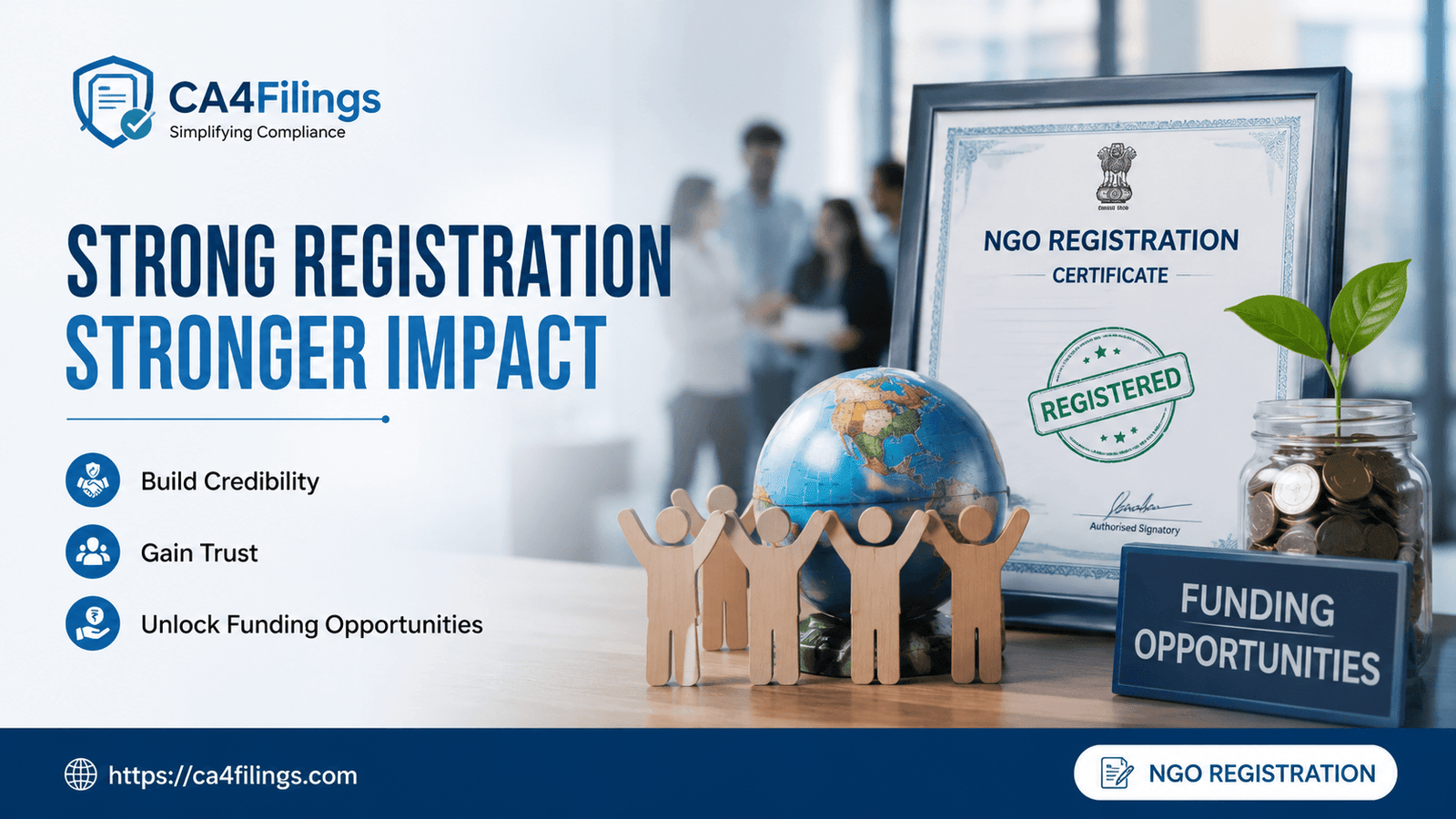
Starting a social initiative in India is a noble journey, but transforming that passion into a sustainable organization requires a solid legal foundation. Many grassroots leaders ask me if they can simply operate informally, but as a Chartered Accountant, I have seen firsthand how legal status changes the trajectory of a social enterprise. Understanding The Impact of Registration on NGO Credibility and Funding Opportunities is the first step toward scaling your social impact. If you are ready to take your initiative to the next level, our team at CA4Filings can help you streamline your NGO Registration to ensure you are fully compliant and ready for growth.
Why Formal Status is the Backbone of Trust
In the nonprofit sector, trust is your most valuable currency. When potential donors or partners engage with you, they aren’t just looking at the work you do; they are assessing whether you are a stable, transparent, and legally recognized entity.
The Impact of Registration on NGO Credibility and Funding Opportunities cannot be overstated. Without official recognition, your organization is viewed merely as an informal group. With it, you become an institution. Registration provides a unique identity that allows you to open bank accounts, sign legal contracts, and enter into formal partnerships.
Building Organizational Credibility Through Legal Compliance
Credibility is built on transparency. When an NGO registers under the Societies Registration Act, the Indian Trusts Act, or Section 8 of the Companies Act, it commits to a higher standard of governance.
Public Accountability: Registered entities must file annual returns and maintain audited books of accounts. This level of scrutiny might seem daunting, but it acts as a badge of honor for donors.
NGO Legitimacy: Potential collaborators, especially government bodies and large CSR departments, perform due diligence. An unregistered entity rarely passes these initial checks.
Professionalism: Registration forces an organization to define its bylaws, objectives, and management structure, which signals to the world that you are serious about your mission.
Scaling Your Reach with Expanded NGO Funding Sources
One of the most practical reasons to prioritize The Impact of Registration on NGO Credibility and Funding Opportunities is the access it unlocks to diverse capital. When you operate as a registered body, you aren't just limited to individual donations from friends and family.
Accessing Corporate Social Responsibility (CSR) Funds
Large Indian corporations are legally mandated to spend a portion of their profits on social welfare. However, they only disburse these funds to registered nonprofit organizations that can demonstrate tax compliance (such as 80G and 12A certificates). If your NGO is not registered, you are effectively invisible to the vast majority of corporate CSR departments.
Government Grants and Institutional Support
Government ministries and international aid agencies require a track record of formal operations. The Impact of Registration on NGO Credibility and Funding Opportunities becomes most apparent when you apply for government grants. The selection process is rigorous, and having a valid registration number is almost always the "gatekeeper" requirement.
The Role of Compliance in Long-term Sustainability
At CA4Filings, we often tell our clients that registration is not just a one-time paper-filing exercise; it is an ongoing commitment to the nonprofit sector. Your registration status provides the legal framework for tax exemptions, which allows more of your funding to go directly toward your cause rather than taxes.
How Registration Benefits Your Daily Operations:
Bank Account Management: Dedicated accounts for your NGO ensure that organizational funds are never mixed with personal finances.
Tax Efficiency: Registered NGOs can seek tax exemptions, making it cheaper for donors to contribute.
Legal Protection: It creates a separate legal personality, providing protection for the trustees or board members against certain operational liabilities.
Frequently Asked Questions
Does registration guarantee funding?
While registration does not guarantee funding, it is a mandatory prerequisite for the vast majority of institutional and corporate funding opportunities. It signals that you are a legitimate player in the sector.
What is the most common registration type in India?
Most social organizations opt for either a Society, a Trust, or a Section 8 Company. The right choice depends on your long-term goals, governance structure, and the nature of your activities.
Can an unregistered group receive foreign funding?
No. To receive foreign contributions, an NGO must be registered and obtain FCRA (Foreign Contribution Regulation Act) clearance, which is only possible after establishing a registered legal status.
How long does the registration process usually take?
The timeline varies depending on the structure chosen and the state of incorporation, but with professional guidance, it can be a smooth, time-bound process.
Understanding The Impact of Registration on NGO Credibility and Funding Opportunities is essential for any visionary leader wanting to make a lasting difference in India. Formalizing your organization is the bridge between a good idea and a sustainable, high-impact reality.
At CA4Filings, we specialize in helping social entrepreneurs navigate the complexities of regulatory compliance. We understand that your focus should be on your mission—the children you educate, the communities you empower, and the environment you protect. Let us handle the legal heavy lifting. Contact CA4Filings today to start your journey toward a fully compliant and credible NGO. Together, we can ensure your organization has the solid foundation it needs to thrive.
Latest Updates
ca4filings.com Services

























-registration.png)