The Role of Training in Achieving ISO Certification Success
Discover why training is the secret weapon for business growth. Learn The Role of Training in Achieving ISO Certification Success with CA4Filings.
Running a business in India is a thrilling journey, but as any seasoned Chartered Accountant will tell you, scaling up requires robust systems. Whether you are running a manufacturing unit in Pune or a tech startup in Bengaluru, there comes a point where you need to prove your credibility to the world. That is where standardisation steps in. However, many entrepreneurs treat the certification process as a mere paperwork drill—a certificate to hang on the wall.
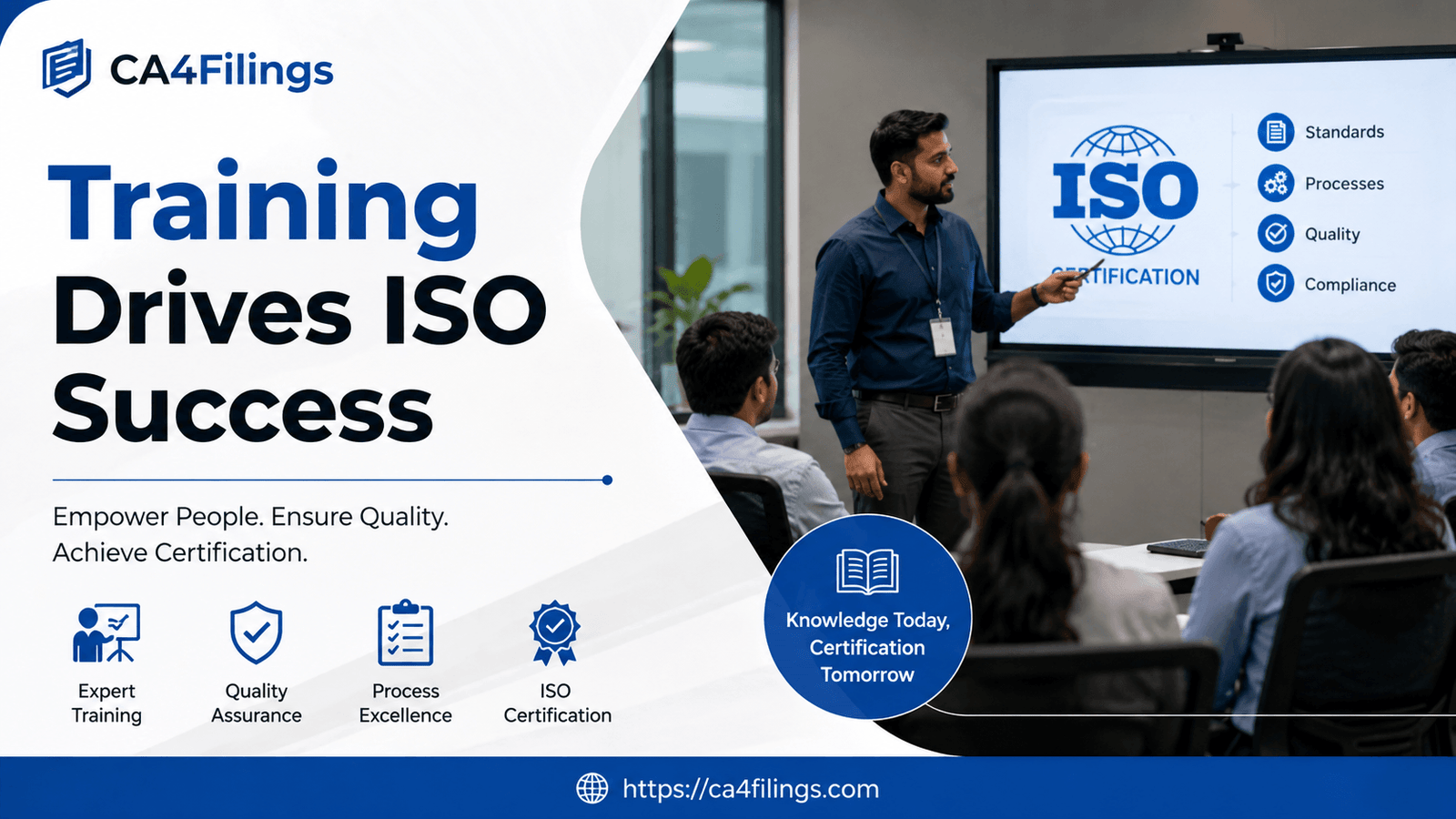
At CA4Filings, we always tell our clients that getting certified is not about pleasing an auditor; it is about transforming how your business operates. If you want a smooth, hassle-free transition, you need to understand The Role of Training in Achieving ISO Certification Success. True compliance does not come from a well-written manual sitting on a shelf; it comes from your team knowing exactly how to execute those standards every single day. If you are looking to streamline your business operations, securing an authentic ISO Certification is the first definitive step toward global credibility.
Why Getting Certified is More Than Just Paperwork
When business owners approach us for advice on implementing ISO standards, they often focus entirely on documentation. They want to know about policies, checklists, and manual templates. While these are essential ISO certification requirements, they only form the skeleton of your management framework. Your employees are the lifeblood that makes it function.
Without proper training for ISO certification, a gap forms between what is written in your policy and what actually happens on the shop floor or in the office. Auditors are smart; they do not just read your files. They interview your staff. If an auditor asks a team member about a process map or a quality check, and that employee looks clueless, your compliance efforts can fall apart. That is why building a culture of continuous learning is non-negotiable.
The Role of Training in Achieving ISO Certification Success
To build a sustainable framework, education must be woven into every stage of your business growth. Let us break down how structured learning directly drives your successful certification process.
1. Demystifying Complex Standards
ISO manuals are notoriously heavy with technical jargon. Expecting your team to read a 50-page document and automatically change their daily habits is unrealistic. Structured training programs break these dense clauses down into practical, everyday actions. It translates abstract requirements into clear answers for your team, such as: "Here is what this means for your daily morning quality check."
2. Bridging the Gap Between Policy and Action
When implementing ISO standards, you are essentially defining the gold standard for your operations. Whether it is ISO 9001 for quality management systems or ISO 27001 for information security, your staff must understand the "why" behind the "what." When people understand why a specific data entry rule or safety check exists, they are far more likely to follow it consistently.
3. Creating Internal Champions
You cannot rely on external consultants forever. A core benefit of robust training for quality assurance is that it upskills your internal team. By training select team members as internal auditors, you create local leaders who can monitor compliance, answer peer questions, and fix minor errors before they turn into major non-conformities during official audits.
Designing Effective ISO Training Programs
Not all learning methods yield the same results. Sending a mass email with a PDF attachment does not qualify as training. To truly harness the ISO training benefits, your approach must be structured and targeted based on organizational roles.
Executive Briefings: Leadership needs to understand how the management framework aligns with business strategy and financial performance.
Core Team Training: The managers driving the implementation need deep, clause-by-clause knowledge of the specific standard.
General Awareness Sessions: Every single employee must know the basic quality policy, their role in maintaining it, and how to report issues.
Maintaining ISO Certification: The Long-Term Value of Learning
Getting your certificate is a major milestone, but maintaining ISO certification is an ongoing commitment. Initial training gets you through the front door, but continuous ISO compliance training ensures you stay inside.
Annual surveillance audits are designed to ensure your systems have not decayed. If you introduce new software, onboard new vendors, or hire new staff without updating your training protocols, your compliance level drops. Regular refresher courses ensure that old habits do not creep back in and that your systems adapt smoothly as your business scales.
Practical Checklist for Business Owners
Before you invite an external auditor to review your systems, ensure you can tick off these essential preparation steps:
[ ] Conducted an initial gap analysis to identify team training needs.
[ ] Completed basic awareness sessions for all active staff members.
[ ] Trained and certified at least two internal auditors from your internal team.
[ ] Documented all training attendance sheets and feedback forms for audit evidence.
[ ] Created a structured onboarding training module for future hires.
Frequently Asked Questions
What is the primary ISO training importance for small businesses?
For smaller teams, it prevents critical business knowledge from being locked inside the business owner's head. It creates repeatable, dependable systems so the business can run smoothly even when the founder is away.
Can we handle the training for quality assurance internally?
Yes, provided your internal leads have a strong grasp of the standards. However, working with professionals for your initial setup ensures you do not accidentally overlook critical compliance nuances.
How often should we conduct ISO compliance training?
A complete baseline training session is necessary during initial implementation. After that, brief refresher sessions should be conducted annually, or whenever you update processes, introduce new machinery, or onboard a significant wave of new employees.
Achieve Growth and Compliance with CA4Filings
At the end of the day, understanding The Role of Training in Achieving ISO Certification Success is what separates companies that thrive under international standards from those that view them as a burden. Investing in your team's knowledge ensures that your quality management systems become a powerful engine for efficiency, customer satisfaction, and long-term business growth.
Navigating regulatory compliance, documentation, and staff alignment can feel overwhelming when you are trying to run a business. Let our team at CA4Filings handle the heavy lifting for you. From initial gap analysis and documentation support to structuring your path to certification, we provide the expert guidance you need to succeed. Reach out to CA4Filings today, and let us build a world-class, compliant foundation for your business.
Latest Updates
ca4filings.com Services

























-registration.png)