ISO Audits: What to Expect During the Certification Process
Wondering about ISO Audits: What to Expect During the Certification Process? Learn the complete steps, requirements, and expert tips from CA4Filings.
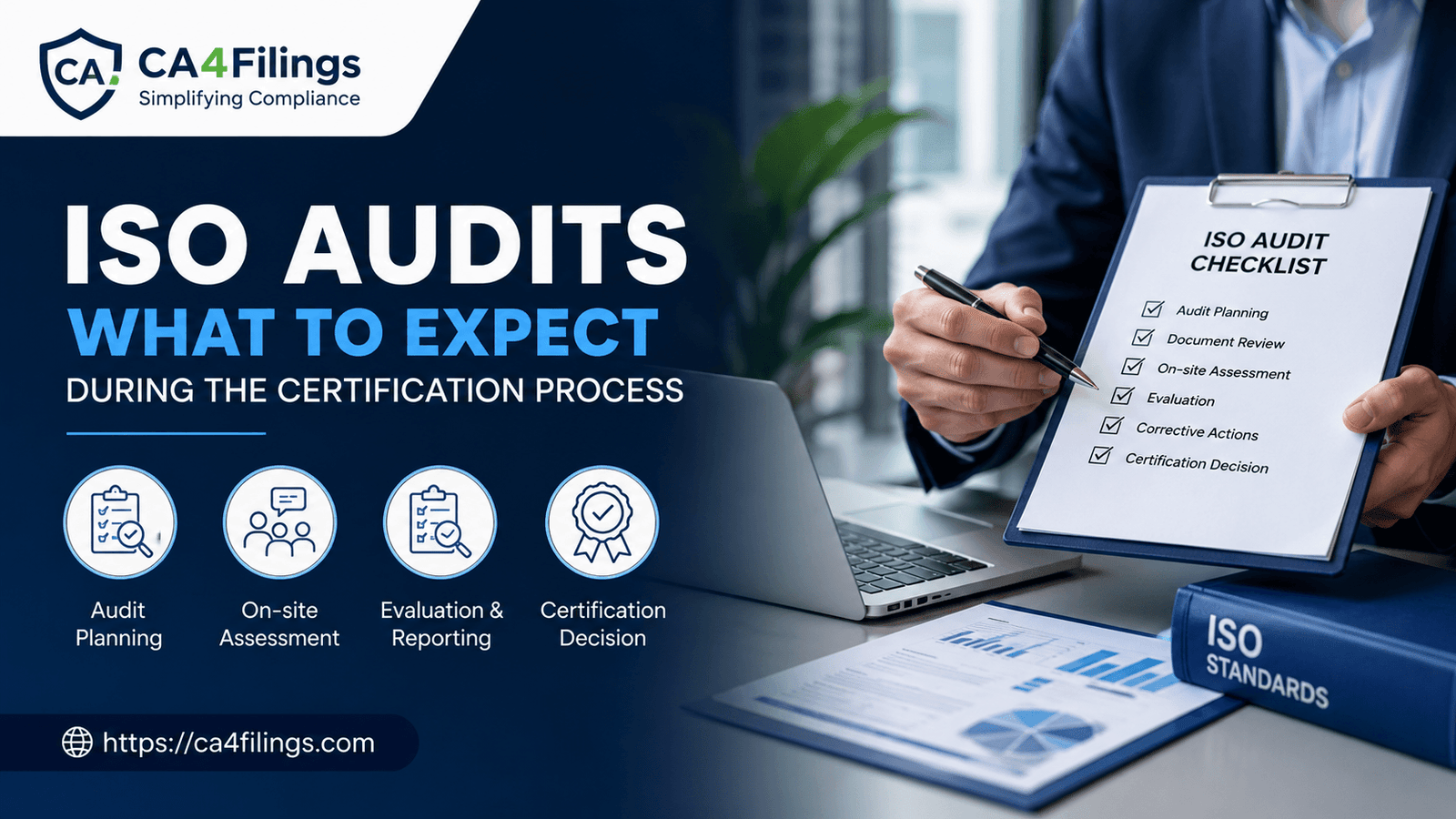
Imagine you are running a manufacturing unit in Pune or a thriving software development agency in Bengaluru. Business is booming, but you notice a bottleneck: global clients are asking for standard operating procedures, and large enterprise tenders require a specific stamp of trust. This is exactly where an international benchmark enters the frame. Getting an ISO Certification is one of the most transformative strategic decisions a business owner can make to scale operations and build international credibility. However, the path to compliance often leaves entrepreneurs anxious about audit expectations and the upcoming evaluations. If you are preparing your business for compliance, you are likely asking: what exactly happens when the auditors arrive? In this comprehensive guide, we unpack ISO Audits: What to Expect During the Certification Process so you can navigate the evaluation with absolute confidence.
At CA4Filings, we have guided hundreds of business owners through the complexities of regulatory approvals and international standard alignments. We understand that the phrase "audit" often triggers panic, conjuring images of strict inspectors looking for reasons to penalize you. But here is an insider secret from a Chartered Accountant’s perspective: an ISO assessment is not a tax raid. It is a structured, collaborative evaluation designed to confirm that your workflows match your documentation. Let us deep dive into the blueprint of these assessments and understand the journey to building a world-class organization.
Deconstructing ISO Audits: What to Expect During the Certification Process
To demystify the entire evaluation, we need to look at it as a journey of continuous improvement rather than a single day of judgement. When exploring ISO Audits: What to Expect During the Certification Process, the first thing to understand is that the review evaluates your systems, not individual people. The primary objective of ISO Audits: What to Expect During the Certification Process is to verify that your organization adheres to the specific frameworks laid out by the International Organization for Standardization.
Whether you are targeting ISO 9001 for quality control or ISO 27001 for information security, the operational mechanics remain remarkably consistent. The external registrar sends an independent expert to evaluate your compliance. During this timeline, you should expect open interviews, thorough walkthroughs, active verification of logs, and a constructive closing conference. Understanding ISO Audits: What to Expect During the Certification Process allows your core management team to shift from a defensive mindset to a proactive stance, turning the audit into a strategic tool for growth. Knowing exactly ISO Audits: What to Expect During the Certification Process ensures everyone stays on the same page.
The Twin Stages of the Certification Process
The formal external evaluation is broken down into two distinct phases, widely known as Stage 1 and Stage 2 evaluations. Navigating these two milestones smoothly requires a clear understanding of the underlying audit process and framework details. When considering ISO Audits: What to Expect During the Certification Process, understanding these stages is highly critical.
Stage 1: The Documentation and Readiness Review
Think of Stage 1 as a preliminary health check. The registrar examines your fundamental architecture to see if you are even ready for a full-scale inspection. When learning about ISO Audits: What to Expect During the Certification Process, Stage 1 is your foundation.
Audit Documentation Review: The assessor evaluates your corporate manuals, policy frameworks, and standard operating procedures (SOPs). They check if your documented quality management system aligns with the rigorous clauses of the specific ISO standards you want to achieve.
Scope Evaluation: The auditor confirms the boundaries of your application. For example, are you certifying your entire corporate entity or just a specific branch office?
Gap Spotting: If there are critical missing links in your paperwork, the assessor highlights them as areas of concern. This gives you a clear window for necessary audit preparation before the final evaluation begins.
Stage 2: The Main On-Site Assessment
This is the main event. Once you clear Stage 1, the assessor returns to verify whether you actually practice what you have documented in your manuals. This phase represents the core operational reality of ISO Audits: What to Expect During the Certification Process.
Opening Meeting: The evaluator outlines the schedule, introduces the scope, and establishes communication protocols with your team leaders.
Evidence Collection: The auditor walks through your operational floor, interviews employees across different hierarchies, and samples real-time files.
Evaluating the Quality Management System: If your manual states that every raw material batch undergoes a 5-point quality check, the auditor will randomly select ten recent batch reports to verify if that check actually took place.
Core Audit Procedures and Behavioral Intent
To achieve complete audit success, your workforce must understand the specific audit procedures deployed by external evaluators. When reviewing ISO Audits: What to Expect During the Certification Process, these procedures form the backbone of the evaluation. Assessors generally rely on three reliable methods to verify your compliance:
Direct Observation: Watching your machinery operators, customer service teams, or IT administrators execute their daily tasks to ensure they follow approved protocols.
Document Sampling: Picking up historical registers, internal calibration files, training logs, and management review data to cross-verify compliance tracking.
Personnel Interviews: Asking open-ended questions to your team members, such as “What do you do if you notice a defective product on the line?” or “How do you report a data security breach?”
The auditor is looking for consistent alignment between your actual operations, your written procedures, and the overarching ISO standards.
Master Blueprint for Effective Audit Preparation
Preparation is the thin line between a stressful evaluation and a seamless walkthrough. When discussing ISO Audits: What to Expect During the Certification Process, preparation cannot be ignored. Based on our extensive experience at CA4Filings, we advise businesses to follow a structured checklist to ensure an optimal outcome.
Step 1: Establish a Robust Internal Review Mechanism
You should never let an external registrar be the first person to spot weaknesses in your operational system. Conducting rigorous internal ISO audits is mandatory before your formal assessment. This internal run simulates the actual evaluation environment, identifies hidden process gaps, and prepares your workforce for auditor interactions, aligning perfectly with ISO Audits: What to Expect During the Certification Process.
Step 2: Organize Your Compliance Logs
The efficiency of your assessment depends heavily on how quickly you can retrieve requested files. Ensure that key compliance documentation—such as customer feedback forms, supplier evaluations, risk registers, and employee training sheets—is systematically indexed and readily accessible. This high level of organization is central to ISO Audits: What to Expect During the Certification Process.
Step 3: Train and Empower Your Team
An evaluation can easily stall if your employees panic during interviews. Conduct brief internal workshops explaining ISO Audits: What to Expect During the Certification Process to your staff. Remind them to answer honestly, keep their responses concise, and point directly to established written procedures when explaining their daily workflows.
Navigating Post-Audit Findings and Non-Conformances
At the conclusion of the Stage 2 evaluation, the assessor hosts a closing conference to present their formal observations. When learning about ISO Audits: What to Expect During the Certification Process, handling these findings correctly is vital. Discovering non-conformances is not a sign of failure; it simply means a gap was identified between your practice and the standard framework.
Understanding Minor vs. Major Non-Conformances
Minor Non-Conformance: An isolated slip-up that does not threaten the integrity of your overall management framework. For instance, a single employee missing a scheduled training session or one instrument skipping a routine calibration date. These require a clear corrective action plan but do not block your certification guidelines from moving forward.
Major Non-Conformance: A systemic collapse of a core process that indicates a complete lack of control. For example, operating without any internal audit records or completely skipping product quality testing. A major non-conformance halts the certification process until you implement verified corrective actions and undergo a partial re-audit.
Why Partnering with CA4Filings Simplifies Your Compliance Journey
Setting up a globally recognized management system while managing daily business operations can feel overwhelming. This is why having an expert corporate advisor makes all the difference. At CA4Filings, we take the stress out of your compliance journey. From initial gap analysis and documentation design to internal pre-audits and final coordination with registrars, our specialized compliance experts guide you through every single phase. We ensure your systems are robust, your staff is thoroughly prepared, and your business achieves certification smoothly.
Frequently Asked Questions (FAQs)
Q1. What is the typical timeline for completing the entire ISO certification process?
The timeline varies depending on your organization's size and operational complexity. For small to medium enterprises with well-documented processes, the entire timeline—from initial gap assessment to final certification award—takes roughly 4 to 12 weeks.
Q2. How long does a standard ISO certificate remain valid?
An ISO certificate is valid for a period of three years from the date of issuance. However, to maintain its validity, your company must undergo annual surveillance assessments conducted by the registrar to ensure continuous compliance.
Q3. Can a business fail an ISO assessment completely?
An organization does not technically "fail" an assessment on a permanent basis. If major non-conformances are discovered during the evaluation, the registrar pauses the approval process. The business is given a specific window (usually 60 to 90 days) to apply corrective actions and clear a follow-up review.
Q4. What is the fundamental difference between ISO 9001 and other specialized ISO frameworks?
ISO 9001 is the foundational standard that defines the core principles of a quality management system across any industry. Other frameworks focus on specialized fields, such as ISO 14001 for environmental management systems and ISO 27001 for information security frameworks.
Q5. Is an internal evaluation mandatory before the external registrar arrives?
Yes, conducting at least one full cycle of internal ISO audits and holding a formal management review meeting are strict prerequisites before you can proceed to the Stage 2 external assessment.
Embarking on the road to international standardization is a powerful milestone that elevates your brand from a local competitor to a globally trusted player. By thoroughly understanding ISO Audits: What to Expect During the Certification Process, you can demystify the entire sequence and transform a complex compliance requirement into a rewarding exercise in operational excellence. Understanding ISO Audits: What to Expect During the Certification Process gives you a competitive edge.
Do not let documentation anxieties slow down your business growth. Let our expert compliance team handle your comprehensive corporate alignment, system structuring, and final certification management. Contact CA4Filings today to kickstart your journey toward seamless global compliance!
Latest Updates
ca4filings.com Services























-registration.png)