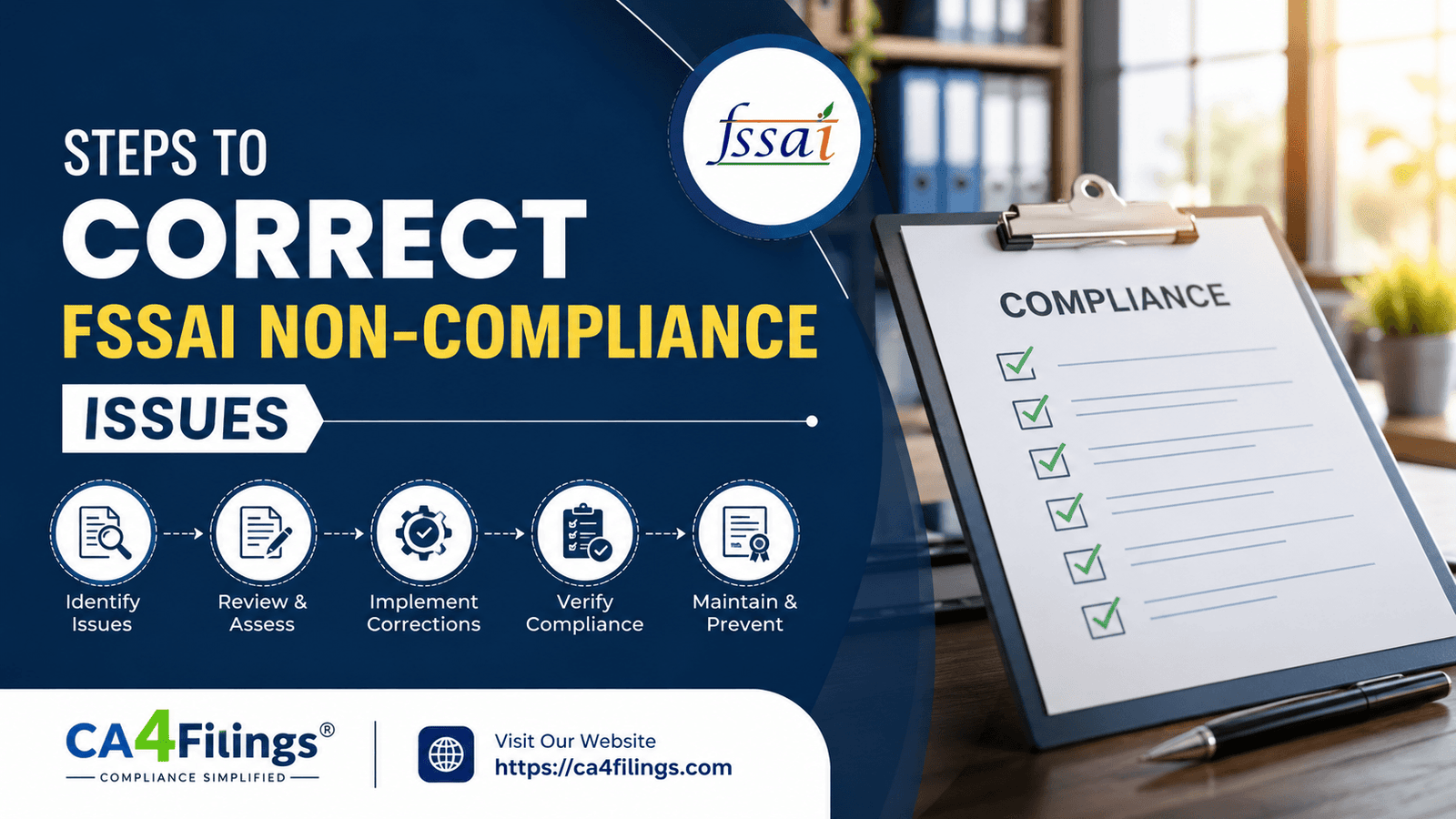
Steps to Correct FSSAI Non-Compliance Issues
Learn the exact Steps to Correct FSSAI Non-Compliance Issues. Avoid heavy penalties and keep your food business safe with expert tips from CA4Filings.
Running a food business in India is an incredibly rewarding journey, but it comes with a massive responsibility: ensuring the health and safety of your consumers. As a Chartered Accountant who has spent years helping food business operators navigate corporate regulations, I often see business owners pour their heart and soul into recipes, branding, and marketing, only to get tripped up by legal compliance.
The Food Safety and Standards Authority of India (FSSAI) is strict, and rightly so. Receiving a non-compliance notice can feel overwhelming, but it is not the end of the road. If your business has run into legal hurdles, you need a clear blueprint. In this comprehensive guide, we will break down the essential Steps to Correct FSSAI Non-Compliance Issues to ensure your business stays secure, lawful, and profitable.
Understanding FSSAI and the Cost of Slipping Up
The food safety authority in India regulates everything from manufacturing and packaging to distribution and sales. The goal is simple: to ensure that the food reaching the public adheres to science-based standards.
When a business fails to meet these regulations, it faces compliance issues. Non-compliance can range from minor paperwork omissions—like failing to submit an annual return—to severe violations like food adulteration or unhygienic manufacturing facilities. If your business is currently facing an enforcement action, acting swiftly is critical.
Before diving into corrective actions, it is vital to understand that complete compliance starts at day one. If you are launching a new food venture or expanding an existing one, securing a valid FSAAI Registration is your very first line of defense against legal hassles.
Actionable Steps to Correct FSSAI Non-Compliance Issues
If an FSSAI officer inspects your premises and flags issues, or if you receive a formal "Improvement Notice" under Section 32 of the Food Safety and Standards Act, you must follow a systematic approach to rectify it. Here are the practical Steps to Correct FSSAI Non-Compliance Issues that we recommend to our clients at CA4Filings.
1. Thoroughly Analyze the Improvement Notice
Do not panic when a notice arrives. Read it carefully to identify the exact standards or regulations you are accused of violating. FSSAI notices generally specify:
The precise nature of the non-compliance.
The specific section of the law violated.
The time frame provided to implement corrective actions (usually 14 to 30 days).
2. Conduct an Internal Audit and Root Cause Analysis
Once you know what the food safety authority has flagged, investigate why it happened. Was it a failure of your internal testing tools? Did your staff skip standard operating procedures? Pinpointing the root cause prevents the issue from repeating.
3. Implement Immediate Corrective Actions
This is the core of the Steps to Correct FSSAI Non-Compliance Issues. You must physically or administratively fix the errors highlighted in the notice.
For Hygiene Issues: Deep clean the facility, pest-proof the premises, and upgrade waste management.
For Labeling Errors: Stop the printing of non-compliant labels and modify them to display exact nutritional values, allergen warnings, and correct FSSAI logos.
For Missing Records: Compile and update your daily production logs, raw material sourcing invoices, and water test reports.
4. Train Your Staff on Revised Standards
Compliance is a team effort. Hold a training session for your kitchen staff, supervisors, and handlers. Educate them on safe food handling, personal hygiene, and the critical importance of keeping up with FSSAI regulations.
5. Submit a Detailed Compliance Report
Once the fixes are live, you must formally reply to the Designated Officer (DO). Your compliance report should be professional and include clear evidence of your corrective actions, such as:
Before-and-after photographs of the facility.
Updated food testing certificates from NABL-accredited labs.
Copies of amended labels or updated employee health records.
Expert Tips to Maintain Long-Term Food Safety Compliance
Fixing a notice is a reactive measure. To build a resilient food business, you need proactive habits. Here are a few expert tips from our team at CA4Filings:
Appoint a Food Safety Supervisor (FSS): FSSAI mandates training for designated supervisors under the FoSTaC program. Having a trained eye on the floor drastically reduces the chances of non-compliance.
Calibrate Your Tools Regularly: Ensure your thermometers, cold storage units, and weighing scales are calibrated. Incorrect storage temperatures are a leading cause of sudden compliance issues.
Track Expiry Dates of Ingredients: Implement a strict FIFO (First-In, First-Out) inventory system to ensure no expired raw materials ever enter your production line.
Common Penalties for Ignoring FSSAI Regulations
Ignoring an FSSAI notice can lead to severe enforcement actions. The table below outlines what a food business might face if it fails to implement the Steps to Correct FSSAI Non-Compliance Issues on time:
| Type of Violation | Potential Penalty / Action |
|---|---|
| Failure to comply with an Improvement Notice | Cancellation or suspension of FSSAI License |
| Selling food not of the nature/substance demanded | Fine up to ₹5 Lakhs |
| Manufacturing or selling sub-standard food | Fine up to ₹5 Lakhs |
| Misbranded food products | Fine up to ₹3 Lakhs |
| Operating a food business without a license | Imprisonment up to 6 months AND fine up to ₹5 Lakhs |
Frequently Asked Questions (FAQs)
What is an FSSAI Improvement Notice?
An Improvement Notice is a formal warning issued by a Food Safety Officer under Section 32 of the FSS Act. It highlights specific non-compliance issues in your business and gives you a strict window to correct them.
What happens if I do not reply to an FSSAI notice on time?
If you fail to execute the necessary Steps to Correct FSSAI Non-Compliance Issues within the stipulated timeframe, the food safety authority has the right to suspend or permanently cancel your FSSAI license, effectively shutting down your business operations.
Can I appeal against an FSSAI non-compliance order?
Yes. If you believe the notice or penalty is unjustified, you can appeal to the Food Safety Appellate Tribunal within 30 days of receiving the order. It is highly recommended to seek professional CA or legal help for this process.
Do small food businesses need to follow the same rules?
While basic hygiene standards apply to everyone, registration and licensing requirements differ based on your annual turnover. Petty food manufacturers require basic registration, while larger operators need State or Central Licenses.
Let CA4Filings Secure Your Food Business
Navigating the legalities of the food industry in India can feel like a tightrope walk. However, following the correct Steps to Correct FSSAI Non-Compliance Issues ensures your business remains on the right side of the law while safeguarding your hard-earned brand reputation.
At CA4Filings, we understand that your primary focus should be on creating amazing food and delighting customers—not drowning in regulatory paperwork. Whether you need to reply to a complex legal notice, conduct a compliance health check, or apply for a fresh license, our experienced team is here to handle it smoothly.
Latest Updates
ca4filings.com Services























-registration.png)