How to Renew Your FSSAI Registration: A Step-by-Step Guide
Learn how to renew your FSSAI registration: a step-by-step guide. Avoid massive late penalties, platform delisting, and keep your food business compliant.
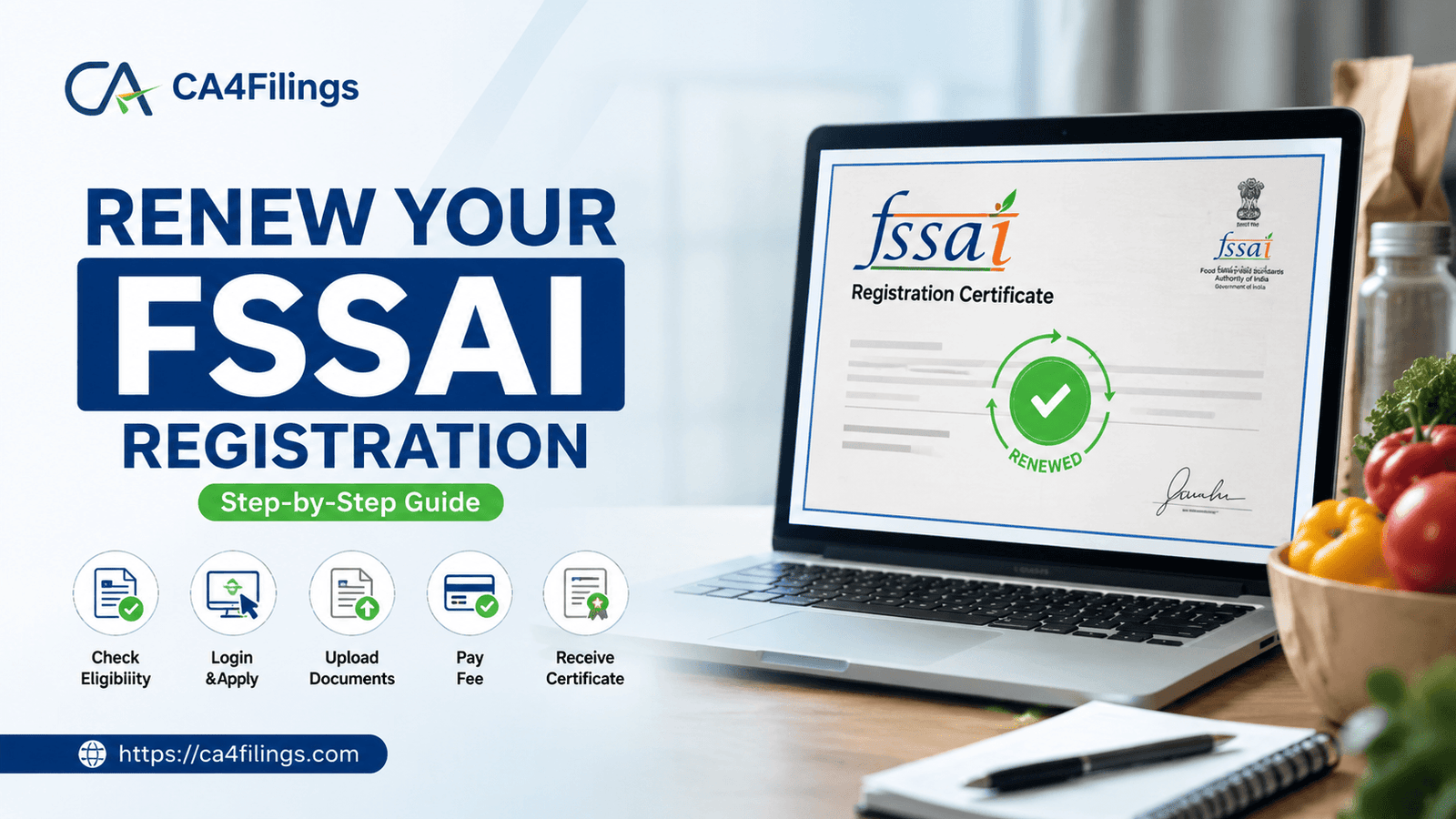
Running a food business in India is incredibly rewarding, but it comes with a massive serving of regulatory compliance. Whether you manage a cozy neighborhood cloud kitchen, a bustling sweet shop, or a large-scale food manufacturing unit, food safety is non-negotiable. At CA4Filings, we often see enthusiastic entrepreneurs focus all their energy on recipes, logistics, and branding, only to get a rude awakening when their legal compliance lapses.
Your Food Safety and Standards Authority of India (FSSAI) license is the baseline lifeline of your food business. However, getting your initial FSAAI Registration is only the first step; keeping it active is where many owners slip up. If you let your registration expire, you risk facing steep daily fines, legal complications, and immediate delisting from food delivery aggregators like Zomato and Swiggy. To ensure your kitchen fires never have to stop burning, let's break down exactly how to renew your FSSAI registration: a step-by-step guide designed for busy business owners.
Why You Cannot Afford to Ignore FSSAI Renewal
Every FSSAI certificate is issued with a fixed validity period ranging from 1 to 5 years. The moment that date passes without a formal renewal application, your legal permission to handle, sell, or distribute food vanishes.
Operating even for a single day with an expired food license is considered a legal offense under the Food Safety and Standards Act. The government levies a flat penalty of ₹100 per day for late applications submitted after the expiration date.
Furthermore, if your license lapses past the threshold limits without a renewal application, the portal blocks late renewals entirely, forcing you to apply for a brand-new certificate. This triggers a fresh processing timeline, potential food safety inspections, and unexpected operational halts.
How to Renew Your FSSAI Registration: A Step-by-Step Guide
The Food Safety Compliance System (FoSCoS) portal has made the compliance journey electronic and highly streamlined. Below is the comprehensive breakdown on how to renew your FSSAI registration: a step-by-step guide to navigating the system smoothly.
1.Log In to the FoSCoS Portal:
Step 1: Access System.
Visit the official portal at foscos.fssai.gov.in. Use your registered username, password, or mobile number to log in via OTP. Ensure you are accessing the exact same account associated with your initial certificate.
2.Locate Your Existing Certificate:
Step 2: Navigate Dashboard.
Once logged inside the user dashboard, navigate to the left-hand menu. Click on the "Renewal" tab and select "Apply for Renewal of License/Registration". A clear list of your active certificates nearing expiration will populate on the screen.
3.Review and Validate Business Details:
Step 3: Verification.
Click the direct action link next to your certificate number. The portal will automatically display your existing pre-filled details, such as manufacturing capacities, specific food categories, and business addresses. Review these carefully.
4.Upload Current Documents:
Step 4: Documentation.
Upload the required up-to-date compliance documentation based on your operational scale. Ensure files are clean, legible, and match the original data format to prevent departmental objections.
5.Select Validity and Process Payment:
Step 5: Fee Execution.
Choose your desired renewal extension period (between 1 to 5 years). Execute the government fee securely using online net banking, credit/debit cards, or authorized UPI channels. Note down your unique Form B application reference number.
Essential Documents Needed for a Hassle-Free Renewal
The specific paperwork required depends entirely on your operational footprint and whether you hold a Basic Registration, a State License, or a Central License. For most standard food business operators, keeping these documents organized guarantees zero delay:
Form A or Form B: Completed and digitally signed by the proprietor or authorized signatory.
Photo Identity Proof: PAN Card, Aadhaar Card, or Passport of the business owner.
Proof of Premises: Latest utility bills (electricity or water), a registered rent agreement, or a NOC from the property owner.
Food Safety Management System (FSMS) Plan: A signed declaration or certificate confirming your operational layout adheres to required hygiene standards.
List of Food Categories: A clear, itemized breakdown of the specific food products handled on-site.
Water Test Report: An official laboratory report proving the chemical and bacteriological purity of the water used in your manufacturing or cooking process (primarily required for State and Central manufacturing licenses).
Expert Tips to Streamline Your FSSAI Renewal
As experienced chartered accountants, we see many business owners run into unnecessary bottlenecks. Here are a few practical compliance insights straight from our desk at CA4Filings to help you stay ahead:
1. The 180-Day Rule vs. The 30-Day Golden Window
The FoSCoS portal allows you to initiate your renewal application as early as 180 days before your expiry date. We highly advise our clients to submit their applications at least 30 days prior to expiry. If you submit during this window, you avoid any potential last-minute platform glitches and ensure your license stays uninterrupted during governmental processing.
2. Opt for the 5-Year Renewal Option
If your business model is stable and your location is fixed, always choose the maximum 5-year renewal validity. This locks in your current fee structure, eliminates annual compliance stress, and protects your business from accidental lapses for half a decade.
3. Renewal vs. Modification
A common point of confusion is trying to update major structural business changes during a routine renewal. If your business name, factory capacity, physical address, or core food categories have drastically changed, you must apply for a License Modification rather than a standard renewal. Trying to force these changes into a renewal application often leads to outright rejections by the food safety officer.
Frequently Asked Questions
Q1. Can I still renew my FSSAI registration after it has officially expired?
Yes, you can apply for a late renewal within a specific grace window after expiration. However, a late penalty of ₹100 per day will automatically be added to your base government renewal fee. If you delay significantly, the portal will completely lock out the renewal option, requiring a fresh application from scratch.
Q2. Does my original 14-digit FSSAI number change after a successful renewal?
No. Your unique 14-digit FSSAI registration number remains exactly the same for the lifetime of that specific business entity at that location, provided you renew it successfully without permanent lapses.
Q3. How long does the department take to approve an FSSAI renewal application?
Basic Registrations are usually processed and issued digitally within 7 to 10 working days. State and Central Licenses can take anywhere between 30 to 45 days, as they undergo deeper departmental scrutiny and may trigger a physical hygiene inspection by a Food Safety Officer (FSO).
Q4. Are online platforms like Swiggy and Zomato alerted if my license expires?
Yes, these aggregators run automated real-time databases synced with government systems. If your FSSAI validity lapses, their merchant portals will automatically flag your account and suspend your active digital storefront until you upload a valid, renewed certificate.
Secure Your Business Continuity with CA4Filings
Managing active kitchen orders, vendor payments, and customer satisfaction is demanding enough without having to track shifting government compliance deadlines. Letting your food safety registration lapse can bring your hard-earned business momentum to an abrupt and expensive halt.
Now that you have read our guide on how to renew your FSSAI registration: a step-by-step guide, you can confidently see how manageable the process is when approached early. If you prefer to focus entirely on growing your culinary brand while letting certified professionals tackle the portal filing, upload constraints, and documentation checks, the team at CA4Filings is always here to handle your end-to-end business compliance. Reach out to us today, and let us get your renewals processed smoothly!
Latest Updates
ca4filings.com Services



























-registration.png)