FSSAI Compliance: What Every Food Business Should Know
Master FSSAI Compliance: What Every Food Business Should Know. Learn about licenses, penalties, and how CA4Filings can streamline your food business journey.
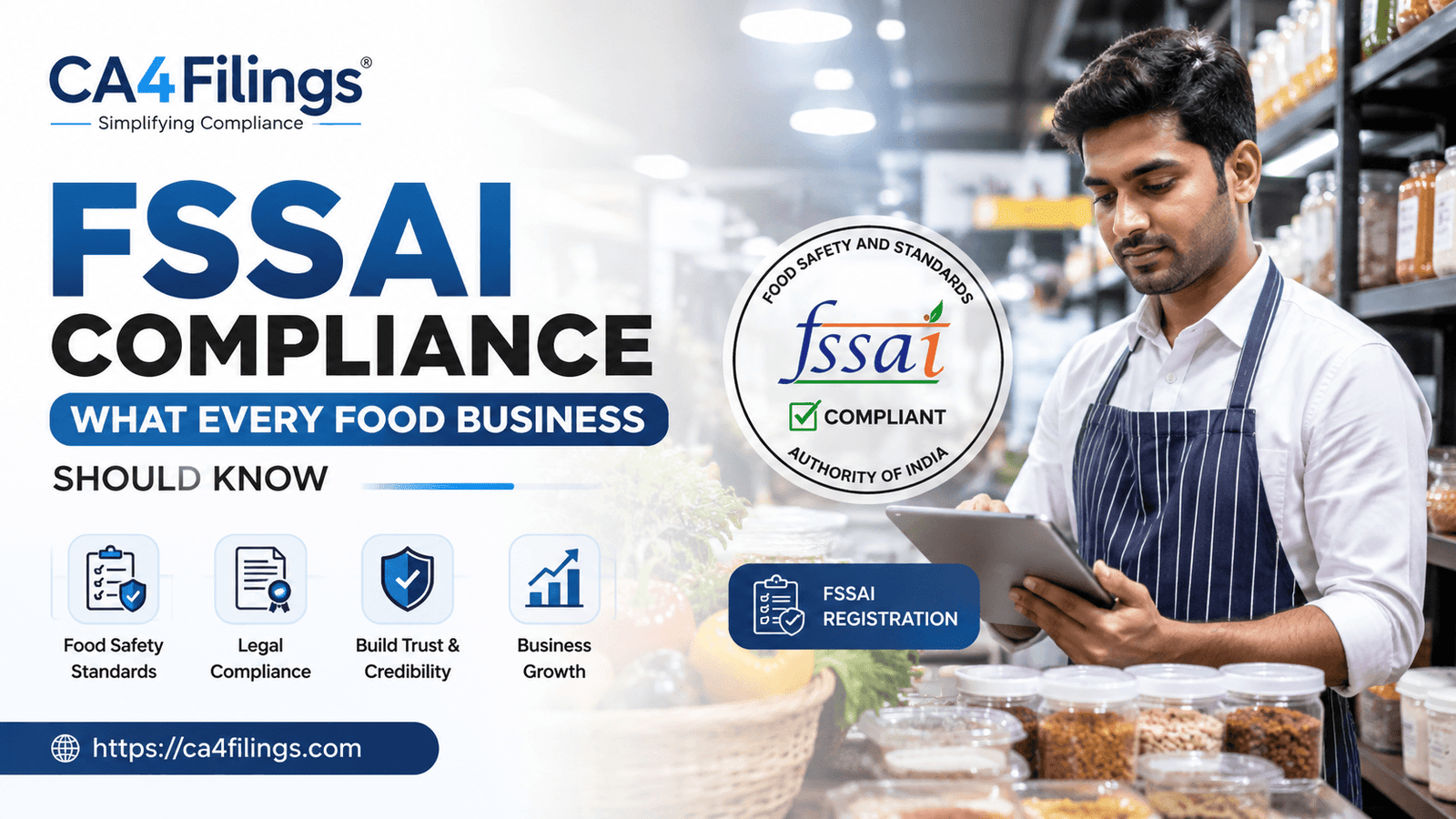
Imagine walking into a bustling kitchen where the aroma of freshly baked bread fills the air, or looking at the sleek packaging of a new health drink ready to hit store shelves. Starting a food business in India is incredibly exciting, but as Chartered Accountants who have helped hundreds of entrepreneurs launch their dreams, we often see one major roadblock trip people up right at the starting line: regulatory compliance.
In India's vibrant culinary landscape, ensuring consumer safety isn't just a moral duty; it is a strict legal requirement governed by the Food Safety and Standards Authority of India. If you are a restaurateur, a cloud kitchen owner, a manufacturer, or an importer, understanding FSSAI Compliance: What Every Food Business Should Know is the foundational pillar of your long-term success. Navigating these food business guidelines can feel overwhelming when you are already managing supply chains, staff, and customer service. That is exactly why we at CA4Filings have put together this comprehensive guide to break down the complexities of food safety standards into actionable, easy-to-digest steps.
Whether you are running a small home-based bakery or a massive manufacturing unit, getting your legal paperwork right is non-negotiable. To begin your journey on the right legal footing, obtaining an authentic FSAAI Registration is your very first milestone, ensuring your business aligns with national safety norms from day one. Let’s dive deep into what it takes to keep your food business fully compliant, safe, and highly profitable.
Decoding the Core of FSSAI Regulations
The Food Safety and Standards Authority of India (FSSAI) was established under the Food Safety and Standards Act, 2006. Before FSSAI came into the picture, the Indian food sector was governed by a tangled web of older, fragmented laws like the Prevention of Food Adulteration Act. FSSAI streamlined everything under a single window to enforce scientific, uniform food safety standards across the country.
For business owners, compliance simply means meeting the precise benchmarks laid down for food product quality, hygienic handling, storage conditions, and clear packaging. FSSAI regulations apply to every single entity in the food value chain, including:
Primary producers and farmers (selling to processors)
Food manufacturers and processors
Packers, wholesalers, and distributors
Hotels, restaurants, and cloud kitchens
E-commerce food delivery platforms and delivery agents
The Three Tiers of Food Business Licensing
One size does not fit all under FSSAI guidelines. The regulatory authority categorizes food businesses based on their operational scale, production capacity, and annual turnover. To maintain proper compliance, you must identify which category your business falls into.
1. Basic FSSAI Registration
This tier is meant for petty food businesses, small-scale retailers, hawkers, or temporary stall holders.
Eligibility Criterion: Annual turnover up to ₹12 Lakhs.
Example: A local juice corner, a home bakery, or a small grocery mom-and-pop shop.
2. State FSSAI License
Medium-sized businesses operate under the jurisdiction of the State food safety authorities.
Eligibility Criterion: Annual turnover between ₹12 Lakhs and ₹20 Crores.
Example: A standard fine-dining restaurant, a mid-sized warehouse, or a local dairy processing plant.
3. Central FSSAI License
Large-scale operations, businesses handling high volumes, or those operating across multiple states require a Central license.
Eligibility Criterion: Annual turnover exceeding ₹20 Crores, or businesses involved in large-scale import/export, or operations running at central government locations like airports and railways.
Example: An e-commerce platform like Swiggy or Zomato, a major food import business, or a multi-state hotel chain.
Critical Steps to Maintain Ongoing FSSAI Compliance
Securing your license or registration is only the first half of the battle. True compliance is an everyday commitment to food safety management. Here is a checklist of regulatory standards that every business owner must implement:
Display the FSSAI License Number (Food Safety Display Boards)
It is mandatory to display your FSSAI license number and color-coded Food Safety Display Boards (FSDBs) prominently at your business premises. These boards display key hygiene rules—like washing hands and separating raw and cooked food—reminding both staff and consumers of your dedication to safety.
Ensure Rigorous Food Safety Training
Under the FoSTaC (Food Safety Training and Certification) initiative, every food business must have at least one trained and certified Food Safety Supervisor for every 25 food handlers on the premises. This ensures that your kitchen or factory staff understand cross-contamination risks and hygienic handling practices.
Regular Food Product Quality Testing
If you are a manufacturer, you cannot just assume your product is safe; you have to prove it. FSSAI mandates that manufacturers get their food products tested at least once every six months through an authorized, NABL-accredited laboratory to verify that the food matches national safety parameters.
Periodic Return Filings
Just like you file income tax or GST returns, certain food businesses must file annual returns (Form D1) by the 31st of May every year. Failing to file these returns can lead to hefty daily penalties that eat into your business profits.
The Cost of Non-Compliance: Penalties and Risks
As CAs, we always advise clients that prevention is infinitely cheaper than a cure. Ignoring FSSAI guidelines can hit your business where it hurts the most—your reputation and your finances.
| Offense | Monetary Penalty / Action |
|---|---|
| Operating a food business without a valid license | Imprisonment up to 6 months and/or a fine up to ₹5 Lakhs |
| Selling food that is not of the nature, substance, or quality demanded | Fine up to ₹2 Lakhs (petty manufacturers up to ₹25,000) |
| Selling sub-standard food products | Fine up to ₹5 Lakhs |
| Manufacturing or selling misbranded food | Fine up to ₹3 Lakhs |
| Highly unhygienic processing conditions | Fine up to ₹1 Lakh |
Beyond the financial penalties, food safety officers have the legal authority to issue "Improvement Notices." If a business fails to fix the highlighted issues within the given timeframe, its food safety certification can be suspended or permanently canceled.
Frequently Asked Questions
Q1. Can I run a home kitchen business without an FSSAI license?
No. Even if you operate from a home kitchen, if your food is going out to consumers for a commercial price, you need a basic registration (if turnover is under ₹12 Lakhs). Consumer safety remains a priority regardless of where the food is cooked.
Q2. What is the validity period of an FSSAI license?
An FSSAI license or registration can be issued for any period ranging from 1 year up to 5 years. You must apply for a renewal at least 30 days before your current license expires to avoid late fees.
Q3. Is FSSAI compliance mandatory for online food sellers?
Yes, absolutely. E-commerce platforms and sellers who list their products online fall under the Central License category and must comply with specific e-commerce food safety guidelines.
Q4. What documents are needed for a State or Central License?
Key documents include proof of premises possession (rent agreement/electricity bill), a detailed layout plan of the processing unit, a list of equipment, a water analysis report, and the ID proofs of the proprietors or directors.
The CA4Filings Advantage: Your Growth Partner
Understanding the fine print of FSSAI Compliance: What Every Food Business Should Know ensures that your enterprise grows on stable legal ground, shielded from sudden closures or legal liabilities.
At CA4Filings, we take the regulatory weight off your shoulders. Our dedicated team of compliance experts handles everything—from evaluating your specific licensing tier and organizing complex documentation to filing your annual food safety returns seamlessly. Let us manage the paperwork while you focus on creating incredible culinary experiences for your customers. Reach out to CA4Filings today, and let’s get your food business fully compliant and ready to scale!
Latest Updates
ca4filings.com Services
























-registration.png)