Benefits of FSSAI Registration for Small Food Businesses
Discover the top Benefits of FSSAI Registration for Small Food Businesses. Learn how it boosts credibility, ensures compliance, and helps your business grow.
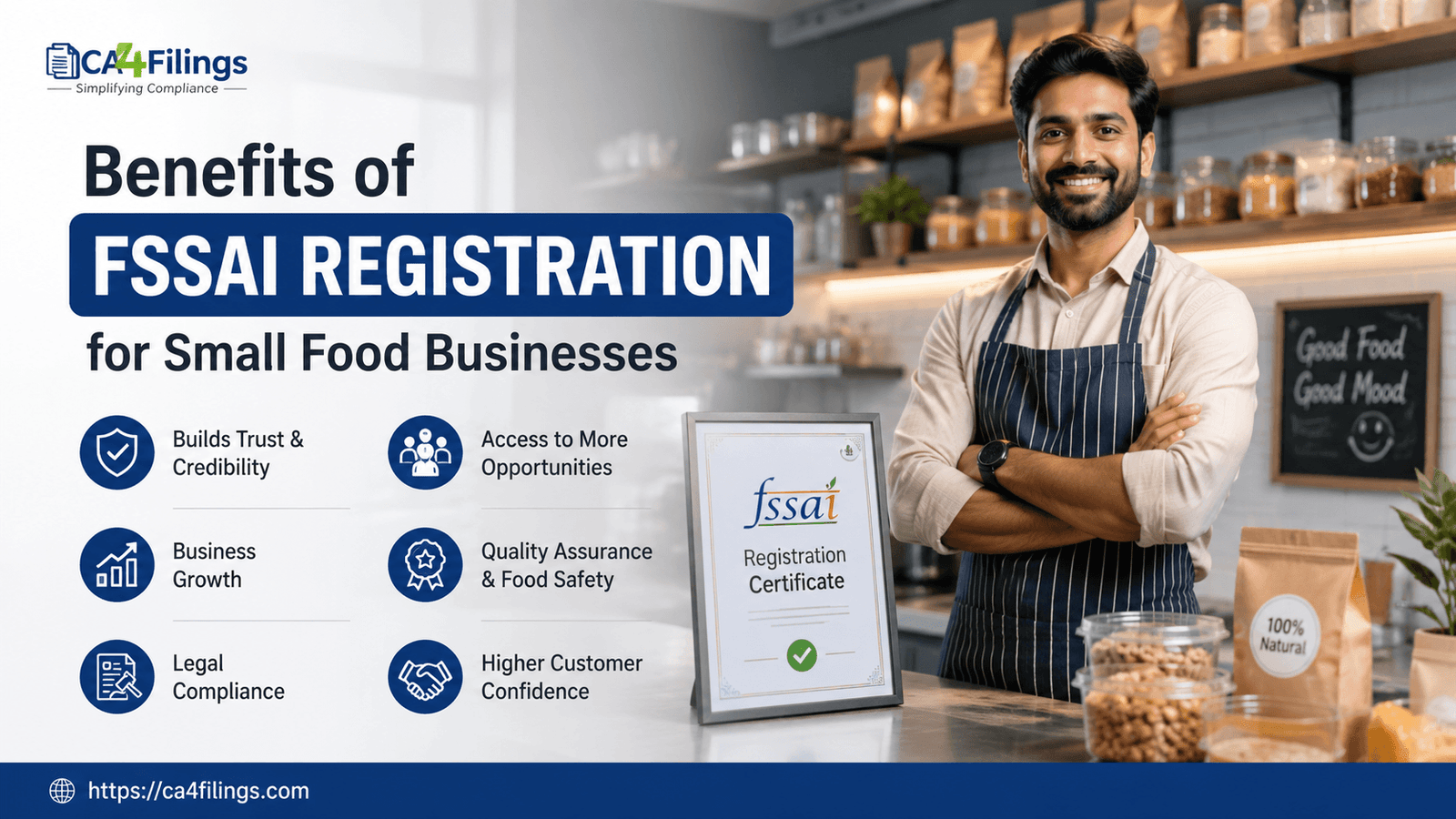
Starting a home kitchen, a local bakery, or a cozy neighborhood cafe is an exciting journey. In India, food is more than just a business—it is an emotion. As a small business owner, your initial focus is naturally on perfecting recipes, sourcing fresh ingredients, and finding the right location or platform to sell. However, amid the hustle of managing daily operations, one critical legal aspect often gets sidelined: food safety compliance.
Many local entrepreneurs ask me, "We operate on a very small scale, so do we really need a government license" The short answer is yes. Obtaining an FSSAI registration is not just a legal formality; it is a foundational step that unlocks massive growth. Understanding the Benefits of FSSAI Registration for Small Food Businesses can completely transform how your venture operates and how customers perceive your brand in India's highly competitive food industry.
At CA4Filings, we regularly guide budding food entrepreneurs through this initial setup. Navigating government portals can feel overwhelming when you are trying to run a business, which is why getting professional assistance for your FSAAI Registration ensures you stay fully compliant without any operational friction. Let us break down why this basic registration is the smartest investment you can make for your food venture today.
Why Small Food Businesses Hesitate (And Why They Shouldn’t)
A common misconception among cloud kitchen owners, small dhabas, and home bakers is that food safety regulations are only meant for giant restaurant chains or manufacturing plants. Many fear that stepping into the regulatory radar means dealing with endless paperwork, complex audits, and unnecessary taxes.
In reality, the Food Safety and Standards Authority of India (FSSAI) has created a simplified, highly affordable tier specifically tailored for micro-entrepreneurs: the Basic FSSAI Registration. If your annual turnover is under ₹12 Lakhs, the process is streamlined, low-cost, and designed to support you rather than penalize you. Postponing this step means missing out on immediate commercial advantages.
Key Benefits of FSSAI Registration for Small Food Businesses
When you secure your 14-digit registration number, you aren't just putting a logo on your packaging. You are establishing a legally sound, growth-oriented enterprise. Here is how it directly helps your business:
1. Building Consumer Trust and Improved Credibility
Today's Indian consumer is highly conscious about hygiene and food quality. When a customer orders food, they want to know it is prepared in a safe, clean environment. Displaying your FSSAI number on your menu, packaging, or storefront provides instant reassurance. This visible commitment to food safety regulations builds immense consumer trust, turning one-time buyers into loyal, long-term patrons.
2. Legal Compliance and Protection from Heavy Penalties
Operating a food business without registering with the apex food safety authority is a legal offense. The Food Safety and Standards Act prescribes strict penalties, fines, and even forced closure for non-compliant businesses. By securing your FSSAI registration early, you protect your hard work from sudden legal hurdles or fines, allowing you to run your daily operations with absolute peace of mind.
3. Easy Onboarding on Food Delivery Apps
If you want to scale a food business today, online visibility is non-negotiable. Swiggy, Zomato, and various quick-commerce grocery platforms have made it mandatory for all food business operators (FBOs) to upload a valid FSSAI document before going live. Without it, you simply cannot access the massive online delivery market, limiting your business to a small radius of walk-in customers.
4. Seamless Access to Business Loans and Funding
Whether you want to upgrade your kitchen equipment, hire more staff, or open a second outlet, you will eventually need capital. Banks and financial institutions treat un-registered businesses as high-risk. Having proper government registrations proves that your business is legitimate and serious, making it much easier to secure small business loans, MSME schemes, or external investments.
5. Corporate Orders and Event Catering Opportunities
Have you ever tried pitching your catering services to a corporate office for a daily lunch plan or a corporate event? The very first document their procurement team will request is your food safety certificate. Large companies and event organizers cannot afford the liability of serving food from an unregistered source. Thus, registration instantly qualifies you for high-margin, bulk corporate orders.
Understanding the Eligibility Criteria for Small Businesses
Before applying, it is helpful to understand where your business fits in the regulatory structure. The FSSAI categorizes businesses based on their operational capacity and financial turnover:
Basic FSSAI Registration: For small food businesses, home kitchens, retailers, and petty hawkers with an annual turnover of up to ₹12 Lakhs.
State License: For mid-sized food businesses, restaurants, or manufacturers with an annual turnover between ₹12 Lakhs and ₹20 Crores.
Central License: For large-scale manufacturers, importers, or businesses operating across multiple states with a turnover exceeding ₹20 Crores.
For most startups and local shops, the Basic Registration is all that is required to legally launch and enjoy all the operational benefits.
Step-by-Step Overview of the Registration Process
While the government has digitized the portal, ensuring your documentation is accurate is vital to avoid sudden rejections or delays. Here is a simplified look at how the process unfolds:
Document Preparation: Gather basic documents, including a passport-sized photograph of the owner, a valid government ID proof (Aadhaar Card or PAN Card), and proof of ownership or rental agreement for the business premises.
Application Submission: Fill out Form A on the FoSCoS (Food Safety Compliance System) portal, ensuring your business activity code accurately reflects what you sell.
Application Review: The food safety officer reviews the details. In rare cases concerning small setups, they may request additional clarifications.
Certificate Generation: Once approved, the FSSAI registration certificate containing your unique 14-digit number is issued digitally.
Expert Advice from the CA4Filings Desk
As financial and legal consultants, our advice to small food businesses is always to prioritize compliance from Day 1. Trying to bypass the system might save a minor fee today, but it can cost you your reputation and business continuity tomorrow.
Think of food safety compliance not as an administrative burden, but as a strategic marketing tool. Use your registration to differentiate your brand in a crowded market, proudly displaying it on your social media pages, boxes, and bills.
Frequently Asked Questions (FAQs)
What is the validity period of a basic FSSAI registration?
An FSSAI registration can be applied for a period ranging from 1 to 5 years. We generally advise small businesses to opt for a 3 or 5-year validity so they do not have to worry about annual renewals while building their brand.
Can I run a cloud kitchen from my residential home with this registration?
Yes, you can operate a home kitchen or cloud kitchen from a residential address. You will need to provide a utility bill (like an electricity bill) in the owner's name or a no-objection certificate (NOC) from the property owner along with your application.
What happens if my annual turnover crosses ₹12 Lakhs during the year?
If your business experiences great success and your turnover exceeds the ₹12 Lakhs threshold, you must apply for an upgrade from a Basic FSSAI Registration to an FSSAI State License to remain compliant with the updated business scale.
Is an FSSAI number required if I am only selling pre-packaged foods?
Yes. Even if you are not cooking or manufacturing the food yourself—such as running a small grocery retail shop or an online candy marketplace—you still require a registration as a distributor or retailer to legally handle and sell food items.
Take Your Food Business to the Next Level
The Indian culinary market is booming, but sustainability belongs to those who build on solid ground. Embracing the Benefits of FSSAI Registration for Small Food Businesses gives your brand the competitive edge, legal safety net, and consumer trust needed to scale seamlessly from a local kitchen into a well-known brand.
Don't let legal paperwork stall your culinary passion. Let the experts handle the regulatory heavy lifting while you focus on what you do best—making incredible food. Contact CA4Filings today, and let us get your food business officially registered, compliant, and ready for rapid growth!
Are you planning to launch your food business soon, or are you looking to transition an existing home kitchen into a commercial brand? Let me know what specific challenges you're facing with your setup so we can figure out the best approach for your launch.
Latest Updates
ca4filings.com Services




















-registration.png)