Common Mistakes to Avoid When Submitting DIR-3 KYC
Struggling with your director compliance? Discover the Common Mistakes to Avoid When Submitting DIR-3 KYC to ensure a smooth, penalty-free filing process.
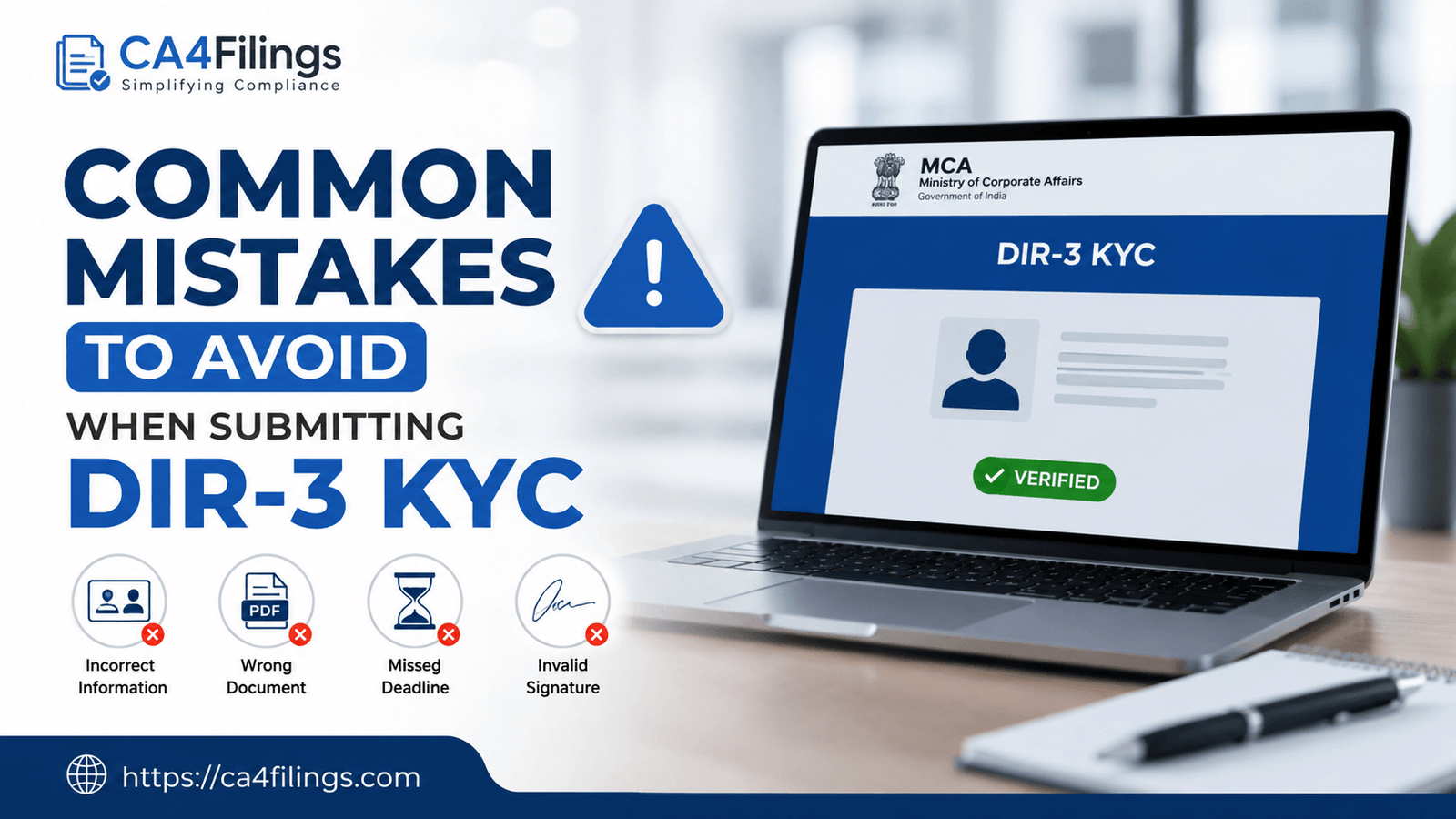
Every year, thousands of directors across India scramble to meet their annual compliance requirements. As professionals at CA4Filings, we often see clients receive notices or face unnecessary late fees simply because of minor errors in their filings. If you are a director, keeping your DIR-3 KYC status active is non-negotiable to maintain your legal standing. Understanding the Common Mistakes to Avoid When Submitting DIR-3 KYC can save you time, stress, and the steep penalty of ₹5,000 imposed for late filings. Let’s break down how you can get this right on the first attempt.
Why Your KYC Filing Matters More Than You Think
Many directors treat the DIR-3 KYC as a "tick-box" activity. However, the Ministry of Corporate Affairs (MCA) uses this process to keep the corporate database updated. When you fail to file correctly or miss the deadline, your Director Identification Number (DIN) gets marked as 'Deactivated'. Once this happens, you cannot file any e-forms for the company, and in some cases, the company itself may face operational roadblocks. We see many business owners panic when their DIN is suspended, but with proper care, these issues are entirely preventable.
Common Mistakes to Avoid When Submitting DIR-3 KYC
Precision is key when dealing with government portals. Here are the most frequent slips we encounter at our desk and how you can steer clear of them.
1. Mismatched Personal Details
This is the most common reason for form rejection. The details you enter in the DIR-3 KYC form—such as your name, father’s name, and date of birth—must match exactly with what is on your PAN card. Even a small discrepancy, like an extra space or an abbreviated middle name, can trigger an error. Always keep your PAN card in front of you while filling the form, rather than relying on memory.
2. Issues with Mobile Number and Email OTP Verification
The MCA requires unique contact details. You cannot use a mobile number or email ID that is already linked to another director’s KYC filing. Furthermore, the OTPs are time-sensitive. If you are in an area with poor network connectivity, do not attempt the filing until you have a stable connection. If the OTP expires, you must restart the verification process, which can occasionally lead to technical glitches on the portal.
3. Submitting Expired or Blurred Documents
For proof of identity and address, you must upload clear, legible copies. Often, directors upload photos that are too dark or documents that are nearing expiration. Ensure that your address proof (like a bank statement or utility bill) is not older than two months. If the text is not readable or the edges of the document are cropped out, the processing officer will reject the form, forcing you to go through the entire process again.
4. Failing to Use the Latest Version of the Form
The MCA frequently updates the e-form structure. Always download the latest version of the DIR-3 KYC form directly from the official MCA website before you start filling it out. Using an old, saved version of the form from a previous year is a guaranteed way to encounter a "file validation error" upon upload.
Expert Tips for a Seamless Submission
Beyond avoiding errors, there are ways to make the process more efficient. At CA4Filings, we recommend the following:
Digital Signature Readiness: Ensure your Digital Signature Certificate (DSC) is active and has not expired. If your DSC is near expiry, get it renewed well before the KYC window closes.
Verification by a Professional: While the form is self-attested, having a practicing professional (CA, CS, or CMA) verify the document ensures that any nuanced errors are caught before the final submission.
Don't Wait for the Deadline: The MCA portal often experiences heavy traffic and server lag during the final days of the filing period. Aim to complete your filing at least two weeks before the due date.
Frequently Asked Questions
What happens if I fail to file my DIR-3 KYC on time?
If you miss the deadline, your DIN will be marked as 'Deactivated' by the MCA. To reactivate it, you will have to pay a late fee of ₹5,000, which can be avoided by staying proactive.
Can I use the same mobile number for two different directors?
No, the mobile number and email address must be unique to the director filing the form. You must provide your own active contact details for OTP verification.
Is it mandatory to file DIR-3 KYC if my DIN is inactive?
Yes, even if your DIN is currently deactivated due to a previous lapse, you must file the DIR-3 KYC to get it reactivated, along with the payment of the prescribed late fee.
Do I need to file KYC if I have just been appointed?
If you have obtained your DIN via the SPICe+ form during company incorporation, your initial KYC is considered filed. However, you must file the web-based KYC for all subsequent financial years.
Ensure Your Compliance with CA4Filings
Managing corporate compliance can be overwhelming, especially when you have a business to run. By being aware of these Common Mistakes to Avoid When Submitting DIR-3 KYC, you are already ahead of the curve. However, if you want complete peace of mind and want to ensure your documents are perfectly prepared, our team at CA4Filings is here to help.
We handle the end-to-end filing process, ensuring accuracy and timeliness so you never have to worry about a deactivated DIN. Don't risk late fees or operational delays—reach out to CA4Filings today and let our experts handle your compliance requirements with professional precision.
Latest Updates
ca4filings.com Services

















-registration.png)