The Environmentalist's Choice: Start Up Registration as a Certified B-Corp
Explore how start up registration as a Certified B-Corp supports sustainable growth, environmental responsibility, and long-term business success in India.
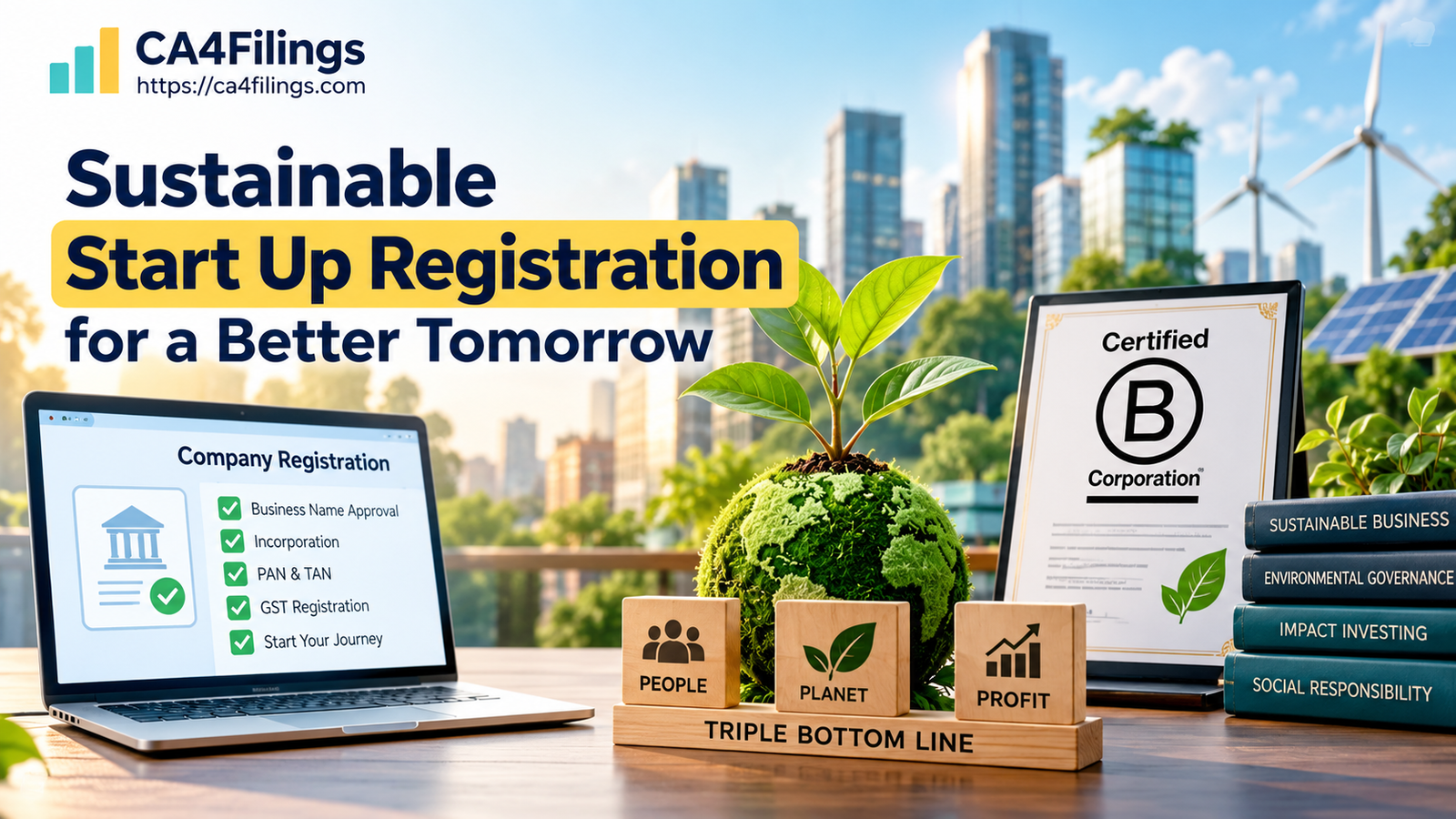
Why Sustainable Start Up Registration Matters
Today's entrepreneurs are looking beyond profits to build businesses that create a positive impact on society and the environment. From eco-friendly packaging brands to renewable energy ventures, sustainability has become an important part of modern business planning. For founders who want to combine commercial success with environmental responsibility, start up registration is the first step towards building a legally compliant and purpose-driven business.
One approach worth exploring is becoming a Certified B Corporation, commonly known as a B-Corp. This certification recognises businesses that meet defined standards of social and environmental performance, transparency, and accountability. At CA4Filings, we help entrepreneurs understand the legal and financial foundations of responsible business ownership, including Company Registration, so they can establish a strong foundation for sustainable growth.
However, it is important to understand that registering a company and obtaining B-Corp certification are two separate processes. A business must first establish the appropriate legal structure and then assess whether it meets the relevant certification requirements.
What Is a Certified B-Corp?
A Certified B Corporation is a business certified by B Lab, a global nonprofit organisation that promotes responsible business practices. Certification evaluates how a company affects its workers, customers, community, governance practices, and the environment.
Unlike businesses that focus exclusively on financial returns, B-Corps aim to balance profitability with positive social and environmental outcomes.
For example, imagine an Indian start-up manufacturing reusable household products. The company may use recycled materials, pay fair wages, reduce manufacturing waste, and maintain transparent supplier relationships. These practices can support its sustainability objectives and may contribute to its eligibility for b lab certification, provided it meets the applicable assessment and verification requirements.
A B-Corp is not simply a green brand. It is a business that must demonstrate responsible practices through evidence, policies, and measurable performance.
How Start Up Registration Supports Your B-Corp Journey
Before applying for certification, entrepreneurs should establish a legally recognised business structure in India. The right structure depends on the founders' objectives, funding plans, operational needs, and long-term commitments.
Common options include:
Private Limited Company: Suitable for start-ups planning to raise equity investment, expand operations, or bring multiple shareholders into the business.
Limited Liability Partnership (LLP): A flexible structure for founders who want limited liability and relatively adaptable internal management.
One Person Company (OPC): An option for an eligible individual entrepreneur who wants to establish a company with a single member.
For many growth-oriented start-ups, a private limited company can provide a practical foundation for fundraising and governance. However, the best choice depends on the business model rather than sustainability goals alone.
A typical start up registration process for a private limited company includes:
Obtaining Digital Signature Certificates (DSCs) for the relevant individuals.
Applying for name approval and preparing incorporation documents.
Filing the required incorporation forms with the Ministry of Corporate Affairs (MCA).
Receiving the Certificate of Incorporation after approval.
Completing applicable tax, banking, accounting, and other statutory formalities.
Founders should also consider whether their proposed activities require environmental permissions, registrations, or licences. For example, a business involved in manufacturing, waste processing, or plastic packaging may face additional compliance requirements depending on its activities and location.
At CA4Filings, we recommend identifying these obligations early rather than treating compliance as an afterthought.
Understanding B Lab Certification and Its Requirements
Completing start up registration does not automatically make a business a Certified B-Corp. Certification involves a separate evaluation of the company's social and environmental performance and accountability.
The exact requirements depend on B Lab's applicable certification standards, the company's size, industry, geography, and legal structure.
Entrepreneurs should generally prepare to demonstrate the following:
1. Environmental and Social Performance
Businesses must assess how their operations affect the environment and the people connected with them. Relevant areas may include energy consumption, waste management, employee welfare, ethical sourcing, and community engagement.
2. Governance and Accountability
A company should maintain transparent decision-making processes, responsible management practices, and appropriate accountability mechanisms.
Founders should review whether their existing governance arrangements support their stated social and environmental objectives. Any required legal or constitutional changes should be evaluated with qualified professionals.
3. Documentation and Verification
Businesses should maintain reliable records supporting their claims, such as:
Energy and water consumption records.
Waste reduction and recycling data.
Employee policies and workplace safety procedures.
Supplier codes of conduct.
Environmental targets and progress reports.
Governance policies and relevant financial records.
Certification is not a substitute for legal compliance. A business must continue meeting applicable Indian corporate, labour, tax, environmental, and sector-specific requirements.
The Triple Bottom Line: People, Planet, and Profit
The triple bottom line is a business approach that evaluates success through three dimensions: people, planet, and profit.
This framework can help founders make sustainability part of everyday decision-making rather than treating it as a marketing exercise.
People: Businesses can invest in employee welfare, fair employment practices, customer safety, and stronger relationships with local communities.
Planet: Companies can reduce unnecessary packaging, monitor resource consumption, adopt energy-efficient equipment, and improve waste management.
Profit: Sustainable practices can improve operational efficiency, strengthen customer loyalty, and support long-term business resilience.
Consider a start-up selling organic personal care products. By sourcing responsibly, reducing plastic packaging, and tracking production waste, the company may lower certain operating costs while building customer trust. These improvements should be measured rather than assumed, since sustainable alternatives can also involve higher initial expenses.
During start up registration, founders should begin planning how they will track these outcomes alongside conventional financial indicators.
Environmental Governance and Sustainable Business Legalities
Environmental governance refers to the policies, responsibilities, controls, and reporting processes a business uses to manage its environmental impact.
For Indian start-ups, sustainability must go hand in hand with legal compliance. Depending on the nature and scale of operations, relevant obligations may involve environmental clearances, pollution control permissions, waste management rules, plastic waste requirements, and Extended Producer Responsibility (EPR).
For example, an online retailer using plastic packaging may need to examine the environmental obligations applicable to its role in the packaging supply chain. Similarly, a manufacturing unit may need approvals from the relevant State Pollution Control Board or Pollution Control Committee.
Not every start-up faces the same requirements. Obligations depend on factors such as the products manufactured, the materials used, the operating location, and the applicable regulations.
Practical steps for founders include:
Identify all business activities that may have environmental implications.
Determine which registrations, approvals, and licences apply.
Assign responsibility for monitoring compliance.
Maintain records of waste, energy use, emissions, and relevant permissions.
Review compliance periodically as the business expands.
Getting these fundamentals right makes sustainable business legalities easier to manage and helps prevent avoidable operational disruptions.
How B-Corp Certification Can Benefit Sustainable Start-Ups
For the right business, certification can offer several potential advantages.
Stronger brand credibility: Demonstrable environmental and social commitments may help distinguish a company from competitors making unsupported sustainability claims.
Customer confidence: Consumers increasingly consider ethical sourcing, responsible packaging, and transparency when choosing certain products and services.
Investor interest: Businesses with credible impact strategies may appeal to investors interested in impact investing, although certification does not guarantee funding.
Better internal processes: Formal assessments can help identify weaknesses in governance, employee policies, resource efficiency, and supply-chain management.
Long-term resilience: A structured sustainability approach can help businesses identify environmental and social risks before they become more difficult to manage.
Certification also requires effort. Documentation, internal improvements, assessment, and ongoing compliance can involve meaningful time and expense. Founders should assess the likely business value before committing resources.
Step-by-Step Roadmap for Aspiring B-Corp Founders
If your goal is to build an environmentally responsible business, follow this practical roadmap.
Step 1: Define your purpose. Establish clear social and environmental objectives that align with your products, services, and business model.
Step 2: Complete start up registration. Choose a suitable legal structure and complete the applicable incorporation formalities.
Step 3: Establish compliance systems. Organise accounting, tax filings, corporate records, employment policies, and environmental permissions where applicable.
Step 4: Measure your impact. Track meaningful indicators such as waste generated, recycled material used, energy consumed, and employee welfare outcomes.
Step 5: Review B Lab's current requirements. Check the relevant certification standards, eligibility conditions, assessment process, and applicable fees directly with B Lab.
Step 6: Address identified gaps. Improve governance, environmental performance, and workplace practices where necessary, keeping evidence of the changes.
Step 7: Apply for certification. Follow the applicable B Lab process and provide the requested documentation. Certification is subject to assessment and approval.
This approach helps founders build a responsible business systematically rather than rushing into certification before their internal processes are ready.
Latest Updates
ca4filings.com Services