Success Stories: Organizations That Thrived After 80G Registration
Discover inspiring Success Stories: Organizations That Thrived After 80G Registration. Learn how Indian NGOs unlocked massive donor support and grew.
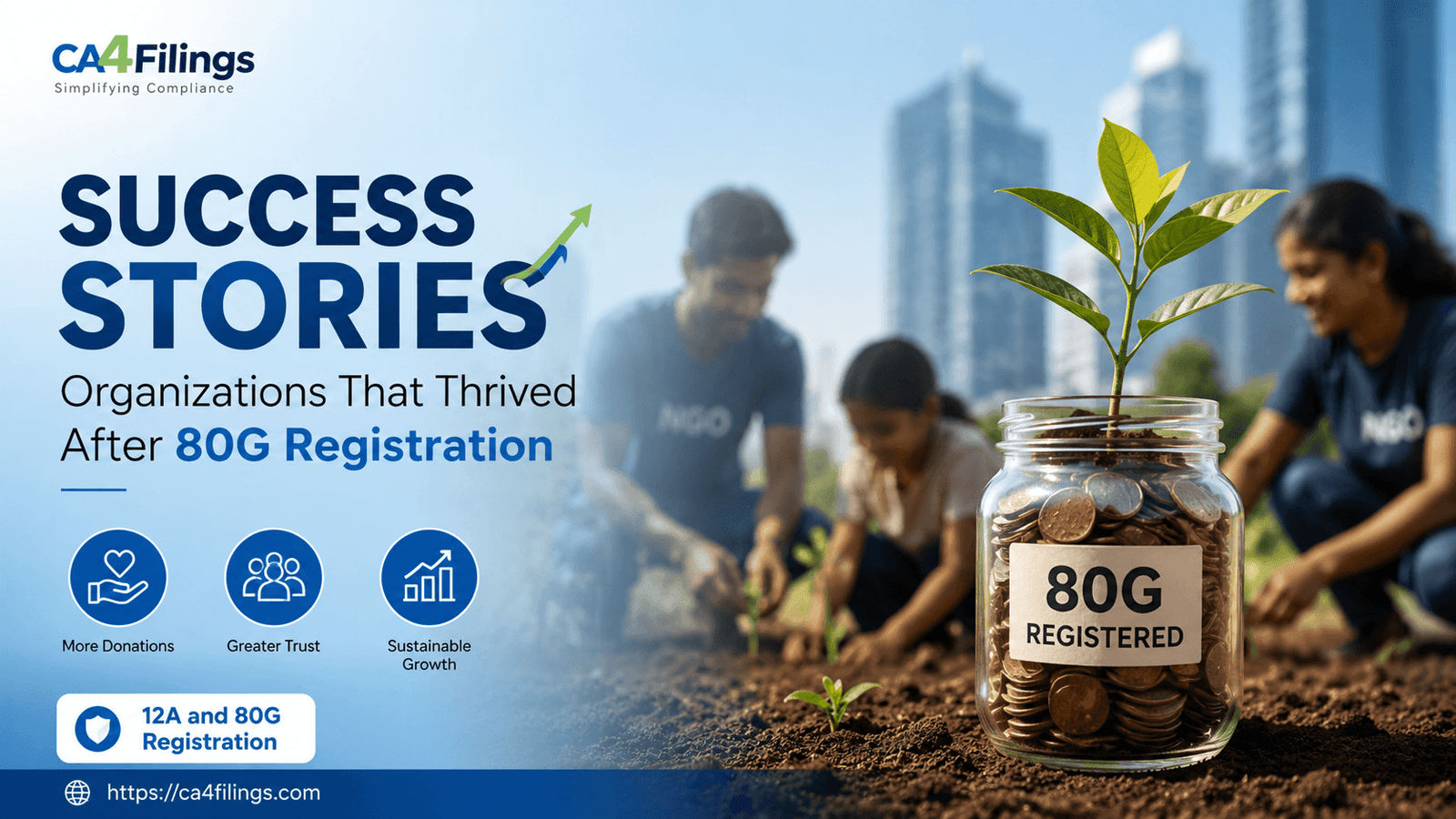
Running a Non-Governmental Organization (NGO) in India is a labor of love. Every day, you pour your heart and soul into creating a tangible social impact. However, even the most passionate charitable organizations face a common, harsh reality: noble intentions require sustainable funding. Without financial backing, scaling your operations remains an uphill battle. If you have been struggling to attract corporate donors or large-scale individual funding, the missing puzzle piece is almost always the Section 80G certification. In this article, we will explore inspiring Success Stories: Organizations That Thrived After 80G Registration, proving how this single regulatory milestone can fundamentally rewrite an NGO's growth trajectory.
At CA4Filings, we regularly meet brilliant changemakers who are stuck in a cycle of limited resources simply because they lack proper tax credentials. Securing your 12A and 80G Registration acts as a trust-building mechanism, transforming your grassroots initiative into an institution capable of receiving massive philanthropic support. Let's look at real-world scenarios and breakdown exactly how this registration shifts the dynamics of NGO development.
The Turning Point: Why 80G Matters for Indian Nonprofits
To understand the core of these success stories after 80G registration, we first need to look at it from a donor’s perspective. Why should a corporate entity or a high-net-worth individual (HNI) cut a cheque for your NGO instead of another? It boils down to trust and financial incentives.
An 80G registration in India allows donors to claim a deduction—usually 50% or 100% of the donated amount—from their taxable income. This means giving to your cause lowers their tax liability. When you combine this with the mandatory Corporate Social Responsibility (CSR) laws under the Companies Act, 2013, 80G registration becomes non-negotiable. Corporates simply cannot route their CSR funds to an NGO that doesn't hold this certification.
Success Stories: Organizations That Thrived After 80G Registration
Let’s dive into a few realistic case studies modeled after actual Indian nonprofit success trajectories. These examples illustrate how overcoming the compliance hurdle triggers rapid organizational growth.
Case Study 1: The Rural Education Initiative's CSR Breakthrough
An educational trust based out of Maharashtra started with a humble goal: providing free evening tuition to 50 village children. For three years, the founders ran the operations out of their personal savings and small contributions from friends. They wanted to expand to five neighboring villages but completely hit a wall. Corporates liked their work but kept asking for their tax-exemption certificates.
After consulting a chartered accountant and securing their registration, the narrative changed entirely. With the focus keyword milestone achieved, they pitched to a mid-sized manufacturing company nearby. Armed with 80G compliance, they secured a corporate CSR grant worth ₹15 Lakhs in the first year alone. The tax exemption benefits served as a powerful incentive for the corporate sponsor. Today, that small trust manages digital classrooms across 20 villages, a classic example of nonprofit success stories driven by regulatory compliance.
Case Study 2: An Environmental NGO’s Retail Donor Boom
Another phenomenal success story involves a Bengaluru-based group working on lake restoration. Initially, they relied on weekend volunteering drives and small cash donations. However, to buy desiltation machinery, they needed larger individual sums.
Following their 80G certification, they launched an online crowdfunding campaign titled "Clean Our Lakes, Save Our City." Because they could now offer donor incentives in the form of tax deduction certificates, their individual donor support increase was massive. High-salaried tech professionals willingly contributed larger amounts knowing they could optimize their income tax. The NGO's annual collection jumped by over 300% within twelve months, demonstrating how retail fundraising relies heavily on structural trust.
The Ripple Effect: How 80G Fuels Long-Term NGO Development
The benefits of navigating the 80G registration process extend far beyond immediate financial gains. It sets off a positive chain reaction that elevates every aspect of your operations.
Institutional Credibility: The Income Tax Department grants 80G registration only after thoroughly auditing your books, objectives, and past activities. Holding this license tells the world that your financial practices are transparent and verified.
Access to International Grants: Many foreign philanthropic foundations and foreign contribution channels prioritize Indian NGOs that have their local tax exemptions entirely sorted out.
Sustainability and Scale: Instead of planning month-to-month based on erratic pocket donations, 80G allows you to sign multi-year grant agreements with corporate partners, giving your nonprofit growth a stable foundation.
The CA4Filings Step-by-Step Guide to Getting 80G Compliant
If these philanthropic success stories inspire you, it’s time to take action for your own organization. The registration process requires precision, as incomplete paperwork is a leading cause of rejection.
Prerequisite Checklist
Before applying for 80G, your organization must ensure the following bases are covered:
The NGO must be registered as a Trust, Society, or a Section 80 Company.
The NGO must possess a valid 12A registration (which provides tax exemption on the NGO's own income).
The organization’s bye-laws or trust deed must not contain any clause allowing the usage of funds for non-charitable purposes.
Your accounting books must be maintained meticulously and up to date.
The Application Blueprint
Form 10A / 10AB Submission: Applications are submitted electronically on the Income Tax e-filing portal using Form 10A (for provisional registration) or Form 10AB (for permanent registration).
Document Compilation: You will need to upload your PAN card, registration certificate, trust deed, last three years' financial statements, and a detailed note on the charitable activities undertaken.
Scrutiny and Approval: The Commissioner of Income Tax (CIT) reviews the application. If satisfied with the authenticity of your charitable organizations impact, they will issue the formal 80G certification.
Frequently Asked Questions
Q1. Can a newly formed NGO apply for 80G registration?
Yes, absolutely. New organizations can apply for a Provisional 80G Registration, which is valid for a period of 3 years. This allows upcoming nonprofits to start raising corporate and retail funds right from their inception stage.
Q2. Is 80G registration a one-time process?
No, under the current income tax laws, NGOs must renew their permanent 80G registration every 5 years by filing Form 10AB at least six months before the expiry of their existing validity.
Q3. Does 80G registration mean the NGO doesn't have to pay any tax?
No, there is a distinct difference. Section 12A exempts the NGO's income from being taxed. Section 80G provides a tax deduction benefit to the donors who give money to your NGO. Both work hand-in-hand but serve different purposes.
Q4. Can an NGO lose its 80G registration?
Yes. If an organization fails to maintain transparent books, spends funds on religious or non-charitable activities, or fails to file annual returns, the Income Tax Department can cancel the registration.
Every single one of the Success Stories: Organizations That Thrived After 80G Registration started at the exact same crossroads where you are standing today. They had a powerful vision but lacked the structural compliance needed to unlock large-scale funding. By prioritizing their regulatory compliance, they built a bridge of trust between their social cause and institutional capital.
Don't let complex paperwork or legal jargon stand in the way of your NGO's mission. At CA4Filings, we specialize in taking the compliance burden completely off your shoulders. From structuring your books to flawlessly executing your documentation, our experienced team of Chartered Accountants ensures your path to tax compliance is smooth, transparent, and error-free.
Let’s turn your grassroots initiative into the next great milestone of Indian nonprofit success. Reach out to CA4Filings today, and let’s get your tax registrations sorted out together!
Latest Updates
ca4filings.com Services























-registration.png)