The Impact of Trust Registration on Social Welfare Initiatives
Discover The Impact of Trust Registration on Social Welfare Initiatives. Learn how registration boosts credibility, funding, and tax benefits.
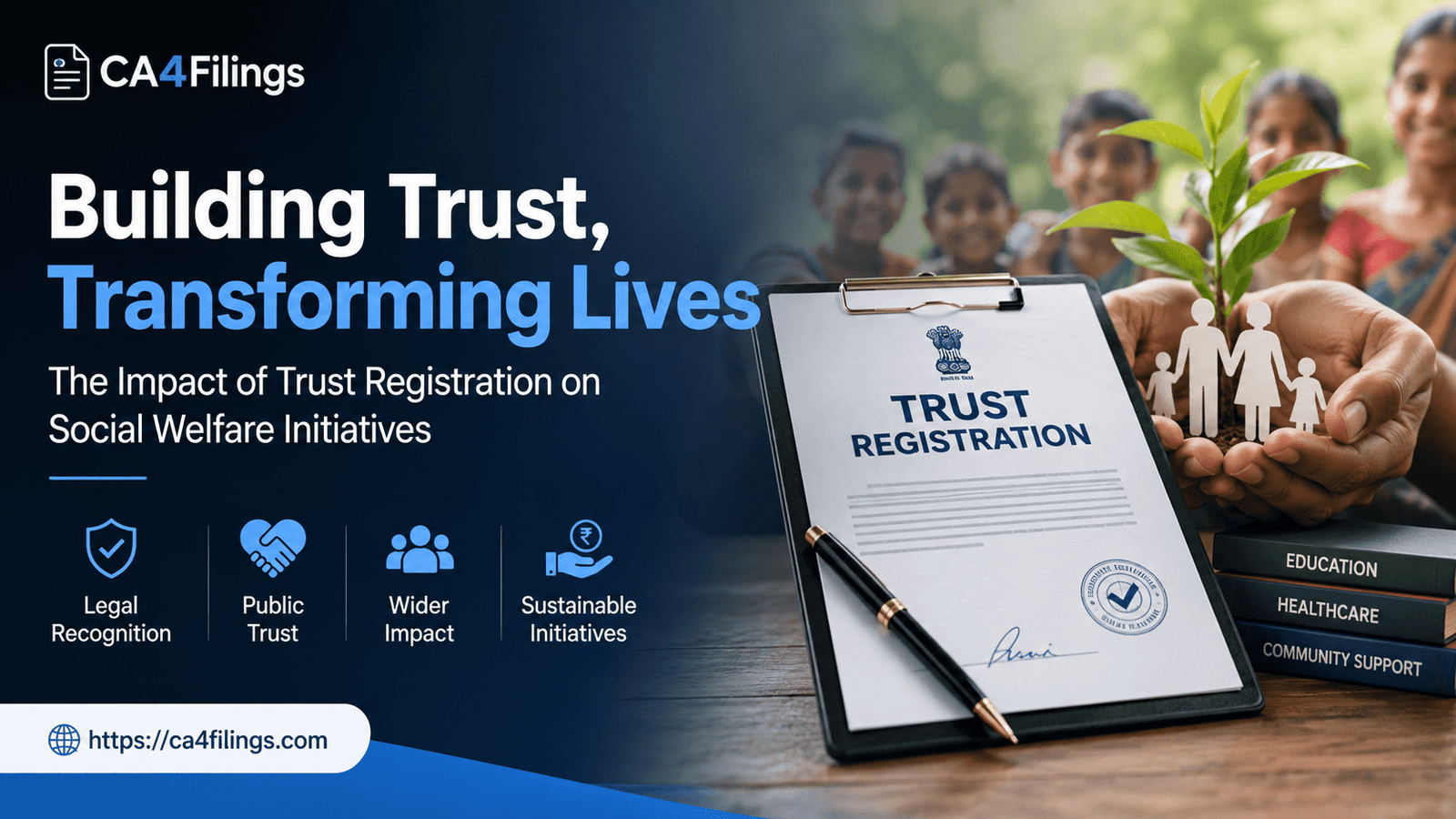
Every day, thousands of passionate change-makers across India set out to resolve deep-rooted community issues, driven by an unyielding spirit of philanthropy. Whether it is setting up free healthcare camps, running schools for underprivileged children, or spearheading rural community development, the heart of these social welfare initiatives is pure. However, a common roadblock many founders hit early on is translating this pure intent into sustainable, long-term impact. This is precisely where understanding The Impact of Trust Registration on Social Welfare Initiatives becomes essential. For an unorganized group, scaling charity work or gaining the trust of large contributors can feel like an uphill battle. Registering your organization as a formal legal entity completely transforms this trajectory.
At CA4Filings, we regularly guide visionaries through this evolutionary transition. Navigating the structured process of formal Trust Registration serves as the foundational bedrock for any scalable NGO strategy in India. Without formalizing your entity under the Indian Trusts Act, 1882, your social welfare initiatives remain restricted to close personal circles and limited personal finances. A registered charitable trust bridges the gap between grassroots passion and institutional scale, laying out a transparent framework that converts a local passion project into an institutional legacy. Let’s dive deep into exactly how formalizing your setup redefines your impact, operational capabilities, and long-term viability.
Elevating Credibility and Instilling Stakeholder Confidence
The currency of the social sector is trust. When your NGO applies for corporate funding or approaches individual patrons, the first question people ask isn't just about your mission—it's about your legitimacy. Exploring The Impact of Trust Registration on Social Welfare Initiatives reveals that formal registration acts as an immediate badge of trustworthiness. It signals to the world that your organization is willing to open its doors to legal scrutiny, formal audits, and structured public oversight.
When you register a charitable trust, you establish a separate legal identity. This separation means that your public perception shifts instantly from a "casual group of volunteers" to a recognized, institutionally sound platform. This newly established organizational management structure dramatically builds stakeholder confidence. Donors, volunteers, and beneficiaries feel secure knowing that their time, money, and faith are invested in an entity bound by explicit statutory rules rather than personal whims.
Unlocking Institutional Funding Opportunities and Financial Sustainability
Good intentions require solid capital to make a difference. Financial sustainability is the primary engine behind successful social welfare initiatives, and registration unlocks the keys to this engine. Major corporate houses, international philanthropic agencies, and Government bodies do not write donation cheques to individuals or unverified committees due to strict compliance standards.
By studying The Impact of Trust Registration on Social Welfare Initiatives, we observe that formalization opens up critical funding opportunities that are otherwise completely out of reach:
Corporate Social Responsibility (CSR) Grants: Under the Indian Companies Act, 2013, companies with specified profitability must spend 2% of their net profits on CSR. These corporations only collaborate with registered entities possessing a valid CSR-1 registration.
Government Subsidies and Tenders: For large-scale community development programs—such as building public sanitation facilities or rural skill centers—the Government actively invites partnerships from registered nonprofit organizations.
Foreign Contributions (FCRA): If your vision involves receiving support from international donors or global philanthropy networks, holding a registered trust deed is the mandatory starting point to apply for an FCRA license.
The Power of Tax Exemptions (12A & 80G)
A registered trust can apply for sections 12A and 80G of the Income Tax Act. Section 12A exempts the trust's own income from tax, allowing you to reinvest 100% of collected funds back into your social welfare initiatives. Simultaneously, Section 80G provides a 50% tax deduction to your donors, making your trust an incredibly attractive destination for strategic philanthropy.
Ensuring Transparency through Robust Governance Practices
A major aspect of The Impact of Trust Registration on Social Welfare Initiatives lies in how it revolutionizes internal organizational management. Registration mandates a clear governance structure, establishing a defined Board of Trustees. The trust deed specifies exactly who holds administrative power, how decisions are made, and how vacancies are filled, which prevents internal disputes and secures organizational continuity.
Furthermore, regulatory compliance ensures high levels of internal accountability and operational transparency. Registered trusts are legally required to maintain formal books of accounts, get them certified by a practicing Chartered Accountant, and file annual returns with the Income Tax Department and the local Trust Review authorities. This level of rigorous maintenance eliminates errors, minimizes the risk of fund mismanagement, and reinforces public trust in your operations.
Amplifying Social Impact and Ensuring Long-Term Sustainability
What separates a temporary charity drive from an enduring social institution? The answer is sustainability. When analyzing The Impact of Trust Registration on Social Welfare Initiatives, we notice that registration builds a permanent bridge for long-term social impact. Since a trust can hold property, buy assets, and sign legal agreements in its own name, it can build physical infrastructure—like schools, orphanages, hospitals, or training centers—that benefits society for generations.
This structural stability completely redefines public perception. Communities embrace your programs more deeply when they perceive your organization as a permanent anchor of development rather than a short-term intervention. This long-term presence makes it easier to recruit qualified professional talent, design multi-year community development strategies, and create deep, measurable social change.
Fulfilling Legal Requirements: A Step-by-Step Overview
To fully experience the legal registration benefits and protect your organization from compliance risks, you must navigate the legal requirements accurately. Here is a brief, practical roadmap of the process:
Drafting the Trust Deed: This is the core constitutional document. It must clearly outline the names of the settlor and trustees, the main office address, and the specific charitable objects of the trust.
Fixing the Trust Property: A nominal amount of cash or property (often called the trust fund or settlement amount) must be dedicated to starting the trust.
Submitting to the Sub-Registrar: The finalized deed must be executed on appropriate stamp paper and registered before the local Sub-Registrar of the jurisdiction where the trust's registered office is located. This requires the physical presence of the settlor and trustees along with valid identity proofs and witnesses.
Obtaining PAN and TAN: Post-registration, the trust must apply for its own distinct Permanent Account Number (PAN) and Tax Deduction Account Number (TAN) to open an institutional bank account.
Frequently Asked Questions (FAQs)
Q1: Can a registered trust run commercial or business activities?
A: A charitable trust's primary objective must remain social welfare. However, under Section 11(4A) of the Income Tax Act, a trust can carry out business activities if the business is incidental to attaining its primary charitable objectives, and separate books of accounts are meticulously maintained for such business.
Q2: How many people are required to form a trust in India?
A: Generally, you need a minimum of two individuals: one Settlor (the person creating the trust) and at least one Trustee. However, practically, it is highly recommended to have at least three trustees to ensure smooth decision-making, effective governance practices, and balanced voting.
Q3: Is a trust registration valid across all states in India?
A: Yes, a trust registered under the relevant authorities in one state can execute social welfare initiatives across India. However, if your state has a specific Public Trusts Act (like Maharashtra or Gujarat), you must additionally register with the state's Charity Commissioner.
Q4: What happens if a registered trust fails to complete its annual regulatory compliance?
A: Non-compliance can lead to severe penalties, loss of tax-exempt status under sections 12A and 80G, and potential legal prosecution of the trustees. Regular financial auditing and filing are non-negotiable for maintaining your trust's active status.
Let CA4Filings Supercharge Your Social Welfare Legacy!
Understanding The Impact of Trust Registration on Social Welfare Initiatives highlights that formal legal standing is the ultimate catalyst for expanding your social footprint. Don't let confusing paperwork, complex legal jargon, or rigorous registration benefits delay your philanthropic mission. Let our team of expert Chartered Accountants handle your end-to-end documentation, trust deed drafting, Sub-Registrar filings, and tax registrations seamlessly. Reach out to CA4Filings today, and let's build an accountable, sustainable, and credible foundation for your noble cause!
Latest Updates
ca4filings.com Services





















-registration.png)