The Relationship Between TAN and Income Tax Returns
Discover The Relationship Between TAN and Income Tax Returns. Learn how your tax identity affects tax filing, business taxes, and compliance.
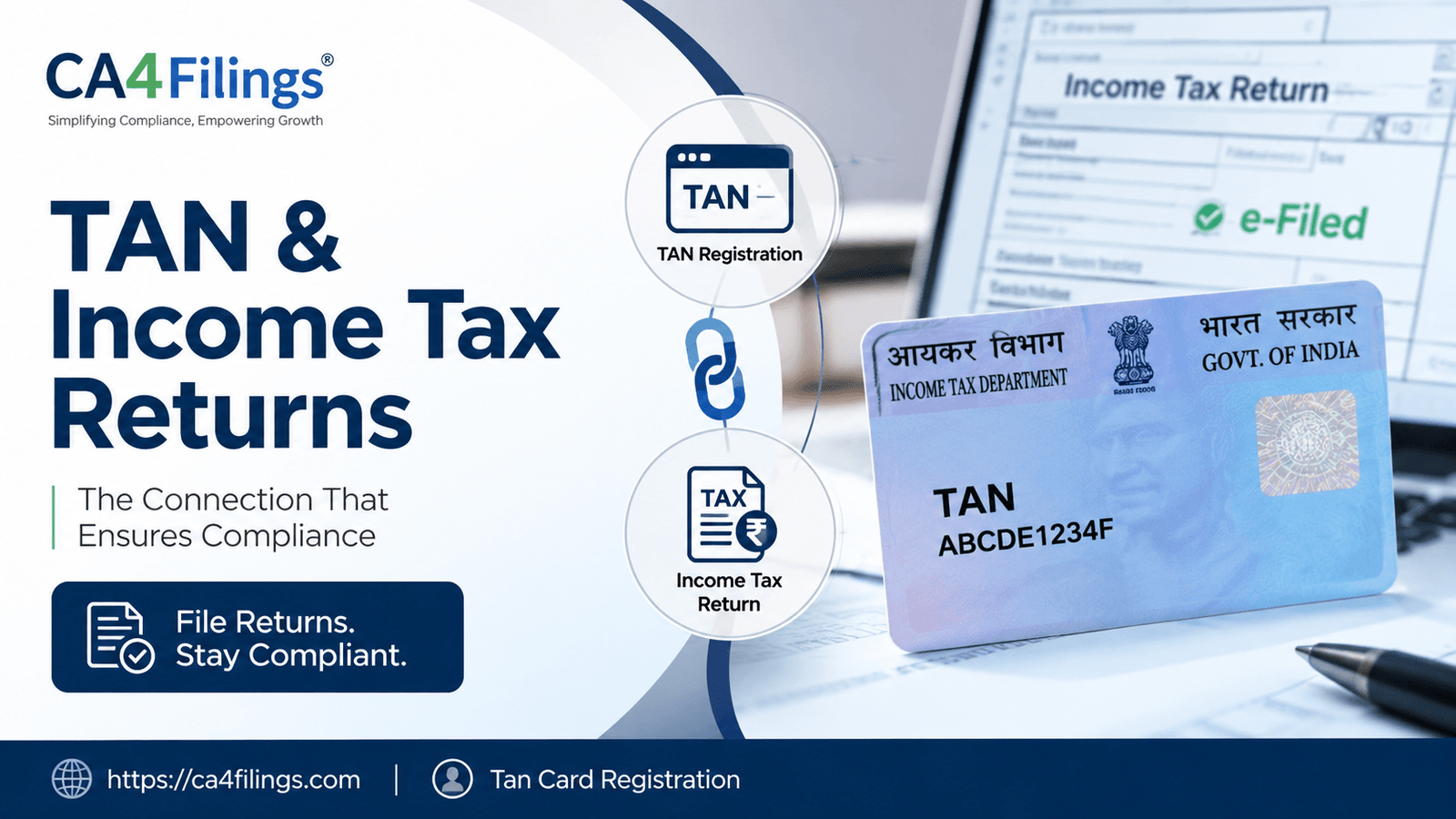
Every week at CA4Filings, we meet enthusiastic entrepreneurs and business owners eager to scale their ventures. They have incredible business plans, but when it comes to Indian tax compliance, things often get a bit blurry. One of the most common points of confusion we encounter is how different tax identification numbers interact with each other. Specifically, people frequently ask us about The Relationship Between TAN and Income Tax Returns and whether holding a PAN is enough to satisfy all their tax obligations.
If you are running a business, hiring employees, or paying rent on a commercial property, understanding this connection is not just academic—it is a vital part of staying compliant and avoiding heavy penalties. Navigating this landscape requires a clear understanding of your unique tax identity, ensuring you meet all legal requirements seamlessly. If you are just starting out or need to regularize your business taxes, getting your Tan Card Registration sorted out is your very first step toward foolproof tax compliance.
Let’s break down exactly how these two critical pillars of Indian taxation connect, why they cannot substitute for one another, and how they collectively impact your regular tax filing.
What Exactly is a TAN?
Before exploring The Relationship Between TAN and Income Tax Returns, we need to clarify what TAN actually stands for. TAN is the Tax Deduction and Collection Account Number. It is a unique 10-digit alphanumeric identifier issued by the Income Tax Department of India to individuals and entities that are required to deduct or collect tax at source.
In the Indian tax ecosystem, the government uses a multi-layered approach for taxpayer identification. While your PAN (Permanent Account Number) tracks your direct income and individual taxes, your TAN is specifically designed to track money you withhold on behalf of the government from payments made to others.
Think of it this way:
PAN tracks what you earn and the taxes you owe.
TAN tracks the tax deduction or tax collection you manage on behalf of third parties (like employees, contractors, or landlords).
Decoupling the Duo: Is TAN Different from PAN?
Yes, completely. A common mistake business owners make is assuming that because they have a PAN, they do not need a TAN to file TDS returns, or vice versa.
| Feature | PAN (Permanent Account Number) | TAN (Tax Deduction & Collection Account Number) |
|---|---|---|
| Primary Purpose | Tracking income, wealth, and direct tax liabilities. | Tracking tax deducted at source (TDS) or collected at source (TCS). |
| Who Needs It? | Every earning individual, HUF, company, or firm. | Any entity or individual responsible for deducting or collecting tax. |
| Impact on Returns | Used to file annual income tax returns. | Used to file quarterly TDS/TCS returns. |
Exploring The Relationship Between TAN and Income Tax Returns
To understand The Relationship Between TAN and Income Tax Returns, we have to look at how cash flows through an economy and how the Income Tax Department cross-references data. The entire relationship boils down to one primary objective: mismatch reconciliation.
When a business uses its TAN to deduct tax from a vendor or an employee, that deducted amount must be deposited with the government. This deduction is tied to the recipient’s PAN. When that employee or vendor goes to file their personal income tax returns, the system automatically checks if the tax credits claimed match the data uploaded via your TAN.
Here is a breakdown of how this relationship functions practically in day-to-day business operations:
1. The Source of Tax Credits (Form 26AS and AIS)
When you deduct tax using your TAN and file your quarterly statements, this data populates directly into the recipient's Form 26AS and Annual Information Statement (AIS). Without your accurate TAN reporting, your vendors or employees cannot claim credit for the tax deducted in their own income tax returns. A mistake on your end leads to a compliance nightmare for them.
2. Corporate Tax Compliance and Expense Disallowance
If your business is auditing its accounts and preparing its own income tax returns, the Income Tax Department matches your claimed business expenses against your TDS compliance. If you fail to deduct tax or fail to report it using a valid TAN, a significant portion of your business expenses (up to 30% for domestic payments) can be disallowed. This drastically increases your taxable income and leaves you with an unexpectedly high tax bill.
3. The Cross-Referencing Mechanism
The Income Tax Department uses advanced data analytics to link your business's PAN and TAN activity. If your annual income tax returns show massive salary expenses or professional fees paid, but your TAN records show zero quarterly TDS filings, an automated red flag is raised, often resulting in a tax notice.
Step-by-Step: How TAN Compliance Feeds into Smooth Tax Filing
Managing your tax obligations shouldn't feel like guesswork. At CA4Filings, we advise following a systematic approach to ensure your paperwork flows perfectly from monthly transactions all the way to final annual returns.
Step 1: Accurate Deduction at the Time of Payment
Whenever you pay salaries, contractual fees, or rent exceeding threshold limits, calculate the correct tax deduction percentage based on current financial year guidelines.
Step 2: Timely Monthly Deposit
Deposit the collected tax with the government by the 7th of the succeeding month (or by April 30th for the month of March) using your unique taxpayer identification data.
Step 3: Quarterly TDS Return Filing
File your quarterly TDS returns (Form 24Q for salaries, Form 26Q for non-salaries) accurately using your TAN. This bridges the gap between your daily transactions and the government's master database.
Step 4: Annual Reconciliation before Filing Income Tax Returns
Before submitting your final business or individual taxes, reconcile your profit and loss statements with your filed TDS returns. Ensuring these numbers align perfectly guarantees an effortless, stress-free tax filing process.
Common Pitfalls and Penalties to Avoid
Failing to appreciate The Relationship Between TAN and Income Tax Returns can lead to steep financial consequences. The Income Tax Department treats TDS defaults very strictly.
Failure to Apply for TAN: If you are required to deduct TDS but fail to apply for a TAN, a flat penalty of ₹10,000 can be levied under Section 272B.
Late Filing of TDS Returns: Delaying your quarterly returns attracts a late fee of ₹200 per day under Section 234E, capped at the total amount of TDS deducted.
Interest on Delayed Payments: Interest accumulates at 1% per month for delays in deducting tax, and 1.5% per month from the actual date of deduction to the date of deposit.
Frequently Asked Questions
Can I use my PAN instead of TAN to deduct TDS?
No, PAN and TAN serve entirely different regulatory functions. You cannot use your PAN for deducting or depositing TDS. Doing so is illegal and results in invalid transactions and penalties.
Do salaried individuals need a TAN?
Generally, no. Salaried individuals paying personal expenses do not need a TAN. However, if an individual is running a proprietorship business that crosses tax audit thresholds, or if they are purchasing immovable property valued above ₹50 Lakhs, specific provisions require temporary or permanent compliance numbers.
How does a mistake in my TAN return affect someone else’s income tax returns?
If you enter an incorrect PAN or incorrect deduction amount in your quarterly statements, the credit will not reflect in the recipient's Form 26AS. Consequently, they will face discrepancies and potential tax demands when filing their income tax returns.
Can a business have more than one TAN?
No, an entity is legally permitted to hold only one TAN. Applying for or holding a duplicate TAN is against regulations and attracts a penalty of ₹10,000.
Master Your Tax Compliance with CA4Filings
Managing a growing business while keeping up with changing tax laws is a tough balancing act. Now that you understand The Relationship Between TAN and Income Tax Returns, you can see why flawless record-keeping is non-negotiable for modern Indian enterprises.
At CA4Filings, we remove the stress from corporate compliance. From setting up your initial tax identity to managing quarterly filings and ensuring your annual tax returns are flawless, our team of experienced professionals handles the heavy lifting so you can focus entirely on growing your business.
Latest Updates
ca4filings.com Services




























-registration.png)