Understanding Startup India: A Comprehensive Guide to Registration
Read our blog on Understanding Startup India: A Comprehensive Guide to Registration. Learn eligibility, benefits, and steps to register your business today.
Every single week at the CA4Filings office, we meet brilliant entrepreneurs with groundbreaking ideas. They have the drive, the technology, and the vision to change the market. However, a common roadblock they face is navigating the legal and regulatory landscape of starting a business in India. If you are an entrepreneur looking to scale, understanding the government's flagship initiatives is crucial. That is exactly why we have put together this article on Understanding Startup India: A Comprehensive Guide to Registration, to help you decode the system, cut through the bureaucratic jargon, and kickstart your entrepreneurial journey with confidence.
The Indian startup ecosystem is currently the third-largest in the world, and the government is leaving no stone unturned to fuel this growth. Through the Startup India initiative, young companies can access incredible tax holidays, funding opportunities, and relaxed compliance norms. To unlock these perks, your business must be formally recognized by the Department for Promotion of Industry and Internal Trade (DPIIT). At CA4Filings, we specialize in seamless Startup India Registration to ensure your business structure aligns perfectly with government norms from day one, allowing you to focus entirely on building your product.
Eligibility Criteria for Startup India
Before diving headfirst into the startup registration process, it is important to know if your business qualifies. The government has set specific boundaries to ensure that the benefits reach genuine, innovative, and scaling entities.
To be recognized under the Startup India program, your business must fulfill the following conditions:
Company Type: The business must be incorporated as a Private Limited Company, a Registered Partnership Firm, or a Limited Liability Partnership (LLP). Solo entrepreneurs running a Sole Proprietorship cannot apply for this recognition.
Business Age: The entity must not have exceeded 10 years from its date of incorporation or registration.
Turnover Limit: The annual turnover of the business must not have exceeded ₹100 crores in any of the financial years since its incorporation.
Innovation and Scalability: This is the most crucial subjective criteria. The business must be working towards innovation, development, or improvement of products, processes, or services. Alternatively, it should have a scalable business model with a high potential for employment generation or wealth creation.
Original Entity: The business must not be formed by splitting up or reconstructing an existing business. It has to be a fresh, independent idea.
Key Benefits of Startup India Program
Why should you bother going through the registration process? As CAs, we always advise clients to look at the return on investment. The tax and operational benefits of the Startup India program provide an undeniable competitive edge.
1. Tax Exemptions (The 3-Year Tax Holiday)
Under Section 80-IAC of the Income Tax Act, recognized startups can apply for a 100% tax rebate on profits for three consecutive financial years out of their first ten years. While you still need to pay Minimum Alternate Tax (MAT), this exemption frees up massive cash flow for reinvestment during your critical growth years.
2. Capital Gains Tax Exemption
To encourage investment, the government allows exemptions on capital gains tax for investors who reinvest their capital gains into shares of recognized startups. This makes your venture significantly more attractive to angel investors and venture capitalists.
3. Easy Winding Up of Business
We understand that not every business succeeds, and that is okay. The Startup India program provides an easy exit route. Startups can wind up their operations within 90 days under the Insolvency and Bankruptcy Code (IBC), compared to the years it traditionally takes for standard companies.
4. Intellectual Property (IP) Protection and Rebates
Startups receive an 80% rebate on patent filing fees and a 50% rebate on trademark filings. Additionally, the government provides fast-tracked patent examination to ensure your intellectual property is protected quickly.
Understanding Startup India: A Comprehensive Guide to Registration
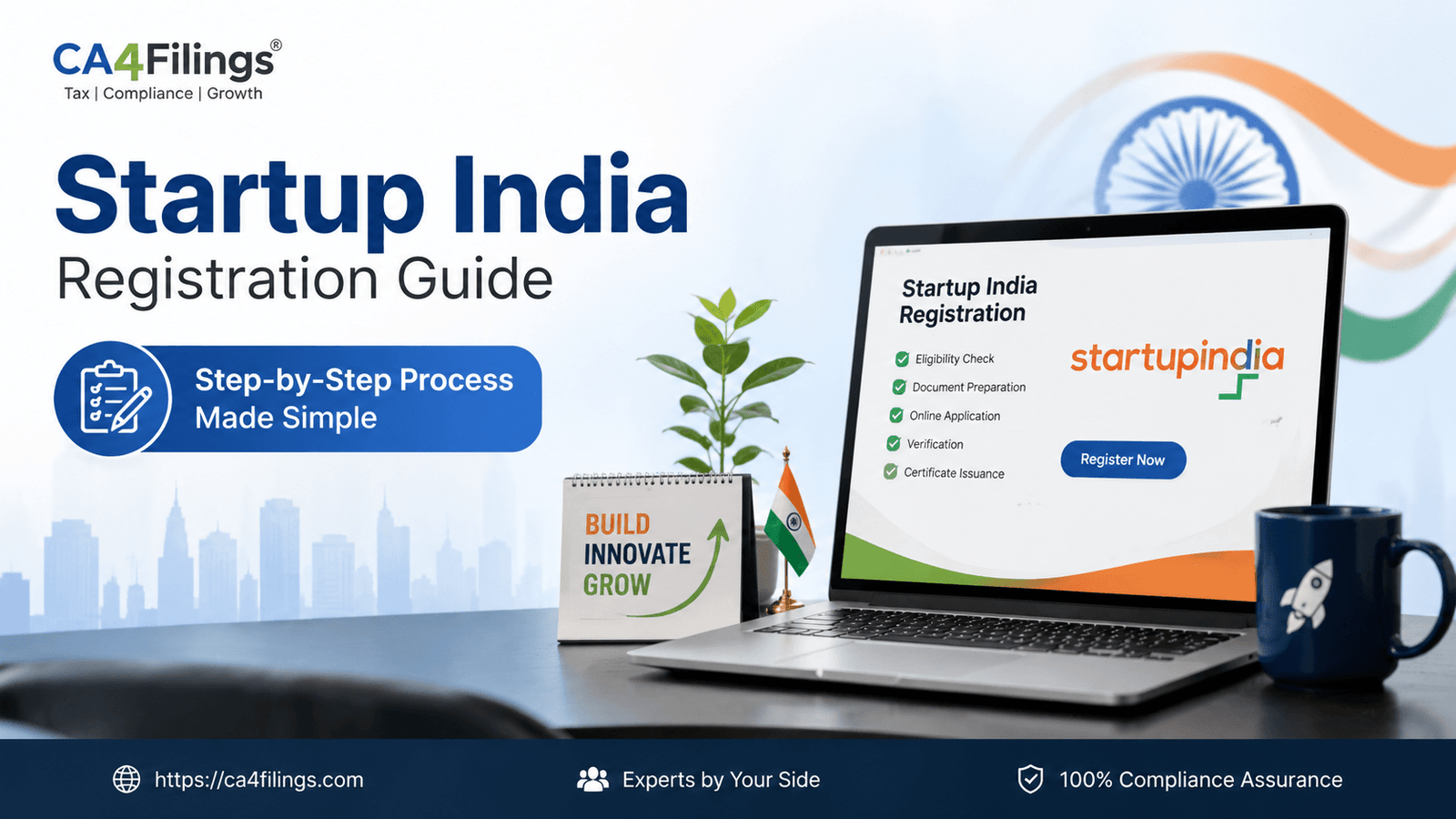
Now, let us get into the core operational steps. Many founders find the process intimidating, but when broken down systematically, it becomes completely manageable. Here is the step-by-step roadmap to successfully registering your business under this scheme.
Step 1: Incorporate Your Business First
You cannot register for Startup India if you do not have a legal entity. Your first milestone when starting a business in India is incorporating your company as a Private Limited Company or registering it as an LLP/Partnership Firm. This involves obtaining Digital Signature Certificates (DSC), Director Identification Numbers (DIN), and name approval from the Ministry of Corporate Affairs (MCA).
Step 2: Register on the Startup India Portal
Once your incorporation certificate is in hand, log on to the official Startup India portal. Create a business profile by filling in basic details about your company, industry, stage of development, and contact information.
Step 3: Apply for DPIIT Recognition
This is where the actual startup registration process takes place. You will need to fill out the online application form for DPIIT recognition. The form requires deep details about your business model, the problem you are solving, your uniqueness, and how you plan to scale.
Step 4: Submit the Required Documents
Accuracy is non-negotiable here. A single missing document or a poorly written business write-up can lead to immediate rejection. You will need to upload:
Certificate of Incorporation or Registration.
A brief write-up explaining the innovative nature of your product, process, or service.
A pitch deck, website link, or video explaining your business prototype (optional but highly recommended).
Letters of recommendation or awards (if any).
Step 5: Obtain Your Recognition Certificate
The DPIIT reviews your application. If they find your business aligns with the goals of the Indian startup ecosystem, they will issue a unique Startup Recognition Certificate. You can download this directly from the portal.
Steps to Register a Business in India: Avoid Common Mistakes
While following this Indian startup registration guide, entrepreneurs often stumble on a few critical points. Based on our years of experience at CA4Filings, here is our expert advice to ensure a smooth approval process:
Draft an Impactful Business Write-up: Do not just write a generic summary. Clearly explain how your business is innovative or how it improves an existing process. Use data, mention your target audience, and outline your monetization strategy.
Select the Right Industry Sector: Ensure your chosen sector on the portal aligns exactly with your constitutional documents (Memorandum of Association).
Keep Your Compliances Clean: Ensure your PAN, TAN, and bank accounts are properly set up immediately after incorporation to avoid validation errors during the DPIIT application.
Frequently Asked Questions (FAQs)
Can a sole proprietorship convert to a private limited company to claim Startup India benefits?
Yes. If you are currently operating as a sole proprietor, you can transition and register a business in India as a Private Limited Company or LLP. Once the new entity is incorporated, you can apply for Startup India recognition, provided you meet the eligibility criteria.
Is it mandatory to have a patent to register under Startup India?
No, a patent is not mandatory. While having a patent or a unique intellectual property application strengthens your case, you only need to prove that your business model is innovative, significantly better than existing market solutions, and capable of generating employment.
How long does it take to get the Startup India Recognition Certificate?
If all your documents are perfectly in order and your business write-up clearly demonstrates innovation, the DPIIT usually reviews and approves the application within 7 to 15 working days from submission.
What happens if my Startup India application gets rejected?
If your application is rejected due to a lack of clear information, you can re-apply. However, it is highly advisable to consult professionals like us to review your business pitch and documentation before resubmission to avoid a permanent flag on the portal.
Mastering the nuances of Understanding Startup India: A Comprehensive Guide to Registration is the ultimate first step toward transforming your innovative idea into a legally sound, tax-efficient enterprise. Navigating government schemes for startups does not have to be an overwhelming chore of paperwork and legal jargon. With the right guidance, you can secure your DPIIT certificate swiftly and start leveraging benefits designed to fast-track your growth.
At CA4Filings, we act as your virtual financial and legal partners. From initial company incorporation to securing your Startup India recognition and managing your ongoing tax compliances, our team handles the heavy lifting so you can focus entirely on your vision. Don't let compliance delays stall your dream. Contact the CA4Filings team today, and let’s build your business the right way!
Latest Updates
ca4filings.com Services
























-registration.png)