Legal Compliance for Startups: A Registration Perspective
Learn the roadmap of Legal Compliance for Startups: A Registration Perspective. Avoid costly errors and structure your Indian business efficiently.
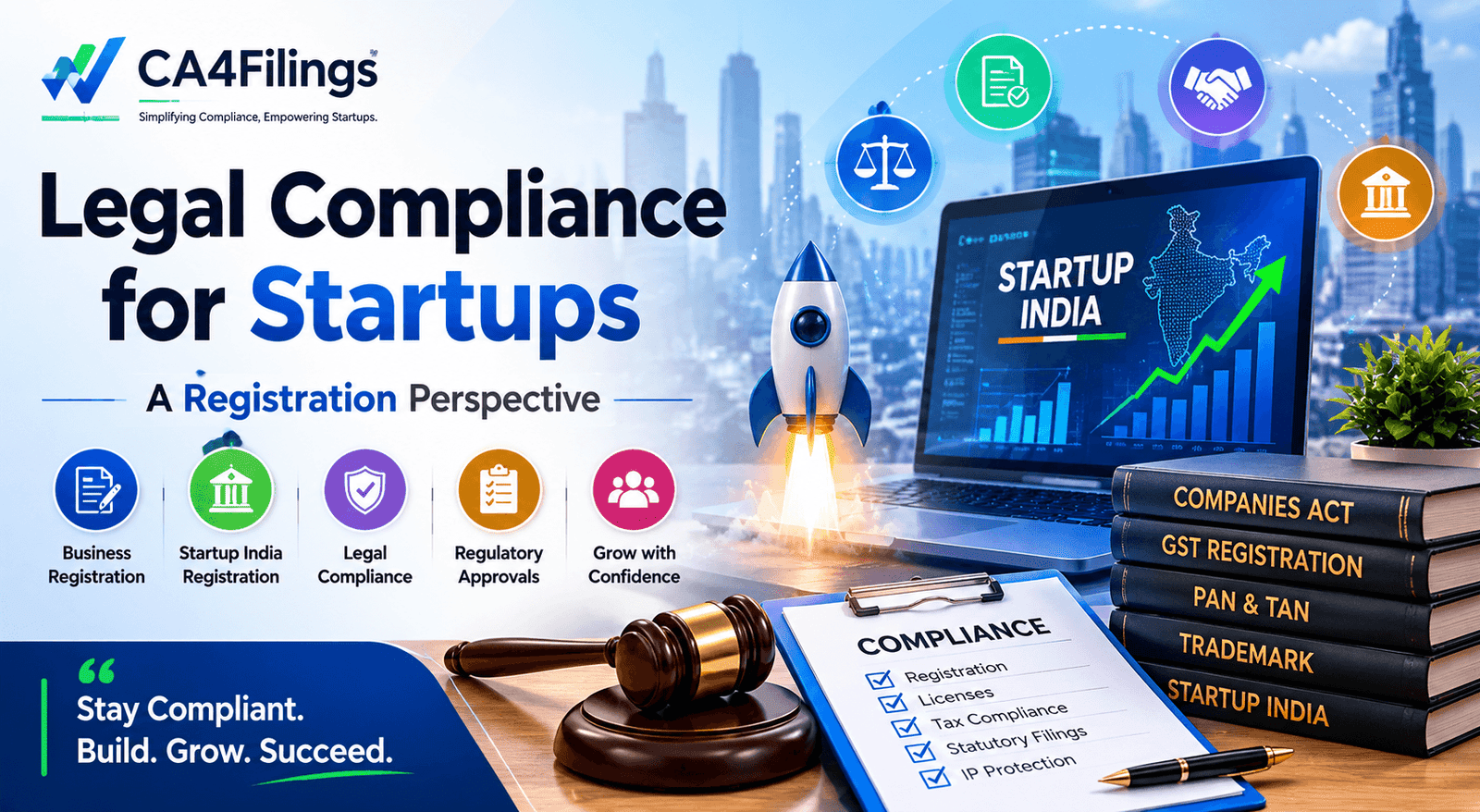
Every single week at CA4Filings, we sit across the table from enthusiastic founders who possess brilliant, ground-breaking ideas. They have built elegant tech stacks, mapped out aggressive marketing funnels, and projected impressive hockey-stick growth curves. However, when we ask them about their corporate structure, regulatory licensing, or tax registrations, the room often goes quiet. It is easy to look at compliance as a bureaucratic roadblock, but as experienced Chartered Accountants, we see it quite differently. True Legal Compliance for Startups: A Registration Perspective is actually the secret bedrock of your business. It is what transforms a casual weekend passion project into a legitimate corporate asset capable of raising venture capital, signing multi-year enterprise contracts, and scaling sustainably.
When you take your first steps into the Indian business ecosystem, navigating the complex web of business registration, municipal permits, and statutory tax departments can feel incredibly overwhelming. If you structure things poorly at day one, you build up a mountain of technical legal debt that costs ten times more to dismantle later on. To guide you seamlessly through this landscape, optimizing for the right incentives is critical. For instance, obtaining your Startup India Registration early on opens up unprecedented avenues for significant tax holidays, simplified self-compliance regimes, and government-backed funding pools that can radically fuel your startup development. Let us deep dive into this definitive guide on Legal Compliance for Startups: A Registration Perspective and break down exactly what you need to know to stay completely bulletproof.
Choosing the Right Legal Framework: The Bedrock of Registration
The first and most critical fork in the road of corporate governance is deciding what kind of legal structure will house your business. Many bootstrapped business owners make the mistake of opting for a traditional Sole Proprietorship or Partnership simply because it involves minimal upfront costs. However, from a long-term startup regulations viewpoint, these structures are completely unviable if you ever intend to raise external funding.
In India, venture capital funds and angel investors will strictly only write checks into two types of entities:
Private Limited Company (Pvt Ltd): Regulated under the Companies Act, 2013, this is the gold standard for startup operations. It offers a totally distinct legal entity separate from its owners, provides robust limited liability protection, and allows for the seamless authorized share capital allocation that makes investor equity funding rounds possible.
Limited Liability Partnership (LLP): Governed by the LLP Act, 2008, this structure combines the organizational flexibility of a regular partnership with the classic protection of limited liability. It is highly tax-efficient and features much lower ongoing corporate maintenance costs compared to a Pvt Ltd company, making it ideal for service providers or bootstrapped founders who do not need institutional venture capital right away.
The Stepping Stones of Company Registration and Initial Onboarding
Once you zero in on the precise structure that aligns with your long-term roadmap, the formal journey through business registration begins. The Ministry of Corporate Affairs (MCA) has completely revolutionized this process via integrated digital filing systems, but it still requires meticulous precision.
Here is the tactical step-by-step framework we execute daily at CA4Filings to get a new entity off the ground:
Securing Digital Signature Certificates (DSC): Because all statutory modern corporate filings are 100% paperless, the promoters must first secure authenticated cryptographic DSCs to sign off on digital documents legally.
Director Identification Number (DIN) Allocation: Every proposed director of the incoming entity must apply for and hold a unique identification number allotted by the central government.
Name Approval Application: Your corporate name must be strictly unique, non-offensive, and must not infringe upon any pre-existing trademarks. This is handled via the MCA's specialized web service.
Filing the SPICe+ Form: This single, brilliant integrated form simultaneously applies for your incorporation certificate, PAN (Permanent Account Number), and TAN (Tax Deduction and Collection Account Number).
Tax Registrations and Regulatory Compliance for Modern Operations
Getting your physical incorporation certificate is only half the battle won. To legally kickstart your day-to-day operations and execute commercial transactions without running into stiff penalties, you must address statutory tax registrations immediately.
The Goods and Services Tax (GST) Framework
Generally, if your annual aggregate domestic turnover crosses ₹40 Lakhs for goods or ₹20 Lakhs for services, obtaining a GST registration is a strict legal requirement under Indian business law. However, for digital-first startups, e-commerce vendors, or businesses engaged in inter-state trade, GST registration is completely mandatory right from day one, regardless of your actual top-line revenue. At CA4Filings, we strongly advise modern businesses to secure voluntary GST registration early on anyway, as it establishes corporate credibility and allows you to seamlessly claim Input Tax Credit (ITC) on major business expenses like office laptops, cloud servers, and vendor fees.
Professional Tax (PT) and Shops & Establishments Act
These are state-level startup regulations that vary depending on where your physical workspace is geographically situated. The Shops and Establishments Act regulates standard working hours, rest intervals, and basic employment terms, and it requires mandatory registration within 30 days of commencing work. Concurrently, Professional Tax must be paid by the business entity on behalf of its employees to the respective state treasury every single month.
An Expert CA Insight from CA4Filings: Never mix your personal bank accounts with corporate funds. The second your incorporation certificate lands, open a dedicated corporate Current Bank Account using your PAN and incorporation papers. Mixing personal and business capital destroys the legal concept of a separate legal entity and triggers severe scrutiny during tax audits.
Essential Sectoral Licenses, Permits, and Core Intellectual Property
Beyond standard corporate and tax onboarding, a complete study of Legal Compliance for Startups: A Registration Perspective demands a thorough evaluation of sector-specific business licenses and permits. If you operate in fintech, you will require specific clearances from the Reserve Bank of India (RBI). If you are building an agritech or a food-delivery platform, getting an active FSSAI license is non-negotiable. Similarly, healthcare startups must strictly comply with bio-medical waste laws and local health department permits.
Furthermore, protecting your unique brand identity is a pivotal pillar of early startup development. Registering your trademarks, patents, and copyright protection early protects your core intellectual property from being pilfered by competitors, substantially driving up your company's valuation during future investment fundraising rounds.
The Dangers of Non-Compliance: Why Procrastination Costs Fortunes
In our advisory practice at CA4Filings, we often notice founders pushing off regulatory compliance, believing they can simply sort it out when they become profitable. This is a highly dangerous trap. The Indian regulatory framework imposes severe daily compound penalties, high interest rates, and potential legal prosecution on default directors for missed compliance timelines.
Failing to file your annual financial statements or MCA returns on time can quickly lead to the formal disqualification of company directors and blacklisting of your firm. Missing your monthly TDS or GST filings halts your input credit ecosystem, completely ruining vendor relations and destroying market reputation. Regulatory compliance is not a discretionary cost; it is an foundational investment in survival.
Frequently Asked Questions (FAQs)
Q1: Can a foreign national or an NRI act as a director in an Indian Private Limited Company?
Yes, absolutely. Indian business law explicitly allows foreign nationals and NRIs to hold directorships and own equity shares. However, at least one director on the board must be a resident of India, meaning they must have stayed in the country for not less than 182 days in the previous financial year.
Q2: What is the primary difference between a Private Limited Company and an LLP regarding fundraising?
From a registration perspective, a Private Limited Company allows for the clean split and issue of shares to incoming angel or venture capital investors. An LLP, on the other hand, operates on a partner-contribution model which makes it structurally cumbersome to onboard institutional investors who want equity stock without active daily managerial duties.
Q3: How long does the entire end-to-end company registration process typically take in India?
If all your documentation (such as PAN, Aadhaar, address proofs, and utility bills) is completely clean and error-free, the corporate registration process via the MCA portal usually takes around 7 to 10 working days.
Q4: Are small bootstrapped startups completely exempt from regular compliance audits?
No, there is no blanket exemption. A Private Limited Company must undergo a mandatory statutory financial audit by an independent Chartered Accountant every single financial year, regardless of its turnover or profit status. LLPs enjoy an exemption from audit only if their annual turnover stays below ₹40 Lakhs and capital contribution is under ₹25 Lakhs.
Structuring Your Vision for Long-Term Success
Building a successful enterprise requires a beautiful balance of bold, unbridled commercial ambition and disciplined, grounded governance. When you analyze Legal Compliance for Startups: A Registration Perspective, it becomes crystal clear that compliance is not about ticking checkboxes or filling out endless government forms. Instead, it is about consciously structuring your vision, insulating your personal wealth from corporate liabilities, and signaling to your future clients, vendors, and investors that you run a premium, professional organization.
Let CA4Filings Handle Your Corporate Compliance
Don't let complex legal paperwork distract you from engineering your core product and scaling your customer base. At CA4Filings, our team of seasoned Chartered Accountants specializes in end-to-end business registration, tax optimization, and bulletproof ongoing regulatory compliance tailored explicitly for fast-growing startups. Let us build a rock-solid structural foundation for your business journey today.
Latest Updates
ca4filings.com Services



























-registration.png)