Tax Benefits for Section 8 Companies in India
Explore the key Tax Benefits for Section 8 Companies in India. Learn how 12AB and 80G registrations can help your non-profit save on taxes.
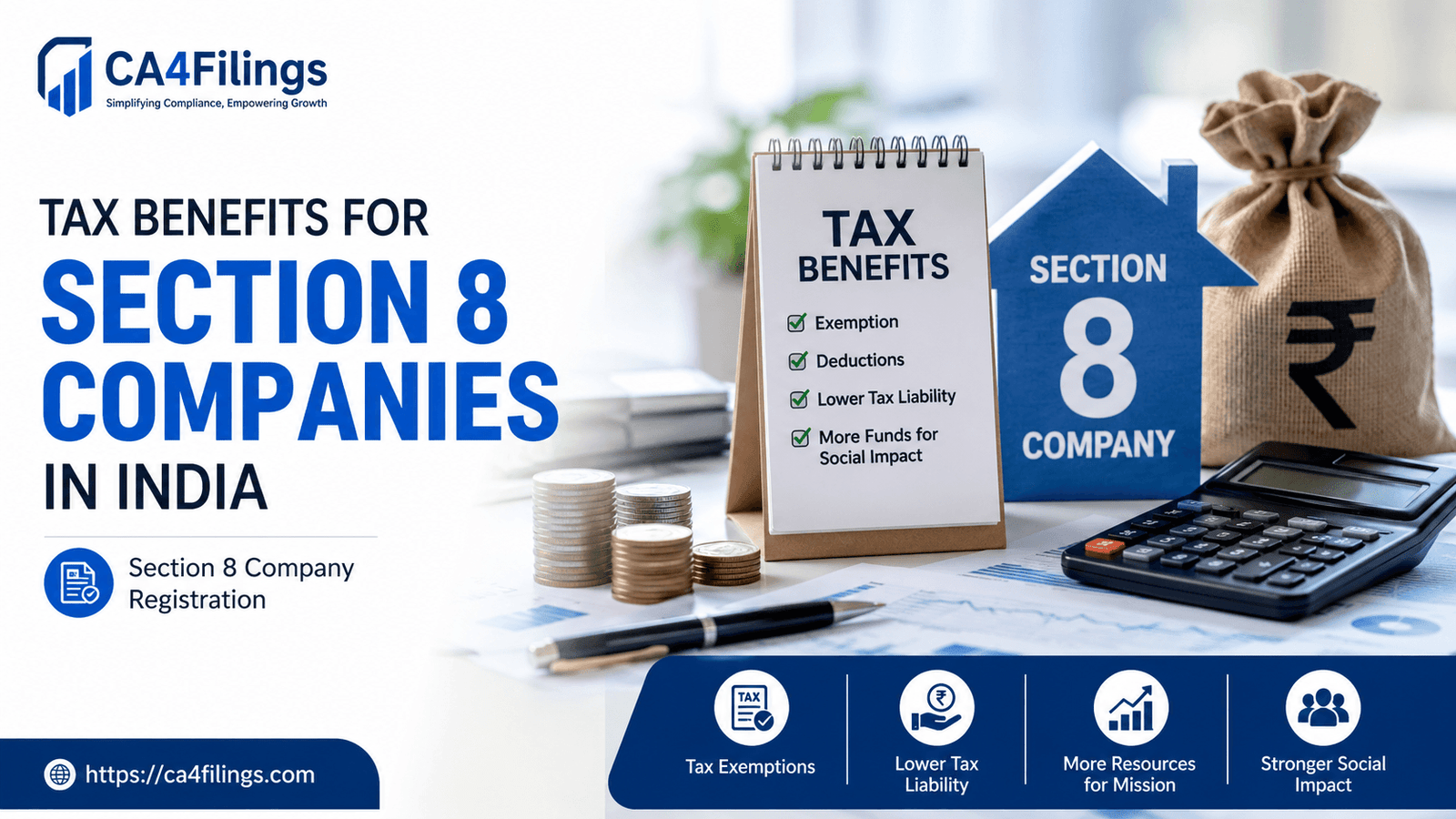
Managing a non-profit organization comes with its own unique set of challenges, but understanding the financial landscape is perhaps the most critical step toward sustainability. Many entrepreneurs who are passionate about social causes often ask me, "Is it really worth forming a non-profit entity" At CA4Filings, we always emphasize that the journey begins with getting your Section 8 Company Registration done correctly, as this serves as the foundational legal step. Once your entity is incorporated, you unlock a gateway to several Tax Benefits for Section 8 Companies in India that are specifically designed to help your organization reinvest surplus funds into its core mission rather than paying them out as corporate tax.
In this guide, I will walk you through these advantages as a Chartered Accountant, helping you navigate the tax complexities so you can focus on what truly matters: your social impact.
Understanding the Tax Framework for Section 8 Companies
It is a common misconception that simply registering as a Section 8 company automatically makes you tax-exempt. In reality, being a "not-for-profit" under the Companies Act, 2013, provides the legal framework, but tax relief is governed by the Income Tax Act, 1961. To truly leverage the Tax Benefits for Section 8 Companies in India, you must move beyond incorporation and obtain specific registrations with the Income Tax Department.
Think of it as a two-pillar system:
Pillar 1 (Registration under 12AB): This allows your organization’s income to be exempt from tax, provided you use it for the objects for which the company was formed.
Pillar 2 (Approval under 80G): This makes your organization an attractive destination for donors, as they can claim tax deductions for their contributions to your cause.
Major Tax Benefits for Section 8 Companies in India
When you operate in compliance with the law, your company can enjoy several financial advantages that significantly boost your operational efficiency.
Income Tax Exemption Under Section 12AB
This is perhaps the most significant of all Tax Benefits for Section 8 Companies in India. Once you obtain 12AB registration, your surplus income—the money remaining after meeting all your operational expenses—is not taxed as corporate profit.
The Condition: You must apply at least 85% of your income toward your charitable objectives within the financial year.
The Flexibility: If you cannot spend that 85% in a single year, you can accumulate the surplus for up to five years, provided you file the necessary forms (like Form 10) with the tax authorities.
Deductions for Donors Under Section 80G
Your donors are your lifeblood. By securing 80G approval, you offer them a tangible incentive to contribute. Donors who support your organization can claim a deduction of up to 50% of their donated amount from their taxable income, subject to certain limits. This not only builds trust with your supporters but also gives them a compelling reason to choose your organization over others.
Relief from Stamp Duty
In many states across India, Section 8 companies are granted concessions on stamp duty during the incorporation process or when acquiring property for charitable purposes. While this varies from state to state, it is a significant cost-saver when you are setting up your office or infrastructure.
Compliance: The Key to Retaining Your Benefits
As your CA, I must remind you that Tax Benefits for Section 8 Companies in India are not a "set it and forget it" feature. They come with the responsibility of strict compliance.
Maintain Proper Books: You must maintain transparent, audit-ready financial records.
File ITR-7: Unlike regular companies, Section 8 companies must file their income tax returns using Form ITR-7, which is specifically designed for trusts, charitable organizations, and non-profits.
Audit Requirements: If your total income exceeds the basic exemption limit, a mandatory audit by a Chartered Accountant is required. We at CA4Filings help many of our clients navigate these annual audits to ensure they remain in the "safe zone" of the Income Tax Department.
Frequently Asked Questions (FAQs)
Q: Are Section 8 companies completely tax-free?
A: No. They are not automatically exempt. You must obtain 12AB registration to claim income tax exemptions. If you fail to comply with the rules, your surplus could be taxed at the normal corporate rate.
Q: Can a Section 8 company generate profit?
A: A Section 8 company can certainly generate a surplus, but it cannot distribute that profit as dividends to its members. All surplus must be reinvested to achieve your social objectives.
Q: Why is 80G registration important for my fundraising?
A: It makes your organization "tax-efficient" for donors. Most corporate donors and high-net-worth individuals prefer to donate to 80G-certified entities because they can lower their own tax liability through that donation.
Q: What happens if I don't spend 85% of my income?
A: If you don't spend the mandated amount and don't file the required forms to accumulate it, that portion of the income may become taxable. It is essential to consult with your CA to manage your fund application effectively.
Securing the Tax Benefits for Section 8 Companies in India is a strategic move that provides your organization with the financial breathing room needed to create real, lasting change. While the compliance landscape can seem daunting, the long-term rewards—both for your organization’s sustainability and your donors—are well worth the effort.
Latest Updates
ca4filings.com Services



























-registration.png)