Key Differences Between Section 8 Companies and Non-Profit Organizations
Understanding the Key Differences Between Section 8 Companies and Non-Profit Organizations? Our expert guide breaks down compliance, registration, and benefits.
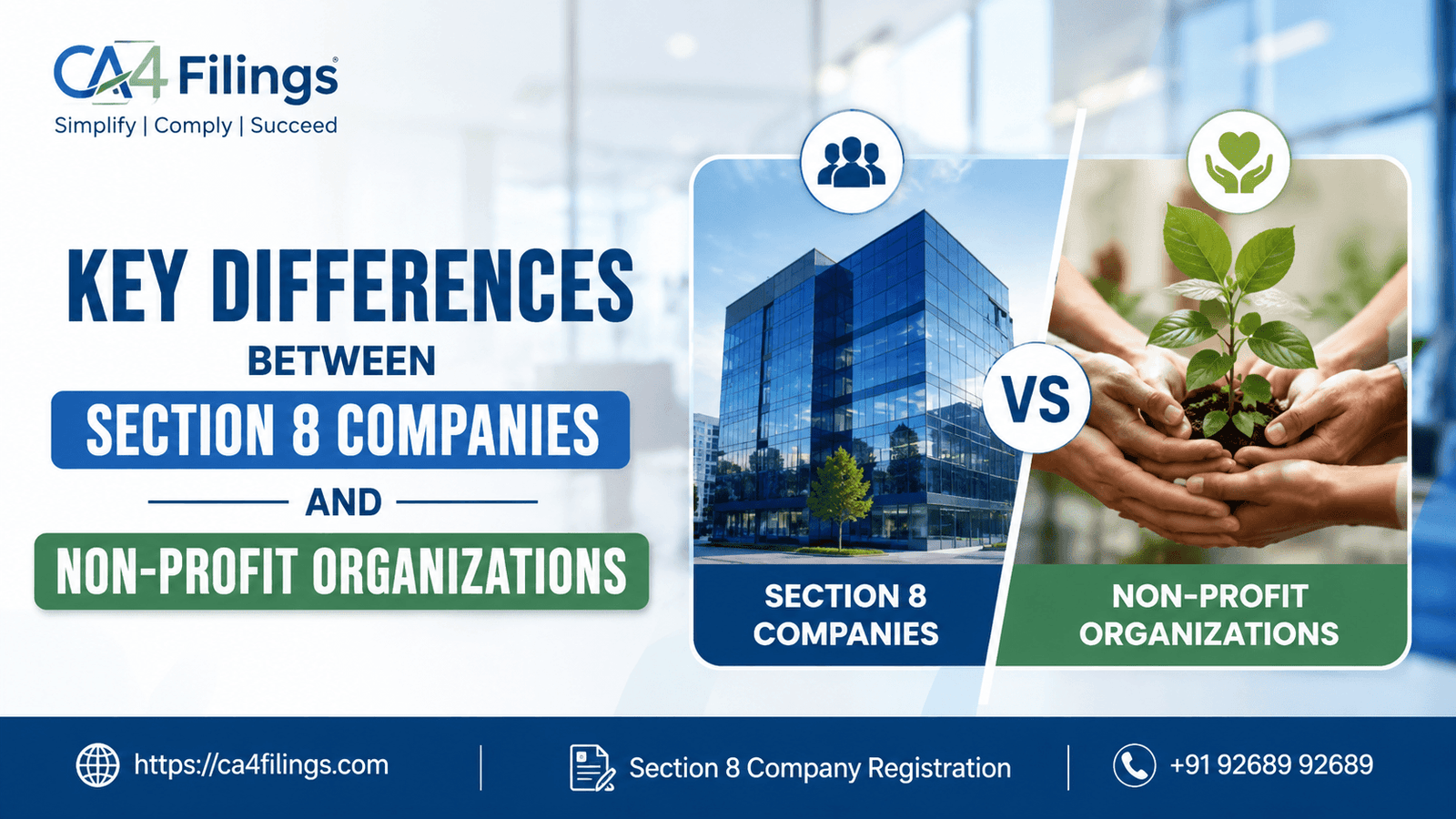
When you decide to step into the world of philanthropy in India, the most common hurdle is choosing the right legal structure. Many people use terms like "NGO" or "Non-Profit" interchangeably, but from a regulatory perspective, there are significant legal and operational nuances. If you are planning to formalize your social cause, understanding the Key Differences Between Section 8 Companies and Non-Profit Organizations is the first step toward long-term sustainability. At CA4Filings, we often help social entrepreneurs choose the right path, and if you are ready to start, our Section 8 Company Registration service ensures your paperwork is handled with absolute precision.
Whether you are looking to set up a charitable trust, a society, or a company, every structure carries different obligations under the Income Tax Act and the Companies Act. Let’s dive deep into the legal landscape to clear the fog.
What Exactly is a Non-Profit Organization (NPO) in India?
In India, the term "Non-Profit Organization" is an umbrella term. It refers to any entity formed for charitable, religious, educational, or social purposes where the profits are not distributed among members but are reinvested into the cause.
NPOs are generally structured in three primary ways:
Trusts: Often formed for charitable or religious purposes, governed by the Indian Trusts Act, 1882.
Societies: Formed by a group of people for literature, science, or fine arts, governed by the Societies Registration Act, 1860.
Section 8 Companies: Governed by the Companies Act, 2013.
The Key Differences Between Section 8 Companies and Non-Profit Organizations largely stem from the governing laws, the level of transparency required, and the perceived credibility in the eyes of donors and international funding agencies.
Comparing Structure and Governance: Key Differences Between Section 8 Companies and Non-Profit Organizations
The fundamental distinction lies in how these entities are regulated. Societies and Trusts are typically governed by state-level legislations, whereas Section 8 Companies are regulated by the Ministry of Corporate Affairs (MCA) at the central level.
1. Regulatory Framework
Societies are state-specific, meaning they are registered under the societies act of the state where they are based. Trusts are often more localized. In contrast, a Section 8 Company is a corporate entity registered under the Companies Act, 2013, making its compliance uniform across India. This central regulation is a major reason why many corporate social responsibility (CSR) initiatives prefer working with Section 8 Companies.
2. Legal Identity and Credibility
A Section 8 Company is viewed as a "body corporate." It holds a separate legal identity from its promoters, which means it can own property, sue, and be sued in its own name. Because of the stringent filing requirements with the ROC (Registrar of Companies), a Section 8 Company generally enjoys higher credibility with foreign donors and corporate sponsors compared to a small, local society.
Compliance and Reporting: Why It Matters
One of the most critical aspects when analyzing the Key Differences Between Section 8 Companies and Non-Profit Organizations is the annual compliance burden.
Section 8 Companies: You are required to file annual returns, balance sheets, and audit reports with the MCA. You must hold board meetings and maintain statutory registers. While this sounds like extra work, it provides a transparent trail that builds trust.
Societies and Trusts: While they still need to maintain accounts and file income tax returns (to claim tax exemptions under Section 12A/80G), they often have less stringent reporting requirements to a central authority. However, this "simplicity" can sometimes be a disadvantage when seeking large-scale professional funding.
Key Differences Between Section 8 Companies and Non-Profit Organizations: A Summary Table
| Feature | Section 8 Company | Society/Trust |
|---|---|---|
| Governing Law | Companies Act, 2013 | State-specific Acts |
| Regulation | Ministry of Corporate Affairs | State Registrar |
| Credibility | High (Corporate standard) | Moderate/Regional |
| Governance | Board of Directors | Trustees/Managing Committee |
| Conversion | Can convert to other types | Generally cannot |
Practical Insights for Your NGO Journey
From my experience at CA4Filings, I tell my clients that your choice should depend on your ultimate goal. If you intend to run a small, community-based welfare center with limited funds, a Trust or Society might be easier to manage initially. However, if your vision involves scaling, receiving international grants, or working with corporate CSR funds, the Section 8 model is far superior.
It is not just about the Key Differences Between Section 8 Companies and Non-Profit Organizations; it is about the "personality" you want your organization to have. A Section 8 Company carries the professional weight of a corporation while maintaining the soul of a charity.
Frequently Asked Questions
Is it difficult to manage a Section 8 Company?
Not necessarily. While it has more compliance requirements than a society, these are largely administrative. With the right CA, these filings are routine and straightforward.
Do Section 8 Companies pay taxes?
A Section 8 Company is not inherently tax-free. You must apply for and obtain registration under Section 12A and 80G of the Income Tax Act to receive tax exemptions on your income and to provide tax benefits to your donors.
Can a Section 8 Company be converted into a regular company?
No. Once you register as a Section 8 Company, your primary objective must remain charitable. You cannot shift to a profit-sharing business model.
Which is better for CSR funding?
Companies looking to fulfill their CSR mandates generally prefer donating to Section 8 Companies because of the standardized regulatory and financial transparency.
Start Your Journey with CA4Filings
Choosing between these structures can be overwhelming. You want to ensure that your legal foundation is strong so you can focus on the real work—impacting lives. At CA4Filings, we specialize in guiding social entrepreneurs through the regulatory maze.
Whether you are debating the Key Differences Between Section 8 Companies and Non-Profit Organizations or you are ready to file your incorporation papers, our team is here to provide the expert support you need. Contact us today to ensure your mission is built on a solid, compliant, and professional foundation!
Latest Updates
ca4filings.com Services
























-registration.png)