Impact of Section 8 Companies on Local Communities
Discover the profound Impact of Section 8 Companies on Local Communities. Learn how these non-profits drive social welfare and economic development in India.
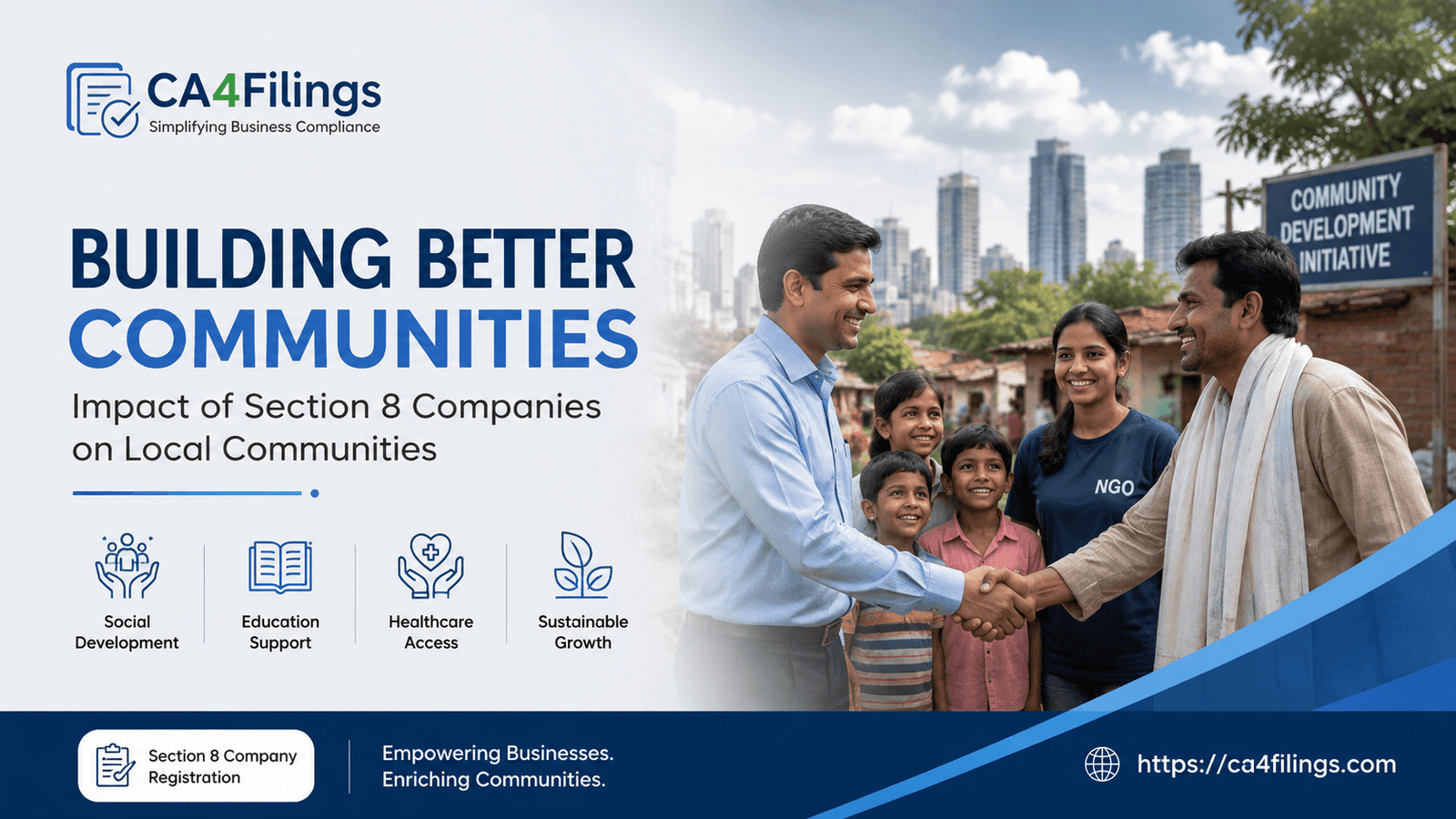
Running a business or managing personal wealth is a fulfilling journey, but there comes a point where many entrepreneurs look beyond the balance sheet. You start thinking about your social responsibility and how you can give back to society. In India, when a group of visionary individuals wants to create a lasting, structured, and highly credible non-profit setup, they choose a Section 8 company.
As Chartered Accountants, we are frequently asked how these specialized corporate structures differ from traditional trusts or societies. The answer lies in their structure and their undeniable grassroots influence. Setting up such an entity requires navigating the Ministry of Corporate Affairs (MCA) frameworks, starting with a flawless Section 8 Company Registration to ensure full statutory compliance from day one. In this comprehensive guide, CA4Filings will walk you through the profound Impact of Section 8 Companies on Local Communities and explain why they are becoming India's most powerful vehicles for social change.
Understanding Section 8 Companies and Their Core Purpose
Before looking into their community footprint, let’s simplify what a Section 8 company actually is. Governed by Section 8 of the Companies Act, 2013, it is a company formed strictly for promoting charitable objects like trade, commerce, art, science, sports, education, research, social welfare, religion, environmental protection, or charity.
The most defining feature of these nonprofit organizations is that they are legally prohibited from paying any dividends or profits to their members. Every single rupee earned—whether through public donations, government assistance, or service charges—must be completely reinvested into promoting the core objectives of the company.
The Broad Impact of Section 8 Companies on Local Communities
The localized Impact of Section 8 Companies on Local Communities is visible across both rural and urban India. Because they operate with the professional governance of a corporate entity but the heart of an NGO, they bring efficiency to social services. Here is how they transform local neighborhoods:
1. Driving Structured Social Welfare Programs
Traditional charitable models often suffer from irregular funding and ad-hoc execution. Section 8 companies, however, manage targeted social welfare programs with corporate precision. They map out community welfare requirements, set clear milestones, and execute projects professionally. Whether it is setting up free localized healthcare clinics, running mobile dispensaries, or organizing regular health camps, their operational model ensures that help reaches the grassroots level systematically.
2. Boosting Local Economic Development
Poverty alleviation cannot happen through charity alone; it requires sustainable economic empowerment. Section 8 companies act as major catalysts for local economic development.
Skill Development Centers: By launching vocational training centers, they equip unemployed youths and women with industry-ready skills like tailoring, digital literacy, and mechanics.
Micro-Entrepreneurship: Many of these entities operate self-help groups, providing small seed grants or micro-loans to help individuals launch local small businesses. This creates jobs locally and breaks the cycle of generational financial distress.
3. Enhancing Educational Accessibility
Education is a primary focal point for many non-profits. The Impact of Section 8 Companies on Local Communities is deeply felt in the educational landscape through the establishment of low-cost or free schools, remedial coaching centers, and specialized learning spaces for underprivileged children. Because they can partner with large corporate houses for Corporate Social Responsibility (CSR) funding, they successfully inject modern infrastructure—like smart classrooms and computer labs—into municipal and rural schools.
Bridging the Gap in Housing and Urban Renewal
While the term "Section 8" in western contexts like the United States specifically refers to government-subsidized housing assistance programs, housing stability, and rental assistance for low-income families, the Indian context applies a broader corporate lens to community development. However, Indian Section 8 companies also play a massive role in urban renewal, public housing support, and developing affordable housing solutions.
Through these interventions, they bring long-term housing affordability and dignity to families living in marginalized conditions.
Why Corporates and Donors Prefer Section 8 Companies
When analyzing the Impact of Section 8 Companies on Local Communities, we must look at where the money comes from. Under India's strict tax and corporate laws, large profit-making companies must spend 2% of their average net profits on CSR initiatives.
Corporates heavily prefer routeing their funds through Section 8 companies rather than unorganized trusts because of three main reasons:
Unmatched Credibility: Registered directly with the MCA, these companies undergo mandatory statutory audits and regular ROC filings, making their financial transactions transparent.
Tax Exemptions: They can easily apply for approvals under the Income Tax Act (such as regular non-profit status, 12A, and 80G registrations), allowing donors to claim valuable tax deductions.
Perpetual Succession: The organization continues to exist and execute its community programs smoothly, regardless of changes in its directors or management.
Step-by-Step: How a Section 8 Company Deploys Community Projects
To maximize the Impact of Section 8 Companies on Local Communities, a highly structured framework is followed for project execution:
Community Need Assessment: Conducting local surveys to identify gaps (e.g., lack of clean drinking water, high school dropout rates).
Resource Mobilization: Securing corporate CSR funds, public crowdfunding, or government grants.
Execution & Project Management: Deploying local teams, setting up physical infrastructure, and initiating social services.
Impact Auditing: Measuring the real-world outcome (e.g., numbers of families lifted above the poverty line, or drop-out rates reduced) to maintain transparency with stakeholders.
Frequently Asked Questions (FAQs)
Q1. Can a Section 8 company generate profits from its community activities?
Yes, it can generate profits or surplus income through nominal service charges, product sales (like items made by local artisans), or investments. However, the strict rule is that 100% of that surplus must be put right back into its social welfare programs. No dividends can be paid out.
Q2. How does the ongoing compliance of a Section 8 company protect local communities?
Strict compliance—including annual financial audits, filing forms like MGT-7 and AOC-4 with the ROC, and tracking fund usage—ensures zero misappropriation of funds. This transparency guarantees that money meant for community welfare actually reaches the people who need it.
Q3. Is there a minimum capital requirement to set up a Section 8 entity for local development?
No, the Ministry of Corporate Affairs has completely exempted Section 8 companies from any minimum paid-up capital requirements, making it highly accessible for passionate change-makers to get started.
Q4. Can a foreign donor fund a local Section 8 company's projects?
Yes, but the company must first register under the Foreign Contribution Regulation Act (FCRA). Because of their corporate-style bookkeeping, Section 8 companies find it much easier to secure FCRA clearances compared to unorganized trusts.
Let CA4Filings Help You Create an Impact
The real Impact of Section 8 Companies on Local Communities is measured by the lives transformed, the children educated, and the neighborhoods revitalized. If you possess a clear vision for social change, choosing a Section 8 corporate structure ensures your mission stands on a rock-solid legal and financial foundation.
At CA4Filings, we take the regulatory weight off your shoulders so you can focus entirely on your social initiatives. From obtaining digital signatures and securing name approvals to drafting your Memorandum of Association (MOA) and securing your final section 8 license, our expert team manages the entire process smoothly. Get in touch with CA4Filings today, and let’s build an entity that drives genuine, lasting change across our communities.
Latest Updates
ca4filings.com Services


















-registration.png)