How to Register a Section 8 Company in Multiple States
Planning to expand your non-profit? Learn How to Register a Section 8 Company in Multiple States with expert guidance from CA4Filings. Start today.
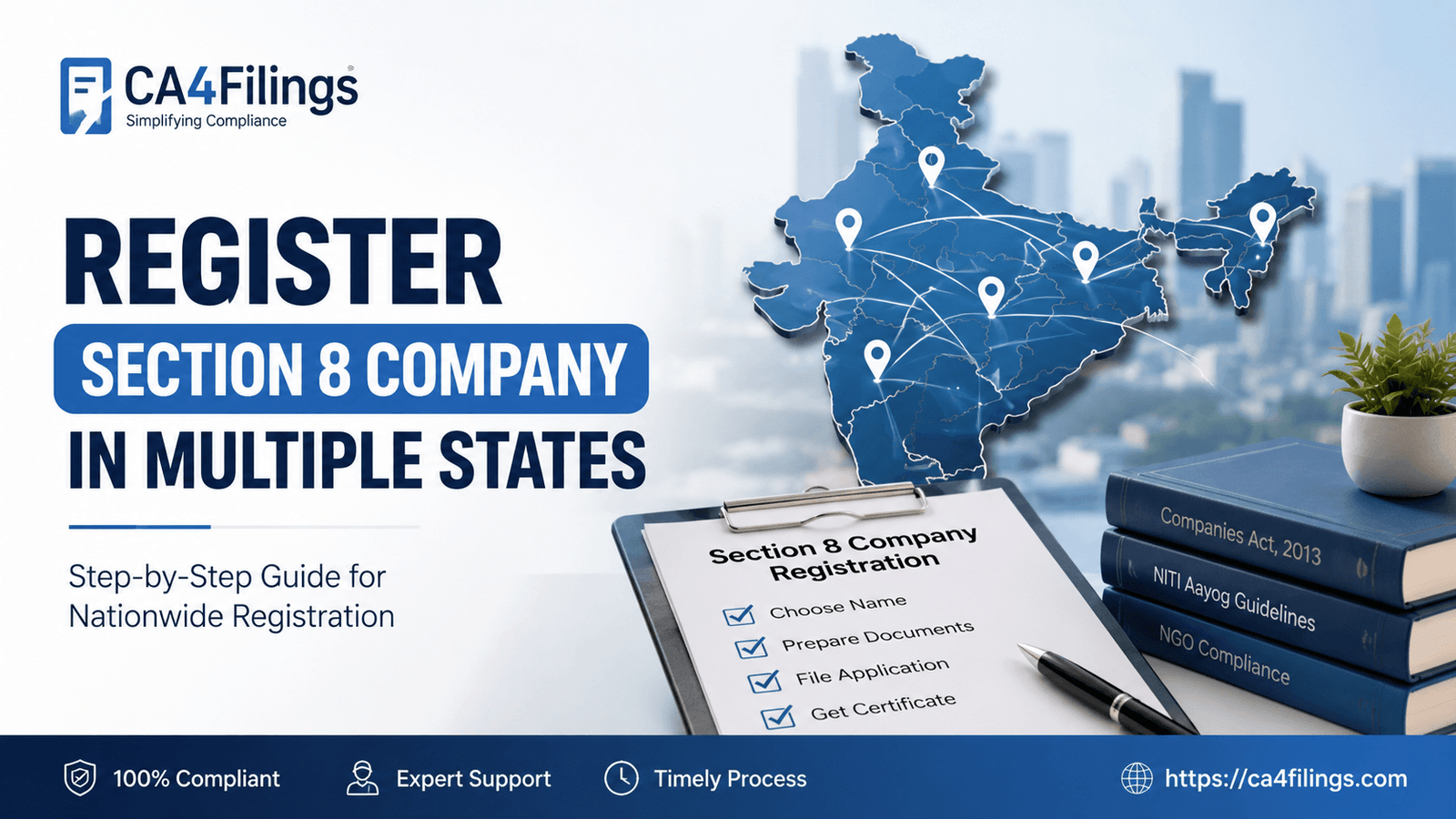
Many non-profits start small, serving a specific community in one city or state. However, as your vision grows, you may realize that your social impact needs to cross state borders. You might be wondering How to Register a Section 8 Company in Multiple States to expand your operations effectively. While the process of Section 8 Company Registration is straightforward for a single location, managing an organization that operates across diverse jurisdictions requires a clear understanding of legal compliance and regulatory requirements. At CA4Filings, we help countless NGOs navigate this path, ensuring their expansion is as impactful as their mission.
Understanding the Concept of Multi-State Operations
Before we dive into the "how-to," let’s clear up a common misconception. In India, a company registered under the Companies Act, 2013—including a Section 8 Company—is a legal entity that holds a "registered office" in one specific state. Unlike an NGO registered as a Trust or Society, which might have different rules for multi-state operations, a Section 8 Company is a national entity once incorporated.
This means you do not technically "register" the company multiple times in different states. Instead, you register your entity in one state and then expand your operations by opening branch offices or operational units in other states.
How to Register a Section 8 Company in Multiple States: The Operational Roadmap
Since you are forming a single legal entity that acts nationally, the process is focused on setting up your primary entity and then expanding your footprint. Here is how you can manage this:
1. Initial Incorporation
You must first complete the standard registration process in your home state. This involves obtaining your Certificate of Incorporation (COI), PAN, and TAN. During this stage, ensure your Memorandum of Association (MOA) and Articles of Association (AOA) are drafted broadly enough to cover activities you intend to conduct in other states.
2. Expanding Operations to New States
Once your entity is active, you don't need a new COI to operate elsewhere. However, you do need to follow these practical steps to maintain legal compliance:
Establish a Branch Office: You can open a branch office in any other state. While the Companies Act does not mandate a separate registration for a branch office, you may need to comply with local state laws, such as professional tax registrations or local municipal licenses.
Update the ROC: While you don't re-register, any significant change in your operational reach or the addition of a major office should be noted in your internal records and reported during your Annual Filings with the Registrar of Companies (ROC).
Compliance with Local Statutes: Each state has specific labor laws, local tax requirements (like Professional Tax), and local administrative regulations. As you expand, ensure you are in touch with local authorities to avoid penalties.
Why Strategic Planning Matters
When learning How to Register a Section 8 Company in Multiple States, the most critical factor isn't just the paperwork—it's the strategy. As a CA, I often advise clients that operating in multiple states increases your compliance burden exponentially.
You must ensure that your Board of Directors is equipped to oversee operations across distances. Additionally, you will need to manage your GST registrations carefully. If you are providing services or generating income in multiple states, you might be required to obtain multiple GST registrations, one for each state where you have an active place of business.
Essential Compliance Checklist for Multi-State Presence
Maintaining transparency is the backbone of a Section 8 Company. To ensure you stay on the right side of the law, keep these points in mind:
Financial Reporting: Even if you operate in ten states, your financial statements are consolidated at the head office. Ensure your accounting software tracks state-wise expenses to make your annual audit smoother.
Board Meetings: You can conduct board meetings virtually, but ensure the minutes are meticulously maintained.
Annual Filings: Your annual returns (AOC-4 and MGT-7) will cover the company’s entire operation. Make sure your data collection from branch offices is timely.
Frequently Asked Questions (FAQs)
Can I have different directors for different states?
No. A Section 8 Company is one legal entity. The Board of Directors governs the entire company, regardless of where its branches are located.
Do I need to pay separate Stamp Duty in every state?
While you don't pay "registration" fees, you may have to pay stamp duty when you lease premises for a branch office in a new state, as per the laws of that specific state.
How do I handle GST if I have offices in multiple states?
If you are generating revenue or providing taxable services in multiple states, you will generally need to obtain a separate GST registration for each of those states.
Does the name of my company change if I expand?
Not at all. Your name remains the same throughout India. Your brand identity is protected under your initial incorporation.
Understanding How to Register a Section 8 Company in Multiple States is the first step toward building a nationwide presence. It is a journey of growth, but it requires diligent attention to regulatory nuances. By keeping your documentation centralized and staying proactive with local state-specific compliances, you can focus on what truly matters: your social cause.
At CA4Filings, we specialize in making these complex processes simple for business owners. Whether you are in the initial stages of registration or looking to scale your existing non-profit across the country, our team is here to provide the expert support you need. Contact us today, and let’s grow your impact together!
Latest Updates
ca4filings.com Services


























-registration.png)