Compliance Requirements for Section 8 Companies
Navigating Compliance Requirements for Section 8 Companies? Discover our expert guide on annual filings, and deadlines to keep your NGO compliant and trusted.
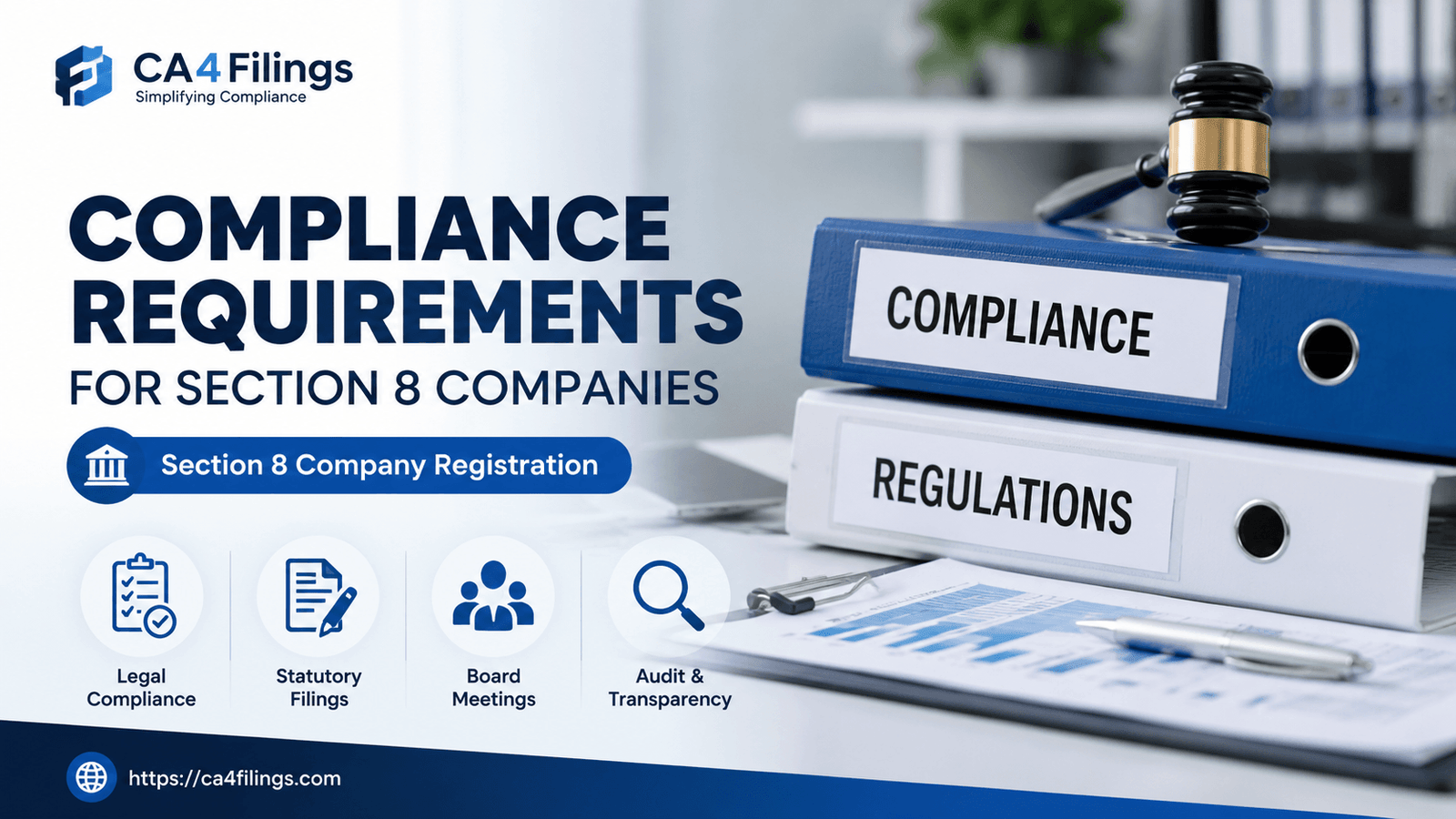
Running a non-profit organization is a noble endeavor, but navigating the legal landscape can often feel like a maze. As professionals at CA4Filings, we frequently speak with passionate changemakers who have successfully completed their Section 8 Company Registration but find themselves overwhelmed by the ongoing regulatory obligations. It is important to remember that maintaining your legal standing is just as critical as the social impact you are creating. Understanding the Compliance Requirements for Section 8 Companies is the backbone of operational transparency and long-term sustainability.
When you incorporate as a Section 8 company, you aren’t just a business; you are a steward of public trust. The Ministry of Corporate Affairs (MCA) mandates strict adherence to the Companies Act, 2013, to ensure that funds are used solely for charitable objectives. Ignoring these rules can lead to heavy penalties, director disqualification, or even the loss of your charitable license. Let’s break down the essential Compliance Requirements for Section 8 Companies to keep your organization running smoothly and compliantly.
The Importance of Staying Compliant
Compliance isn't just about filing forms; it's about building credibility. Donors, government bodies, and potential partners look for organizations with a clean, transparent track record. If your filings are delayed, your reputation takes a hit, making it harder to secure grants or CSR funding. Furthermore, staying on top of the Compliance Requirements for Section 8 Companies helps you avoid the dreaded "non-compliance" penalties, which are calculated on a daily basis and have no upper limit.
Key Annual Compliance Requirements for Section 8 Companies
Every financial year, there is a standard set of actions you must complete. Think of this as your organization’s annual health check-up.
Appointment of an Auditor: Every Section 8 company must appoint a statutory auditor within 30 days of incorporation and subsequently at each Annual General Meeting (AGM). Filing Form ADT-1 is the primary step here.
Maintenance of Books of Accounts: You must keep accurate records of all financial transactions. This includes income, expenses, and donation logs.
Holding Meetings: A Section 8 company must hold at least two board meetings annually (with a maximum gap of 120 days between them) and one Annual General Meeting (AGM) within six months of the financial year-end.
Filing Financial Statements (AOC-4): You are required to file your audited balance sheet and profit-and-loss account with the Registrar of Companies (RoC) within 30 days of your AGM.
Filing Annual Returns (MGT-7/7A): This form provides the RoC with details about your directors, shareholders, and shareholding patterns. It must be filed within 60 days of the AGM.
Income Tax Filings: Even if you are tax-exempt, you must file your annual Income Tax Return (usually ITR-7) by September 30th to maintain your 12A and 80G statuses.
Director KYC: All directors holding a DIN (Director Identification Number) must file their DIR-3 KYC annually by September 30th to keep their DIN active.
Event-Based Compliance: What You Need to Know
Beyond annual tasks, the Compliance Requirements for Section 8 Companies include event-based filings. These are triggered whenever a significant change happens within your organization.
Changes in Directorship: If a director is appointed or resigns, you must file Form DIR-12 within 30 days.
Registered Office Change: Moving your office? File Form INC-22 within 30 days of the shift.
Amendment to MoA or AoA: Any changes to your objectives or rules require a special resolution and filing Form MGT-14.
New Auditor: If you need to change your auditor mid-term, specific forms must be filed to intimate the RoC.
Practical Tips for Success
As your partners at CA4Filings, we suggest adopting a "compliance-first" culture:
Maintain a Compliance Calendar: Mark all due dates (AGM, ITR, MCA filings) on a shared calendar to avoid last-minute panic.
Separate Finances: Never commingle personal funds with your organization’s bank accounts. Use a dedicated corporate account for all NGO activities.
Digital Vigilance: Keep your Digital Signature Certificates (DSCs) updated and secure.
Expert Oversight: Given the technical nature of forms like AOC-4 and MGT-7, always consult with a qualified professional to avoid errors that could lead to scrutiny.
Frequently Asked Questions (FAQs)
What is the penalty for missing an annual filing deadline?
Non-compliance often leads to a penalty of ₹100 per day for each day of default. There is no upper cap on this amount, and it can grow significantly over time, becoming a major financial burden for non-profits.
Do Section 8 companies need to hold board meetings if they have no activity?
Yes. The Companies Act mandates board meetings regardless of the volume of activity. Even if your organization is currently dormant, you must fulfill the basic statutory meeting requirements to avoid being marked as a defaulting entity.
Is an audit mandatory for all Section 8 companies?
Absolutely. Unlike some other entities, every Section 8 company is required to have its accounts audited by a Chartered Accountant every year, regardless of its turnover or financial scale.
What happens if I don't file the Director's KYC?
If you fail to file the DIR-3 KYC on time, the MCA will deactivate your DIN. This prevents you from filing any forms for the company and can even lead to your disqualification as a director.
Managing the Compliance Requirements for Section 8 Companies may seem daunting, but it is the key to ensuring your organization remains a force for good. By staying proactive and organized, you protect your vision and ensure that your NGO remains a trusted entity in the eyes of the law and your supporters.
If you ever feel lost in the paperwork, remember that CA4Filings is here to support you. We specialize in simplifying corporate law for non-profits so you can focus entirely on your mission. Reach out to our expert team today, and let us handle your regulatory needs with the precision and care your organization deserves.
Latest Updates
ca4filings.com Services
























-registration.png)