Key Forms Required for ROC Compliance and Their Purpose
Understand the Key Forms Required for ROC Compliance and Their Purpose to safeguard your company from heavy penalties. Read our expert CA guide.
Running a successful corporate entity in India is an exhilarating journey, but it comes with a bundle of statutory responsibilities. As practicing Chartered Accountants at CA4Filings, we often interact with enthusiastic founders who pour their hearts into product development and sales, yet overlook a critical backend operation: regulatory filing. Under the Companies Act, 2013, every registered company must regularly update the Registrar of Companies (ROC) about its financial health, management updates, and structural changes. Staying on top of these statutory updates requires a thorough grasp of the Key Forms Required for ROC Compliance and Their Purpose. Failing to submit these filings on time is no longer a minor oversight; the Ministry of Corporate Affairs (MCA) has drastically intensified late fees and compliance crackdowns, making regulatory discipline absolutely non-negotiable for modern enterprises.
For small and medium enterprise owners, navigating the labyrinth of the Ministry of Corporate Affairs portal can feel incredibly daunting. To simplify your corporate journey, our team provides an end-to-end ROC Compliance Service that manages your annual submissions seamlessly, letting you focus entirely on scaling your core business operations. Understanding the foundational ROC compliance requirements is the first step toward building an audit-ready, institutional organization. Let us dive deep into the essential ROC compliance documents, timelines, and specialized filing procedures that keep your corporate license active and pristine.
The Core Annual ROC Compliance Forms and Their Purpose
Annual filings represent the financial and structural health report card of your company. Regardless of your annual turnover or operational state—even if your company has zero operational revenue during a financial year—submitting these ROC compliance forms remains legally mandatory.
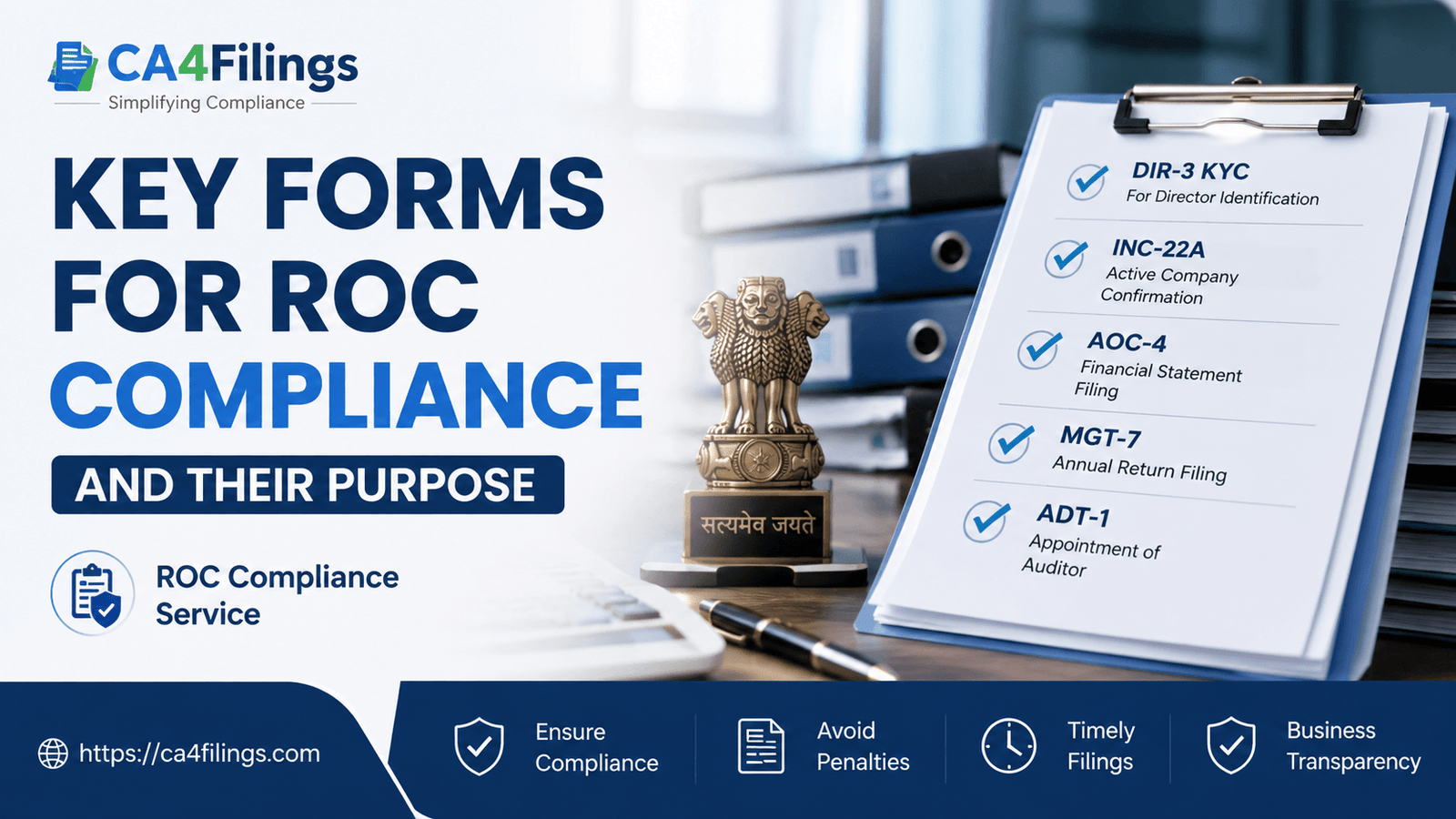
1. Form MGT-7 / MGT-7A: The Annual Return
Form MGT-7 is a comprehensive annual return that contains detailed structural information about your company as of the close of the financial year. For Small Companies and One Person Companies (OPCs), the MCA introduced a simplified variant known as Form MGT-7A to ease the regulatory burden.
Purpose: It acts as an official record of the company’s management framework, registered office configuration, shareholding structure, details of promoters, continuous transfer of shares, board meetings conducted, and remuneration paid to directors.
Due Date: Must be filed within 60 days from the date of the Annual General Meeting (AGM). Since the standard deadline to host an AGM is September 30th, the typical due date for MGT-7 falls on October 29th.
Expert Advice: Ensure your shareholding pattern perfectly tallies with your internal cap table. Any discrepancy between your internal registers and Form MGT-7 can trigger unexpected scrutiny during future fundraising rounds.
2. Form AOC-4: Filing Financial Statements
If MGT-7 represents the structural backbone, Form AOC-4 is the financial mirror of your corporate entity. Every registered company must file its audited financial statements through this medium.
Purpose: To submit the company's Balance Sheet, Profit and Loss Account, Director’s Report, Auditor’s Report, and Corporate Social Responsibility (CSR) details to the ROC.
Due Date: Must be filed within 30 days from the conclusion of your AGM, making October 30th the standard filing deadline for most businesses.
Practical Insight: Specific classes of companies—such as listed entities or those with a paid-up capital above INR 5 Crores or turnover above INR 100 Crores—must submit their financial details via Extensible Business Reporting Language (XBRL) format.
Event-Based ROC Compliance Documentation
Beyond annual routines, corporate entities must inform the Registrar about internal structural transformations. These are known as event-based ROC compliance documents, and their deadlines are strict, usually capped at 15 to 30 days from the date of the event.
Form ADT-1 (Auditor Appointment): Used for the official appointment or replacement of the Statutory Auditor. This must be submitted within 15 days of the AGM where the auditor is appointed.
Form DIR-12 (Management Changes): Filed to notify the ROC about the appointment, resignation, or change in designation of Directors or Key Managerial Personnel (KMP). It must be filed within 30 days from the effective date of the change.
Form INC-22 (Registered Office Shift): Required when a company changes or shifts its Registered Office address. It must be filed within 30 days of passing the structural board or special resolution.
Form PAS-3 (Return of Allotment): When raising fresh capital or equity, a return of allotment of shares must be filed via this form within 30 days from the allotment date.
Form SH-7 (Alteration of Capital): Filed as a notice to the Registrar for an alteration of Authorized Share Capital within 30 days of passing the necessary special resolution.
Crucial Administrative and Governance Essentials
A comprehensive ROC compliance checklist includes ongoing governance forms designed to monitor tracking metrics, eliminate corporate fraud, and protect minority shareholders.
Form DIR-3 KYC: Director Verification
Every individual holding a Director Identification Number (DIN) must complete an annual KYC verification process. This is one of the most critical ROC compliance guidelines to remember, as missing it results in the immediate deactivation of the director's DIN and a steep penalty of INR 5,000. The filing is mandatory even if a director has resigned from a company during the year, provided their DIN remains active. The fixed deadline for this submission is September 30th every year.
Form MSME-1: Monitoring Vendor Payment Cycles
To safeguard the interests of small enterprises, the government requires companies to submit half-yearly returns detailing outstanding dues to MSME vendors. If your company has delayed payments to an MSME vendor beyond 45 days, you must declare the outstanding amount and the reasons for delay via Form MSME-1 twice a year (by October 31st and April 30th).
The Cost of Ignorance: Penalties and Risks
Adhering to ROC compliance for businesses is no longer just a legal recommendation; it is an economic necessity. The financial implications of delaying your statutory updates are severe:
Standard Additional Fee: Missing the due date for forms like AOC-4 or MGT-7 attracts a fixed daily penalty of INR 100 per form. For a company that misses its annual filings by six months, this translates into an avoidable expenditure of tens of thousands of rupees.
Striking Off and Disqualification: If a company fails to file its annual returns for two consecutive financial years, the ROC has the statutory power to strike off the company's name from the active register. Furthermore, the directors of such non-compliant entities risk being disqualified for five years, freezing their ability to manage any other corporate board across India.
Structuring Your Compliance Framework
Understanding the Key Forms Required for ROC Compliance and Their Purpose empowers founders to avoid unnecessary legal traps and preserve corporate goodwill. Clean corporate governance acts as a magnet for institutional investors, venture capitalists, and banking entities. Proactive alignment with ROC compliance procedures transforms legal obligations into a strategic competitive advantage.
At CA4Filings, we handle your entire ROC compliance workflow—from compiling documentation to final submission. Our team of experienced Chartered Accountants and Company Secretaries ensures your corporate records remain flawless, compliant, and up to date. Contact CA4Filings today for a comprehensive corporate health check, and let our experts secure your peace of mind while you grow your business.
Frequently Asked Questions (FAQs)
1. Is ROC filing mandatory for a company with no business activity?
Yes, absolutely. Even if your company is completely inactive, dormant, or has generated zero revenue during a financial year, filing Form AOC-4 and Form MGT-7 (or MGT-7A) remains legally mandatory until the company is formally struck off the MCA register.
2. What happens if a director fails to file Form DIR-3 KYC?
If the DIR-3 KYC is not filed by the September 30th deadline, the MCA deactivates the director's DIN, marking it as "DIN Deactivated due to non-filing of DIR-3 KYC." To reactivate the DIN, a late fee of INR 5,000 must be paid along with the relevant submission.
3. Can a company file its annual ROC forms before hosting an AGM?
No, annual forms like AOC-4 and MGT-7 explicitly require details regarding the date of the AGM and the approval of financial statements by the shareholders. Therefore, hosting the AGM is a strict prerequisite before initiating annual ROC filings.
4. What is the difference between Form MGT-7 and Form MGT-7A?
Form MGT-7 is the standard annual return required for medium and large public or private limited companies. Form MGT-7A is an abridged, simplified version introduced by the MCA specifically for One Person Companies (OPCs) and Small Companies to reduce their compliance burden.
Would you like to review or refine the specific penalty structures, or are there any additional corporate forms you would like to include in this guide?
Latest Updates
ca4filings.com Services


























-registration.png)