Key Dates to Remember for ROC Compliance Throughout the Year
Stay penalty-free with our guide on Key Dates to Remember for ROC Compliance Throughout the Year. Keep your Indian company legally secure.
Running a business in India is an exhilarating journey. You are chasing growth, managing teams, and building a brand. But amidst the daily hustle of scaling up, there is one silent engine that keeps your business legally alive: compliance.
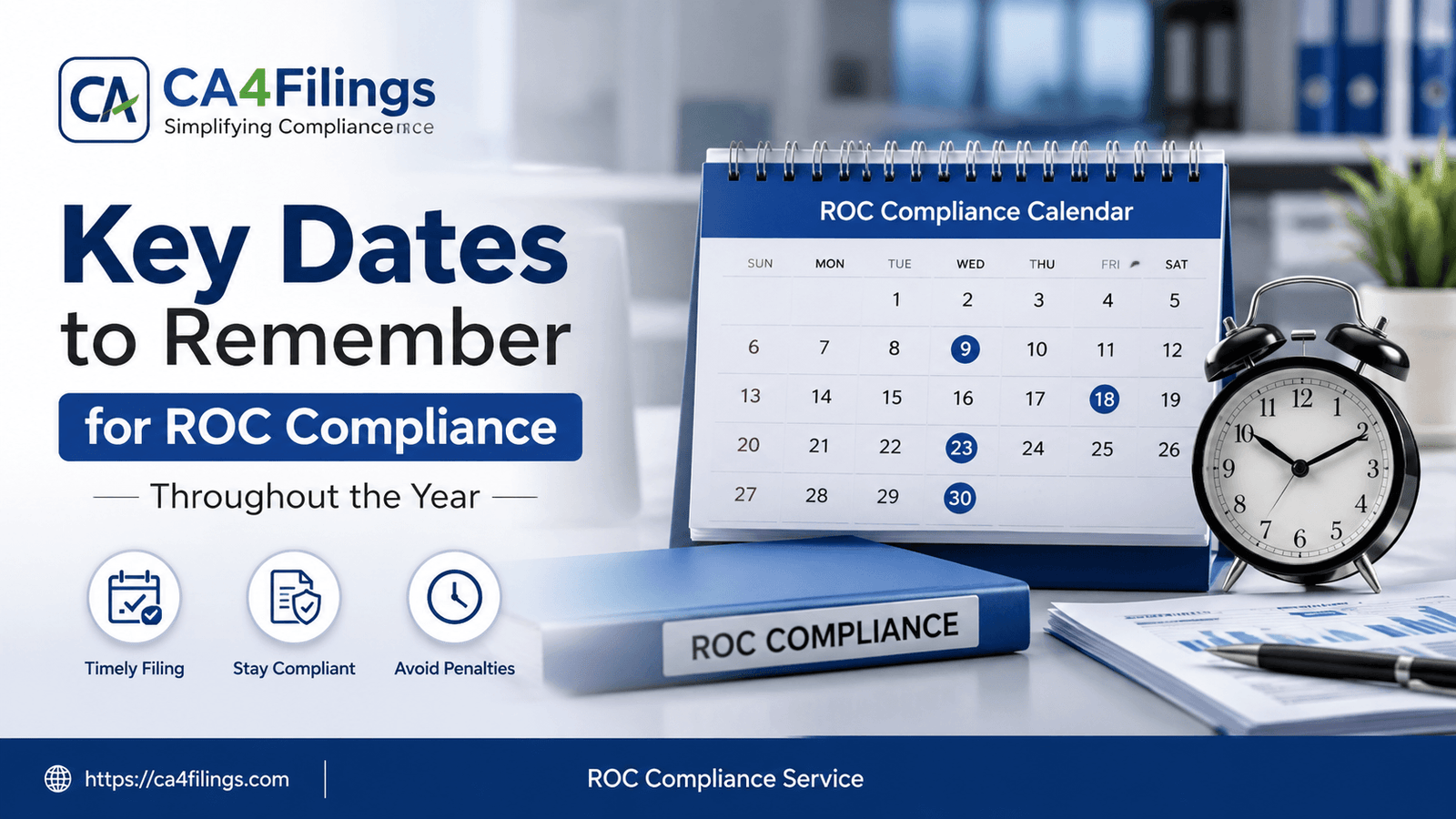
As corporate consultants, we often see enthusiastic founders face steep, unnecessary penalties simply because they missed a deadline. Missing a filing with the Registrar of Companies (ROC) is not just a paperwork delay; it impacts your company's active status, your eligibility for loans, and your peace of mind. Keeping track of the Key Dates to Remember for ROC Compliance Throughout the Year is the easiest way to ensure your corporate engine runs smoothly.
At CA4Filings, we understand that tracking these shifting deadlines can be overwhelming for a business owner. That is why our comprehensive ROC Compliance Service is designed to take the regulatory weight off your shoulders, leaving you completely free to focus on what you do best—growing your business. Let us break down the essential compliance obligations, timelines, and practical strategies to keep your company fully protected.
Understanding ROC Compliance and Its Importance
Before we look at the calendar, let’s establish what ROC Compliance actually means. Every registered company in India, whether a private limited company, a public limited company, or a One Person Company (OPC), is governed by the Companies Act, 2013. The ROC, operating under the Ministry of Corporate Affairs (MCA), acts as the watchdog for these businesses.
Adhering to ROC Regulations is not an optional administrative task; it is the backbone of Corporate Governance. Proper compliance builds trust with investors, financial institutions, and vendors. Think of it as a health checkup for your firm. When your Corporate Filings are up to date, your company maintains its "Active" status, shielding directors from disqualification and protecting the business from crippling daily penalties.
The Foundation: Continuous Board and Corporate Meetings
Company compliance is not a once-a-year event. It begins with regular corporate internal tracking. Your Compliance Checklist must always account for ongoing event-based triggers alongside the usual annual filings.
Board Meetings
Every company must hold its first Board Meeting within 30 days of incorporation. Subsequently, a minimum of 4 Board Meetings must be held every calendar year. The maximum gap between two consecutive board meetings cannot exceed 120 days. For small companies and OPCs, holding at least one meeting in each half of a calendar year (with a gap of at least 90 days) satisfies the rule.
The Annual General Meeting (AGM)
The AGM Due Date is perhaps the most critical anchor on your compliance calendar.
First AGM: Must be held within 9 months from the closing of the first financial year.
Subsequent AGMs: Must be held within 6 months from the closing of every financial year (which means by September 30th). The gap between two AGMs cannot exceed 15 months.
Month-by-Month Key Dates to Remember for ROC Compliance Throughout the Year
To help you plan, here is a structured timeline of the essential Filing Deadlines for a standard financial year (April 1st to March 31st).
April to June: Setting the Baseline
The start of the financial year focuses heavily on disclosure and auditor confirmations.
April 30 (Form MSME-1): Half-yearly return for companies having outstanding payments to Micro and Small Enterprises exceeding 45 days. This first half covers the period from October to March.
May 30 (Form PAS-6): Applicable to unlisted public companies for the reconciliation of share capital audit report on a half-yearly basis.
June 30 (Form DPT-3): Every company (except government entities) must file this return to disclose its outstanding loans, deposits, or receipts that are not considered deposits as of March 31st. Missing this can attract heavy non-compliance flags.
July to September: The KYC and AGM Rush
This quarter demands high vigilance from your Company Secretary or financial advisor.
September 30 (Form DIR-3 KYC): Every individual holding a Director Identification Number (DIN) as of March 31st must submit their KYC details. Even if a director is disqualified or not actively managing operations, the KYC is mandatory. Failure to do so deactivates the DIN, carrying a flat reactivation fee of ₹5,000.
September 30 (The Ultimate AGM Deadline): This is the final date to hold your annual general meeting to adopt the audited financial statements of the preceding fiscal year.
October to December: The Peak Financial Filing Window
Once the AGM concludes, the actual Annual Returns and financial reports must be submitted directly to the Registrar.
October 30 (Form AOC-4): Financial statements, including the Balance Sheet, Profit & Loss Account, Director’s Report, and Auditor’s Report, must be filed within 30 days of the AGM.
October 31 (Form MSME-1 - Second Half): The second half-yearly return regarding outstanding MSME dues (for the April to September period).
November 29 (Form MGT-7 / MGT-7A): The formal Annual Return containing details of shareholding structure, directorship changes, and corporate transfers must be filed within 60 days of the AGM. Smaller companies use the simplified Form MGT-7A.
November 30 (Form PAS-6 - Second Half): Unlisted public companies must submit their second half-yearly share capital reconciliation.
Penalties and Risks of Non-Compliance
Ignoring these Important Dates is an expensive mistake. The MCA has automated its enforcement systems, meaning penalties accrue instantly without human intervention.
Late Filing Fees: Forms filed after their respective deadlines attract an additional fee of ₹100 per day, per form. If multiple forms are delayed by a few months, these costs compound rapidly into tens of thousands of rupees.
Director Disqualification: If a company fails to file its financial statements or annual returns for three consecutive financial years, its directors face disqualification for 5 years.
Striking Off: The ROC retains the authority to strike off a company from its register if it believes the entity is no longer operational, usually triggered by a continuous failure to file annual returns.
Expert Practical Advice for Business Owners
Managing Statutory Compliance does not have to be a source of stress. Over the years, CA4Filings has helped hundreds of entrepreneurs streamline their Legal Compliance using a few core practices:
Do Not Wait for the Deadline: Server bottlenecks on the MCA portal are incredibly common during the final weeks of September, October, and November. Aim to close your books and audit by July or August.
Track Event-Based Changes: Remember that structural updates—such as changing your registered office, appointing or resigning a director, or altering share capital—have their own strict 15 to 30-day filing timelines from the date of the event.
Appoint Trusted Professionals: Trying to handle technical filings on your own often leads to formatting errors or incorrect disclosures. Work with experienced chartered accountants who can act as your proactive compliance partners.
Frequently Asked Questions (FAQs)
1. What happens if I miss the AGM deadline of September 30th?
If your company cannot hold its AGM by the specified date, you must apply for an extension using Form GNL-1 with the ROC well in advance, detailing valid reasons. Holding an AGM late without prior approval constitutes a violation and requires a formal compounding process to rectify.
2. Is ROC annual filing mandatory for a company that has no business activity?
Yes. Even if your company did not execute a single transaction or generate any revenue during the financial year, it is legally alive. You must file "Nil" returns for Form AOC-4 and Form MGT-7/7A to preserve your clean compliance record. Alternatively, you can apply for "Dormant Status" if you plan to keep the company inactive intentionally.
3. What is the difference between AOC-4 and MGT-7?
Form AOC-4 is used to submit the financial performance details of the business (balance sheets, auditor statements, and financial notes). Form MGT-7 focuses on management and ownership metadata, tracking your shareholding patterns, list of directors, and compliance certifications.
4. Can a company file its annual returns if director KYC is pending?
If a director’s DIN is deactivated due to a missed DIR-3 KYC filing, the MCA portal will block the submission of any company forms where that director's signature is required. You must clear the director's KYC penalty first to restore the DIN before proceeding with corporate filings.
Navigating the vast web of regulatory dates can feel like an extra burden when you are focused on building your business. However, keeping tabs on the Key Dates to Remember for ROC Compliance Throughout the Year remains non-negotiable for long-term survival and success. Proactive compliance is significantly cheaper, smoother, and less stressful than reacting to sudden legal notices or penalty accumulation.
Latest Updates
ca4filings.com Services























-registration.png)