How to Submit Special Resolutions to the ROC Effectively
Learn How to Submit Special Resolutions to the ROC Effectively. Avoid penalties with our step-by-step MGT-14 filing guide for company compliance.
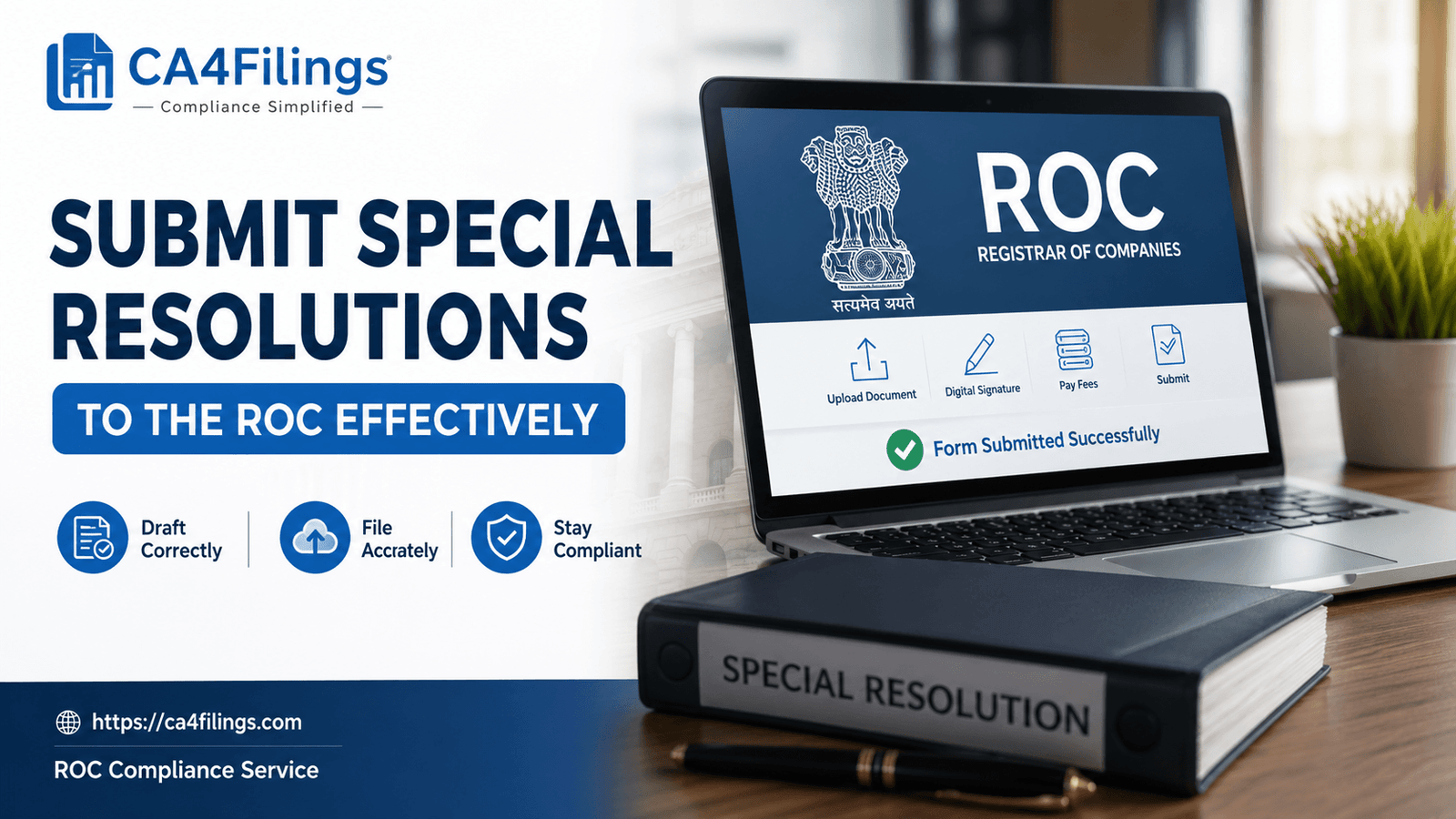
Managing a company in India comes with a regular stream of compliance requirements. Whether you are planning to change your company’s name, alter the object clause of your Memorandum of Association (MOA), or approve a loan to a director, routine board meetings aren't always enough. For major, high-impact decisions, the Companies Act, 2013 mandates a higher threshold of shareholder approval known as a Special Resolution. Knowing How to Submit Special Resolutions to the ROC Effectively is critical to keeping your corporate status active and avoiding steep penalties. At CA4Filings, we handle these statutory obligations daily, helping businesses navigate complex legal pathways effortlessly. Partnering with a dedicated professional for your ROC Compliance Service ensures that every corporate shift you make is executed smoothly, legally, and within the stipulated timelines.
In this comprehensive guide, we will break down the exact roadmap, practical challenges, and step-by-step procedures to submit special resolutions without receiving those dreaded resubmission notices from the Ministry of Corporate Affairs (MCA).
What Exactly is a Special Resolution?
Before diving into the resolution submission process, let’s establish what a special resolution actually is. Under Section 114(2) of the Companies Act, 2013, a resolution is classified as a special resolution when the votes cast in its favor by members are not less than three times the number of votes cast against it. In simple words, you need a minimum of 75% majority approval from the shareholders voting on the matter.
Corporate resolutions act as the official voice of your company's stakeholders. While ordinary resolutions require a simple majority (>50%), special resolutions are reserved for critical company procedures that fundamentally alter the business structure or governance.
Key Scenarios Requiring a Special Resolution
As part of your routine company compliance, you must identify which business decisions trigger the special resolution procedure. Here are the most common instances:
Changing the registered office of the company from one state to another.
Altering the Articles of Association (AOA) or Memorandum of Association (MOA).
Buyback of shares or reduction of share capital.
Section 186 approvals for loans and investments exceeding prescribed limits.
Voluntary winding up of the company.
If your company is executing any of these actions, you must follow the correct resolution submission guidelines to ensure legal validity.
Step-by-Step Guide: How to Submit Special Resolutions to the ROC Effectively
Filing special resolutions requires meticulous documentation and strict adherence to timelines. A single oversight can lead to your form being rejected or marked for resubmission by the Registrar of Companies. Here is the step-by-step corporate protocol to follow:
Step 1: Issuing the Notice of General Meeting
Every effective resolution submission begins long before the actual voting takes place. You must send a clear 21 days' written or electronic notice to all shareholders, directors, and auditors of the company. The notice must explicitly state that the resolution will be proposed as a special resolution. It must also include an explanatory statement under Section 102 detailing the material facts, financial interests, and rationale behind the decision.
Step 2: Conducting the Meeting and Passing the Resolution
On the day of the General Meeting (EGM or AGM), ensure that the required quorum is present. Conduct the voting via a show of hands, polling, or electronic means. For a successful outcome, ensure that at least 75% of the votes favor the motion. Carefully record the minutes of the meeting, capturing the exact wording of the approved text.
Step 3: Preparing the Documentation for Resolution Filing
Once passed, you have a strict legal window of 30 days to submit special resolutions to the local Registrar of Companies (ROC). To achieve a seamless, error-free submission, prepare the following documents in PDF format:
A certified true copy (CTC) of the special resolution signed by an authorized director or the company secretary.
A copy of the General Meeting notice along with the explanatory statement.
A copy of the altered MOA or AOA (if applicable to the decision).
Detailed minutes of the general meeting.
Step 4: Uploading Form MGT-14 on the MCA Portal
The technical process of submitting resolutions to ROC is done electronically via Form MGT-14. Log into the MCA V3 portal, fill out the form details carefully, and attach your prepared PDF documents. The form must be digitally signed using a Class 3 Digital Signature Certificate (DSC) by an authorized director and certified by a practicing professional—such as a Chartered Accountant, Company Secretary, or Cost Accountant. Pay the prescribed statutory filing fees based on your company's authorized capital to complete the resolution submission process.
Common Mistakes to Avoid During the Resolution Submission Process
Even seasoned business owners make minor errors that cause delays. When trying to figure out how to submit special resolutions to the ROC effectively, keep these practical compliance insights in mind:
Missing the 30-day Deadline: Delaying your form submission past 30 days attracts hefty per-day additional fees. If delayed excessively, your company will have to go through a compounding process before the Regional Director.
Vague Explanatory Statements: The ROC closely examines the explanatory statement. If it fails to disclose critical material facts, the Registrar may issue a notice or reject the filing.
Incorrect Digital Signatures: Ensure that the director signing Form MGT-14 is actively mapped on the MCA portal and their DIN (Director Identification Number) is not deactivated due to non-filing of KYC.
Practical Checklist for Effective Resolution Submission
To streamline your company procedures, keep this quick checklist handy before hitting the submit button on the MCA portal:
Is the notice period exactly 21 clear days? (Excluding the day of sending and the day of the meeting).
Is the text of the resolution identical across the notice, minutes, and the certified true copy?
Has the form been certified by a practicing professional to ensure auto-approval or faster processing?
Are all PDF attachments legible and below the maximum file size limits permitted by the MCA portal?
Mastering How to Submit Special Resolutions to the ROC Effectively is not just about avoiding penalties; it is about establishing robust corporate governance that instills confidence in investors, financial institutions, and regulators. By adhering strictly to company guidelines, tracking your 30-day filing windows, and preparing ironclad documentation, you ensure your business transitions remain unhindered by bureaucratic bottlenecks.
Navigating the changing digital landscapes of the MCA portal can feel overwhelming while running your core business operations. Let the corporate legal experts handle it for you. At CA4Filings, we specialize in managing complex corporate workflows, tracking timelines, and managing your ongoing company compliance effortlessly. Contact us today to secure flawless executive filing for all your statutory business needs!
Frequently Asked Questions (FAQs)
Q1: What happens if we fail to file Form MGT-14 within 30 days?
If you fail to submit special resolutions within 30 days, you can still file it by paying additional statutory fees calculated on a daily basis. However, if the delay is prolonged, the company will have to file a condonation of delay application with the Ministry of Corporate Affairs, which involves additional legal costs and procedural delays.
Q2: Can an ordinary resolution be converted into a special resolution?
No, an ordinary resolution cannot simply be converted. The type of resolution required is dictated by the specific provisions of the Companies Act, 2013 for that particular matter. Furthermore, the notice sent to shareholders must explicitly specify that the resolution is intended to be passed as a special resolution.
Q3: Who is authorized to certify Form MGT-14 for resolution filing?
Apart from the company's authorized director, Form MGT-14 must be digitally certified by a practicing professional. This includes a practicing Chartered Accountant (CA), a practicing Company Secretary (CS), or a practicing Cost Accountant (CMA) who verifies that the legal procedures have been correctly followed.
Q4: Are private limited companies exempted from filing special resolutions?
While certain exemptions apply to private companies regarding specific board resolutions, special resolutions passed by shareholders in a General Meeting (under Section 114) must be filed with the ROC using Form MGT-14 by all companies, including private limited companies.
Q5: What is the rule of 'clear days' when issuing a meeting notice under company guidelines?
The phrase '21 clear days' means that the day on which the notice is served/posted and the day on which the meeting is held must be excluded from the 21-day calculation. If sending the notice via post, you must add an extra 2 days for transmission as per standard company procedures.
Latest Updates
ca4filings.com Services
























-registration.png)