How to Maintain Corporate Records for a Public Limited Company
Learn how to maintain corporate records for a Public Limited Company in India. Expert tips from CA4Filings to ensure compliance and avoid penalties.
Running a business is an exciting journey, but once you scale up to a public entity, the administrative side becomes significantly more rigorous. Understanding how to maintain corporate records for a Public Limited Company is not just a legal obligation; it is the backbone of your business integrity and transparency. Whether you are in the initial stages of Public Limited Company Registration or have been operating for years, keeping your documentation in order is non-negotiable under the Companies Act, 2013.
At CA4Filings, we often see business owners view paperwork as a burden. However, proper corporate documentation is your best defense during audits and inspections. In this guide, we will break down the essentials of record keeping, ensuring your company operations remain smooth and compliant.
The Importance of Systematic Record Keeping
When you operate a public limited company, you are dealing with public money and significant stakeholder interest. Consequently, the Ministry of Corporate Affairs (MCA) imposes strict legal requirements regarding how you store and update your documents.
Effective record keeping does more than just satisfy the Registrar of Companies (ROC). It provides a clear audit trail for financial decisions, protects directors from personal liability, and builds trust with investors. If your corporate records are disorganized, you risk hefty penalties and, in severe cases, the suspension of your company’s active status.
Essential Documents You Must Maintain
To master how to maintain corporate records for a Public Limited Company, you first need to know exactly what documents are mandatory. Under the law, your office should always have the following:
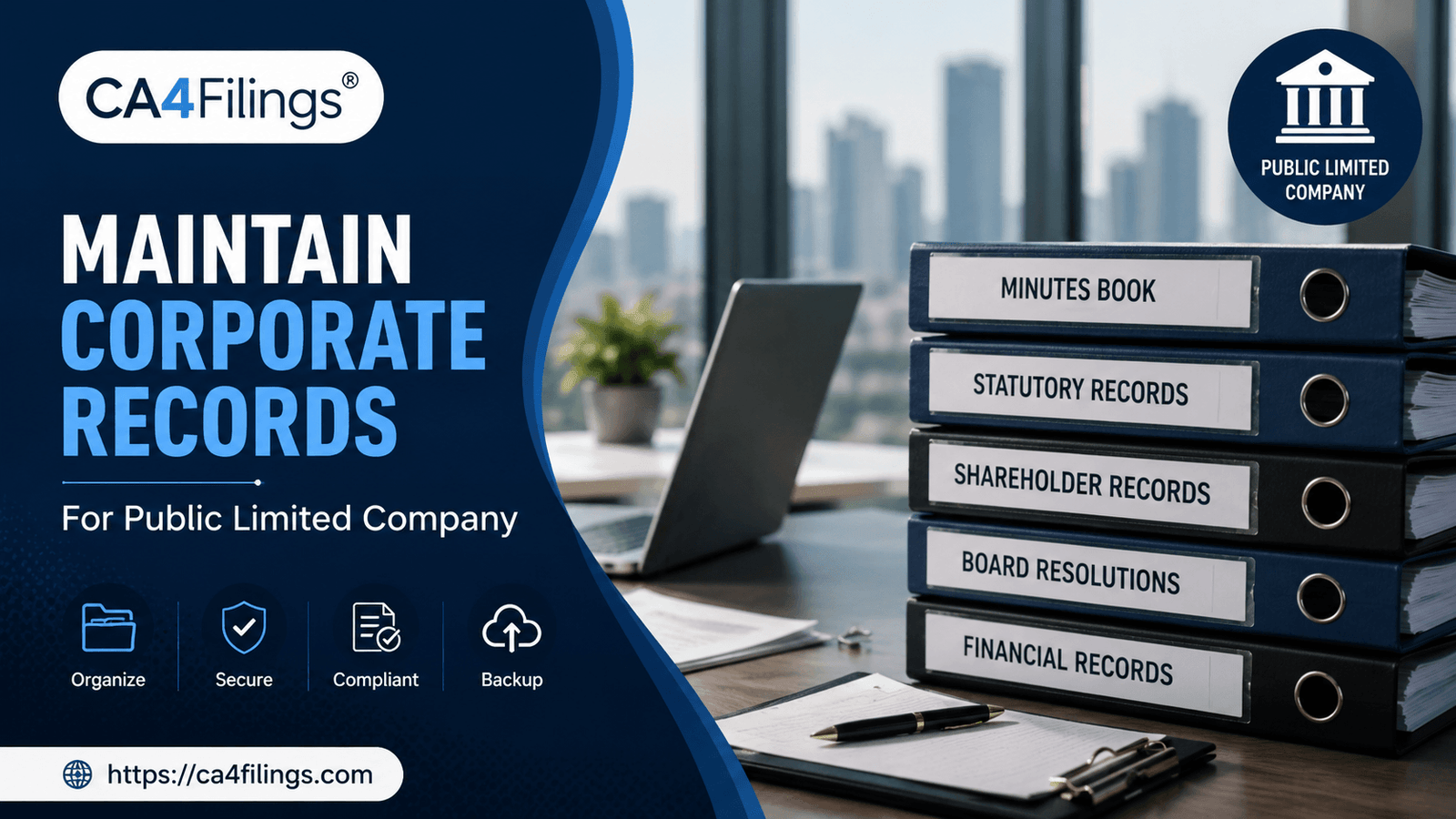
Statutory Registers: These include the Register of Members, Register of Directors and Key Managerial Personnel, and the Register of Charges.
Minutes Books: These are crucial. You must maintain separate minute books for board meetings, general meetings, and committee meetings.
Financial Records: Books of accounts, annual financial statements, and audit reports for at least the last eight years.
Share Certificates: Records of share transfers, transmissions, and duplicate share certificates issued.
Corporate Filings: Copies of all forms (like AOC-4, MGT-7) submitted to the MCA.
Best Practices for Maintaining Corporate Records
Maintaining these documents manually can be overwhelming. To stay on top of regulatory compliance, consider these expert tips from our team at CA4Filings:
1. Digitize Wherever Possible
While the law requires physical copies of certain documents, storing digital versions in a secure, cloud-based environment is a smart move for document management. This ensures that even if physical files are misplaced, you have a verified backup.
2. Establish a Regular Audit Schedule
Don't wait for a notice from the ROC to check your files. Conduct an internal "compliance health check" every quarter. Review your registers to ensure that any changes in shareholding or director appointments have been accurately reflected.
3. Appoint a Dedicated Compliance Officer
For a public limited company, the volume of corporate governance tasks is high. If your team is small, consider outsourcing this to professionals who specialize in maintenance of statutory records. This ensures that every resolution is filed within the mandated timelines, preventing late fees.
Common Challenges in Corporate Compliance
Many directors struggle with how to maintain corporate records for a Public Limited Company because they fail to update records in real-time. A common mistake is waiting until the end of the financial year to update the Register of Members. In reality, every share transfer should be recorded immediately.
Furthermore, public company records must be accessible for inspection by members. If a shareholder requests to view a document and you cannot produce it, it reflects poorly on your corporate governance standards. Always keep your corporate records in a "ready-to-inspect" state.
Frequently Asked Questions
How long must a company keep its corporate records?
Generally, financial records and books of accounts must be preserved for at least eight financial years. However, certain permanent records, like the Certificate of Incorporation and Memorandum of Association, should be kept as long as the company exists.
What are the consequences of poor record keeping?
Failure to maintain proper records can lead to significant monetary penalties for both the company and the directors. In some cases, it can lead to prosecution by the Registrar of Companies.
Can electronic records be used as valid proof?
Yes, the Companies Act recognizes electronic records. However, they must be maintained in a format that ensures security, integrity, and easy accessibility for audit purposes.
Do I need a professional to maintain these records?
While not legally mandated to hire an external firm, the complexity of regulatory compliance often makes it advisable to partner with a CA firm to avoid costly errors.
Mastering how to maintain corporate records for a Public Limited Company is a continuous process, not a one-time task. From meticulous minute-taking to ensuring your statutory registers are always updated, these efforts safeguard your company’s future and reputation.
At CA4Filings, we understand the complexities of corporate law. If you feel overwhelmed by the documentation requirements, don't leave your company's compliance to chance. Let our experienced professionals handle your regulatory needs while you focus on scaling your business. Contact CA4Filings today to ensure your corporate records are in perfect order!
Latest Updates
ca4filings.com Services
























-registration.png)