Understanding the Corporate Identity Number (CIN) for Private Limited Companies
Master the basics of business compliance. Our guide on Understanding the Corporate Identity Number (CIN) for Private Limited Companies covers all essentials.
Starting a business is an exciting journey, but it comes with a fair share of paperwork and regulatory compliance. When you venture into the corporate world, you quickly realize that your business needs a digital footprint recognized by the Ministry of Corporate Affairs. If you have recently completed your Private Limited Company Registration with us at CA4Filings, you might have noticed a unique code on your certificate of incorporation. This is your CIN. Understanding the Corporate Identity Number (CIN) for Private Limited Companies is not just about keeping a number on file; it is about ensuring your business is transparent, verified, and ready for growth.
What is a CIN?
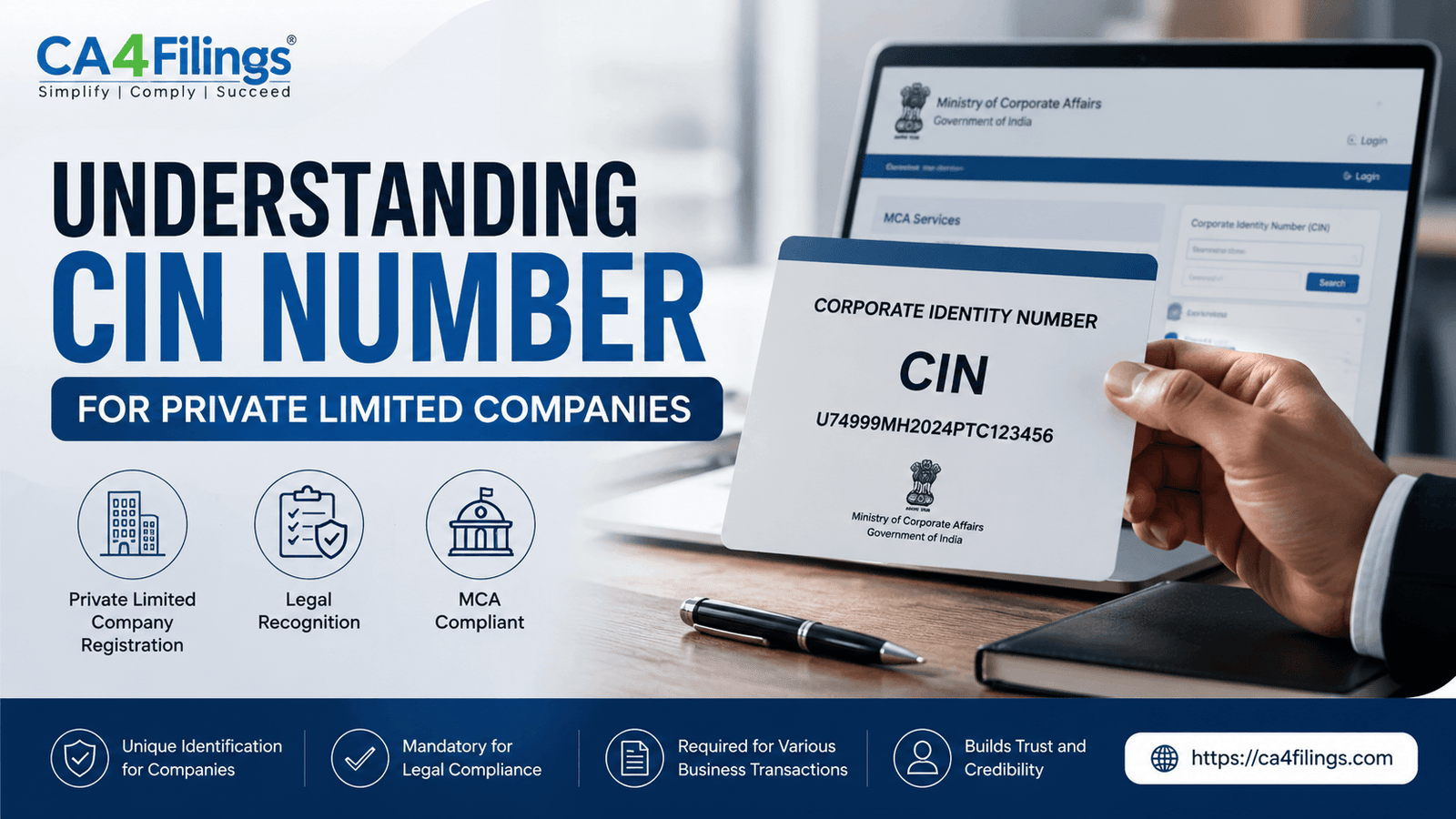
At its core, a Corporate Identity Number (CIN) is a 21-digit alphanumeric code assigned to every registered company in India. Think of it as an Aadhar card for your business. It is a unique identifier provided by the Registrar of Companies (ROC) under the Ministry of Corporate Affairs (MCA).
When you are deep into the complexities of the corporate world, the CIN serves as the primary tool for company verification. Whether you are dealing with vendors, banks, or potential investors, they will often look for this number to ensure that they are dealing with a legitimate, registered entity.
Decoding the 21-Digit CIN
Understanding the Corporate Identity Number (CIN) for Private Limited Companies becomes much simpler once you break down what those 21 characters actually represent. Each segment of the code tells a specific story about your company:
Listing Status (1st character): This indicates whether your company is publicly listed ('L') or unlisted ('U').
Economic Activity (Next 5 characters): These represent the industry code, defining the nature of your business.
State Code (Next 2 characters): This denotes the Indian state where the company is registered (e.g., MH for Maharashtra, DL for Delhi).
Year of Incorporation (Next 4 characters): Clearly states the year your business was born.
Company Class (Next 3 characters): Defines the class, such as Public (PLC) or Private (PTC).
Ownership Pattern (Next 2 characters): Indicates if it is a government-owned company (GOI) or a private entity (Pvt).
ROC Registration Number (Last 6 characters): This is the specific sequence number assigned by the Registrar of Companies.
Why is CIN Essential for Your Business?
You might wonder why such a long string of numbers is required. Beyond being a legal requirement, the CIN acts as a gateway to company information.
1. Proof of Legal Existence
In the corporate world, trust is built on verification. Having a CIN proves that your company is not just a name on a letterhead but a legally recognized entity. It acts as official business identification, allowing stakeholders to cross-reference your existence on the MCA portal.
2. Streamlined Corporate Governance
Maintaining your CIN on all official documents—including letterheads, invoices, and notices—is a mandatory practice of good corporate governance. It shows that your business follows the rules set by the government, which in turn builds credibility with tax authorities and financial institutions.
3. Ease of Company Differentiation
With thousands of new companies being registered every day, the CIN ensures there is no confusion between two businesses that might have similar names. It is the definitive marker that separates your unique entity from the crowd.
Practical Insights: Where Should You Mention Your CIN?
As a CA, I often see business owners overlooking where their CIN should appear. According to the Companies Act, 2013, you are legally required to display your CIN on the following:
Business Letterheads: Every official communication sent from the company.
Invoices and Receipts: Essential for B2B transactions.
Official Notices and Publications: Any announcement made by the company.
Company Website: It is a best practice to keep your CIN in the footer of your website for easy company verification by prospective clients.
Frequently Asked Questions
Is the CIN the same as a GSTIN?
No. A CIN is issued by the Ministry of Corporate Affairs for your company’s registration, while a GSTIN is issued by the tax department for tax collection purposes. They are two different identifiers.
Can a company change its CIN?
Generally, no. Since the CIN contains information like the state of registration and the year of incorporation, it remains static. However, if you shift your registered office from one state to another, the state code part of your CIN will change.
How can I verify if a company's CIN is valid?
You can easily verify this by visiting the official MCA website. By entering the CIN in the 'Check CIN' search tool, you can pull up the latest status of any company.
Does every business need a CIN?
Only companies registered under the Companies Act, 2013 (or previous Acts) are issued a CIN. Sole proprietorships and partnerships do not receive a CIN.
Understanding the Corporate Identity Number (CIN) for Private Limited Companies is an essential step for any entrepreneur who wants to build a compliant and professional organization. It is more than just a regulatory necessity; it is a testament to your business's legitimacy in the eyes of the law and your clients.
At CA4Filings, we believe that compliance should never feel like a burden. Whether you are just starting your journey or looking to streamline your existing filings, our team of experts is here to guide you. If you need assistance with your corporate filings, annual returns, or any other regulatory needs, reach out to us at CA4Filings today. Let us handle the paperwork while you focus on growing your dream business.
Latest Updates
ca4filings.com Services


























-registration.png)