The Process of Issuing Shares in a Private Limited Company
Understanding The Process of Issuing Shares in a Private Limited Company is vital for growth. Here is a clear guide from CA4Filings to help you navigate it.
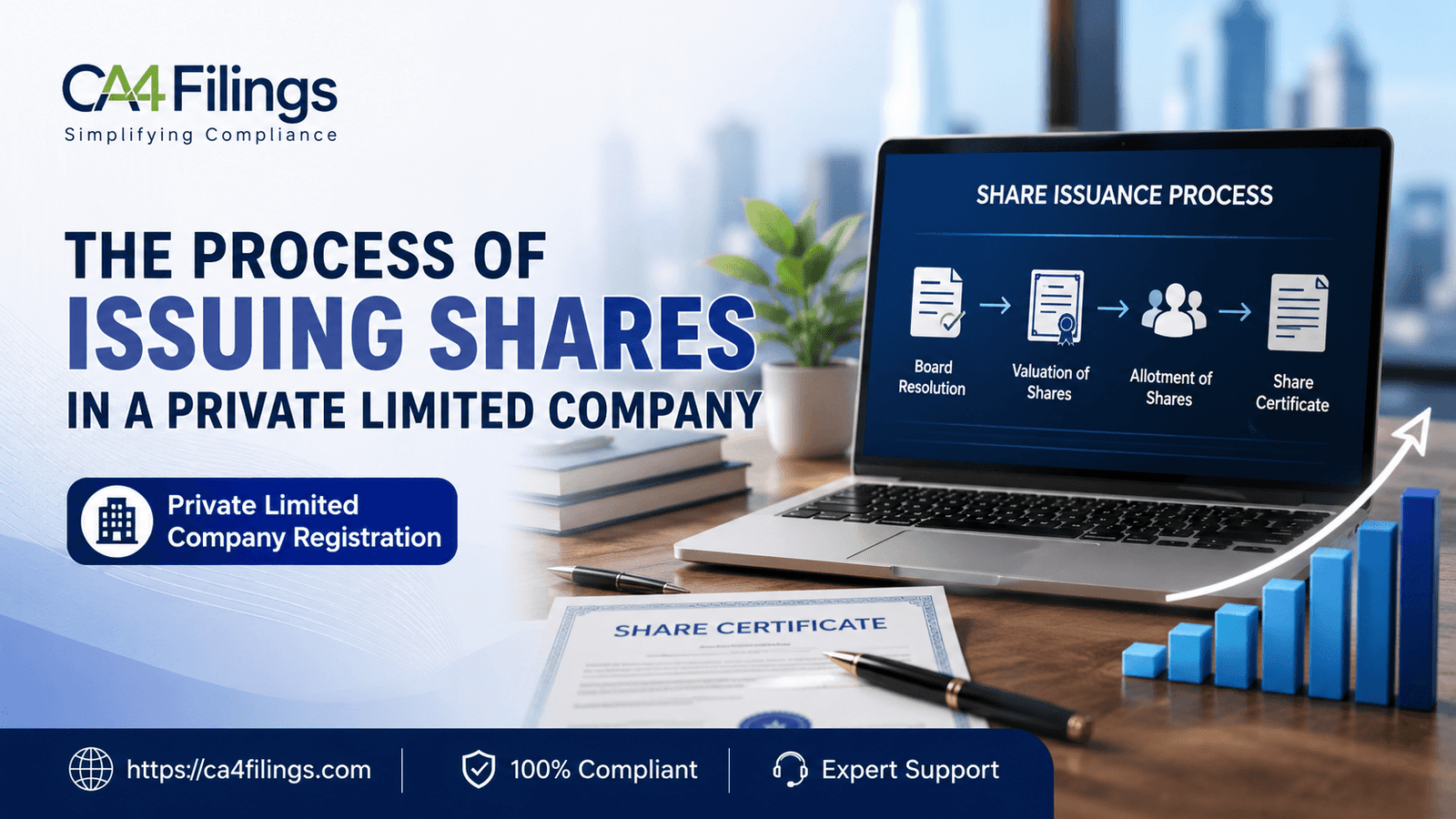
Starting a business is an exciting journey, and for many entrepreneurs in India, choosing the right structure is the first hurdle. If you have recently completed your Private Limited Company Registration with us, you are already on the right track toward professional growth and credibility. However, as your business begins to scale, you will eventually reach a point where you need to inject more funds into the business to expand operations or invest in new technology. This is where mastering the process of issuing shares in a private limited company becomes essential.
Many business owners find corporate law daunting, but it is much simpler when broken down into logical, compliant steps. Whether you are bringing on a new director, inviting an angel investor, or simply increasing your paid-up capital, the process of issuing shares in a private limited company must be handled with care to ensure your business remains legally sound and audit-ready.
Why is Understanding the Share Issuance Process Important?
For a startup or an SME, raising capital is often the difference between stagnation and market leadership. When you start issuing shares, you aren't just moving numbers on a balance sheet; you are formalizing ownership and bringing in new stakeholders. If you fail to follow the share issuance regulations correctly, you risk penalties under the Companies Act, 2013.
At CA4Filings, we often see clients struggle with the share issuance steps because they try to DIY the documentation. Remember, this is a legal process, not just a financial one. Getting it right the first time saves you from future disputes with shareholders and regulatory scrutiny.
Prerequisites for Issuing Company Shares
Before you jump into the capital raising process, you must verify a few internal parameters. You cannot simply issue shares to anyone at any time without checking your foundational documents:
Authorized Capital: Ensure your company has sufficient authorized share capital. If you intend to issue shares beyond your authorized limit, you must first increase it by amending your Memorandum of Association (MoA).
Board Approval: Issuing company shares always requires the consent of your board of directors.
Shareholder Approval: Depending on the nature of the issue (e.g., private placement), you may require a special resolution from the existing shareholders.
The Process of Issuing Shares in a Private Limited Company: A Step-by-Step Guide
Navigating the company share issuing process requires strict adherence to the Companies Act. Here is the sequence of events you should follow to ensure full legal compliance.
1. Convene a Board Meeting
The first of the share issuance steps is to call a board meeting. During this meeting, the directors must approve the proposal to issue shares, determine the number of shares to be issued, and finalize the price of the shares.
2. Prepare Necessary Share Issuance Documents
Documentation is the backbone of the share issuance process. You will need to draft:
Notice of the Board Meeting.
Board Resolution approving the issue.
Letter of offer (for private placement).
List of allottees.
3. Hold an Extraordinary General Meeting (EGM)
If required by your Articles of Association or the Companies Act, hold an EGM to get the shareholders' nod. This is a critical part of the share issuance guidelines to ensure that existing members have no objection to the dilution of their stake.
4. File Relevant Forms with the ROC
After receiving the money from the investors, you must file the necessary e-forms (like PAS-3) with the Registrar of Companies (ROC) within the prescribed timeframe. This is where many businesses falter—missing these deadlines can lead to heavy fines.
5. Issue Share Certificates
Once the allotment is approved and reported, the final step in the share issuance process is to physically or electronically issue the share certificates to the new stakeholders. This completes the transaction.
Common Pitfalls in Private Company Shares Issuance
We often advise our clients that issuing shares is not just about the money; it’s about the long-term impact on your cap table. Be wary of these common mistakes:
Incorrect Valuation: When issuing shares at a premium, ensure you have a valid valuation report from a registered valuer. Ignoring this can trigger income tax issues under Section 56(2)(viib).
Missing Filings: Failing to file form PAS-3 within 30 days of allotment is a common violation.
Incomplete Records: Always maintain a proper Register of Members. It is a mandatory requirement for private company shares.
Expert Advice from CA4Filings
When you are involved in the process of issuing shares in a private limited company, always keep the future in mind. Are you giving away too much equity too soon? Is your valuation justified? We recommend that you consult with a professional who can look at the tax implications, specifically regarding how raising capital affects your company’s valuation for future rounds.
Frequently Asked Questions (FAQs)
1. Is a valuation report mandatory for all share issues?
Yes, if you are issuing shares at a premium (above face value), you must obtain a valuation report from a registered valuer to comply with the Companies Act and to avoid issues with the Income Tax department.
2. Can we issue shares to non-residents?
Yes, but you must comply with FEMA (Foreign Exchange Management Act) guidelines alongside the Companies Act. This involves additional reporting to the Reserve Bank of India.
3. What are the main share issuance documents I need to keep?
You must maintain the Board Resolution, the Letter of Offer (PAS-4), the Register of Members, the Application Form, and the proof of receipt of funds (bank statements).
4. How long does the process take?
Usually, if all documentation is ready and the ROC filing is done promptly, the entire process takes about 3 to 4 weeks.
Mastering the process of issuing shares in a private limited company is a hallmark of a mature, well-managed business. While the rules may seem complex, they exist to protect your company, your shareholders, and your long-term vision. By following the correct share issuance guidelines and maintaining meticulous legal compliance, you position your company for sustainable growth.
If you are planning to raise capital or are unsure about your current shareholding structure, the team at CA4Filings is here to help. We simplify the complexities of corporate law so you can focus on growing your business. Reach out to us today, and let’s ensure your share issuance is handled with professional precision.
Latest Updates
ca4filings.com Services



























-registration.png)