Private Limited Company vs. Public Limited Company: Key Differences
Confused between structures? Read our expert guide on Private Limited Company vs. Public Limited Company: Key Differences to make the right choice.
When you are standing at the crossroads of expanding your business in India, one of the most critical decisions you will face is choosing the right legal framework. If you are aiming for a scalable, credible, and robust corporate structure, your choices generally boil down to two heavyweight options: a private limited company or a public limited company. Making the wrong choice early on can impact your funding options, compliance costs, and day-to-day operations.
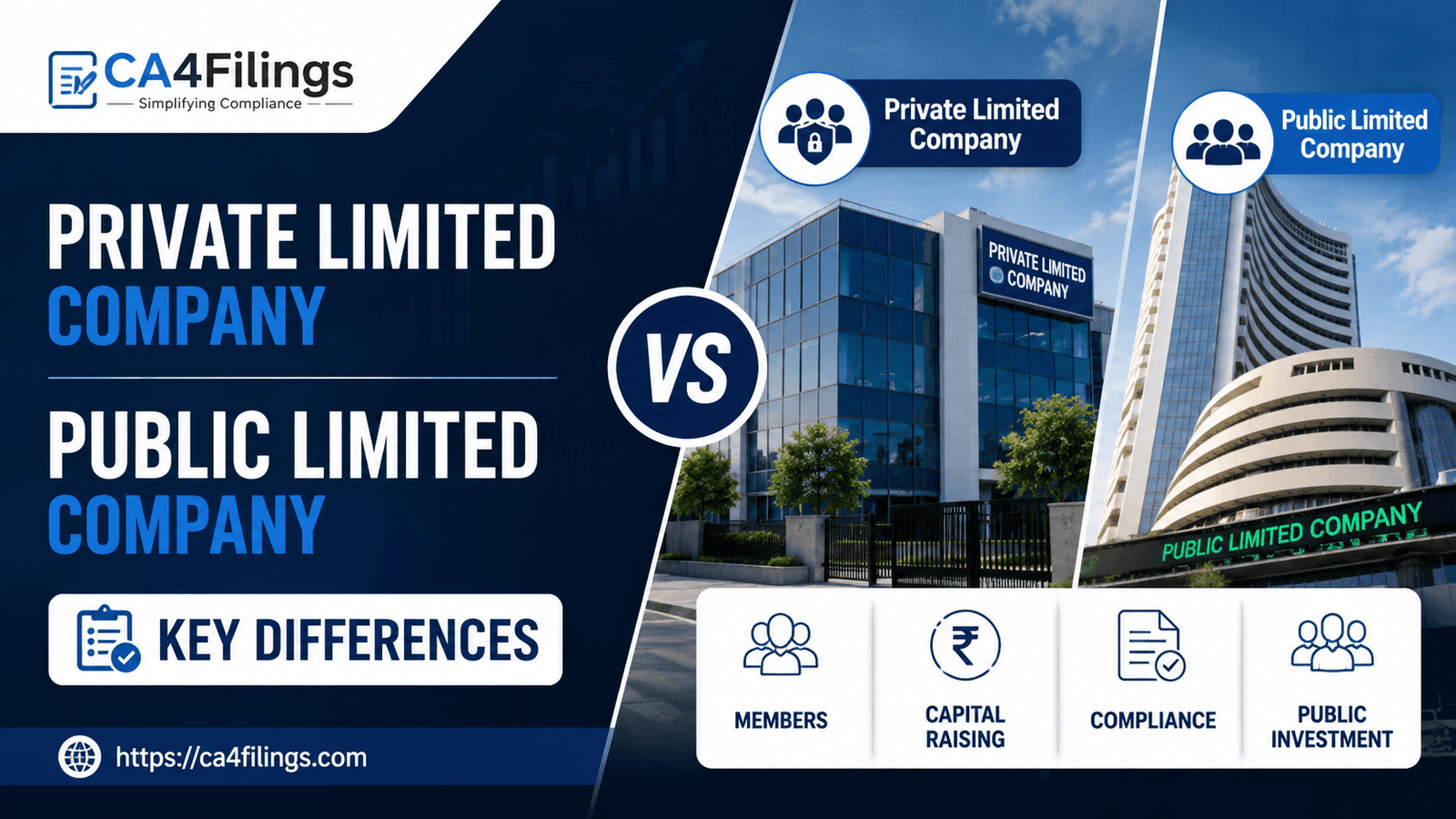
In this comprehensive guide, we will break down the Private Limited Company vs. Public Limited Company: Key Differences to help you identify which path aligns perfectly with your business goals. Whether you are a startup looking to secure your first round of angel investment or an established business eyeing massive public market capital, understanding these distinctions is vital. If you are just starting out with a close-knit group of co-founders, your journey will likely begin with a Private Limited Company Registration, which offers a secure foundation with fewer compliance burdens before you scale up to a public structure.
Understanding the Business Structure: The Basics
Before diving into the core differences, let’s briefly establish what these two entities represent under the Indian Companies Act, 2013.
Private Limited Company: This is the most popular corporate structure for startups and small-to-medium enterprises (SMEs) in India. It is a privately held business entity where the ownership structure is restricted to a close group of individuals, typically founders, family members, or select investors.
Public Limited Company: This structure is designed for large-scale operations. A public limited company can invite the general public to subscribe to its shares and can choose to be listed on stock exchanges like the BSE or NSE. It operates under strict regulatory oversight because public money is involved.
Both entities enjoy the benefit of limited liability, meaning the personal assets of the shareholders are fully protected in case the business faces financial distress or liquidation.
Private Limited Company vs. Public Limited Company: Key Differences Explained
To give you a crystal-clear picture, let’s analyze the Private Limited Company vs. Public Limited Company: Key Differences across various operational and regulatory parameters.
1. Ownership and Shareholder Limits
The ownership structure varies drastically between the two. A private limited company requires a minimum of 2 shareholders and caps its total membership at 200. This makes it ideal for maintaining tight control over the business.
Conversely, a public limited company requires a minimum of 7 shareholders, but there is absolutely no upper limit on the maximum number of members. This unlimited capacity is what allows public companies to build massive communities of retail and institutional investors.
2. Capital Raising and Funding Sources
When evaluating funding sources, your choice of entity determines your financial reach. A private limited company cannot invite the public to subscribe to its shares or debentures. Its capital raising activities are restricted to private placements, venture capital, and angel investors.
A public limited company, on the other hand, has access to diverse and massive investment opportunities. It can issue a Prospectus and launch an Initial Public Offering (IPO) to raise capital directly from the public, alongside traditional institutional funding.
3. Governance and Management Structure
The governance structure is significantly lighter for private entities. A private limited company can run efficiently with a minimum of 2 directors, and there is no mandatory requirement to appoint independent directors.
A public limited company demands much stricter governance, requiring at least 3 directors. Furthermore, listed public companies must ensure that a specific percentage of their board consists of independent directors to protect retail shareholder rights.
4. Transferability of Shares
In a private limited company, the articles of association (AoA) intentionally restrict the free transfer of shares. If a shareholder wants to exit, they must generally offer their shares to existing members first. This prevents hostile takeovers and keeps the ownership intact.
In stark contrast, shares of a public limited company are freely transferable. If the company is listed, investors can buy or sell shares within seconds on the stock exchange, offering unmatched liquidity.
5. Legal Compliance and Disclosure
The burden of legal compliance is a major factor in determining your long-term operational costs. Private companies enjoy numerous exemptions under the Companies Act, making their day-to-day decision-making fast and agile.
Public companies face intensive legal requirements. They must hold mandatory statutory meetings, publish quarterly audited financial results, and maintain high transparency with regulatory bodies like the Securities and Exchange Board of India (SEBI).
Side-by-Side Comparison: At a Glance
| Parameter | Private Limited Company | Public Limited Company |
|---|---|---|
| Minimum / Maximum Members | 2 / 200 | 7 / Unlimited |
| Minimum Directors | 2 | 3 |
| Public Subscription | Strictly Prohibited | Fully Allowed |
| Share Transferability | Restricted by AoA | Freely Transferable |
| Regulatory Burden | Relatively Low | Very High |
| Statutory Meeting | Optional | Mandatory |
Expert Insights: Which One Should You Choose?
As CAs, we often get asked: "Which corporate structure is better for long-term growth" The answer depends on your immediate business objectives and long-term vision.
Choose a Private Limited Company if:
You want to retain tight control over management and ownership.
Your business relies on private funding sources like equity partners, VCs, or personal savings.
You want to keep operational and compliance costs to a minimum.
Choose a Public Limited Company if:
You are planning massive capital expansion that requires funding from the general public.
You want to provide an easy liquidity route for your early investors through a stock market listing.
Your brand requires the high public visibility and institutional credibility that comes with a public listing.
Frequently Asked Questions (FAQs)
Can a Private Limited Company convert into a Public Limited Company?
Yes, absolutely. As a business grows and requires public capital, it can amend its Articles of Association and convert from a private structure into a public limited entity, provided it meets the minimum requirement of 7 members and 3 directors.
What is meant by limited liability in both structures?
In both entities, the liability of the shareholders is limited only to the nominal value of the shares they hold. If the company incurs debts, the personal bank accounts, properties, and assets of the owners cannot be seized to pay off business liabilities.
Are the incorporation steps similar for both?
The basic steps of business registration—such as obtaining Digital Signature Certificates (DSC), Director Identification Numbers (DIN), and name approval—are similar. However, a public limited company has additional documentation requirements and takes longer due to stricter verification.
How CA4Filings Can Help
Deciphering the Private Limited Company vs. Public Limited Company: Key Differences is just the first step. Executing the transition or initiating a fresh company formation requires meticulous legal drafting, regulatory filings, and structural planning.
At CA4Filings, we take the regulatory weight off your shoulders. From checking company name availability to drafting your Memorandum of Association (MoA) and managing your end-to-end business registration, our team of experienced Chartered Accountants ensures a flawless, compliant setup. Let us handle the compliance while you focus on building your empire. Reach out to CA4Filings today to launch your corporate journey smoothly!
Latest Updates
ca4filings.com Services



















-registration.png)