Step-by-Step Guide to Registering an OPC in India
Looking for a Step-by-Step Guide to Registering an OPC in India? Learn the complete process, required documents, and expert tips from CA4Filings.
Running a business entirely on your own terms used to mean opting for a Sole Proprietorship. While easy to set up, it always came with a massive hidden risk: unlimited personal liability. If the business incurred a debt, your personal assets—like your home or savings—were on the line.
To bridge this gap, the Ministry of Corporate Affairs (MCA) introduced a game-changing corporate structure: the One Person Company (OPC). It gives you the absolute freedom of a sole proprietorship combined with the powerful legal protections of a Private Limited Company. If you are a solo entrepreneur ready to institutionalize your venture, this definitive Step-by-Step Guide to Registering an OPC in India will walk you through the entire process seamlessly.
At CA4Filings, we understand that navigating government portals, drafting legal charters, and dealing with compliance jargon can feel overwhelming. That is exactly why we have structured our professional One Person Company Registration services to handle the heavy lifting for you, allowing you to focus entirely on building your brand.
What is a One Person Company (OPC)?
Before diving into the registration steps, let's establish what an OPC actually is. Introduced under the Companies Act, 2013, an OPC allows a single individual to form a corporate entity.
Unlike a traditional Private Limited Company, which strictly requires at least two directors and two shareholders, an OPC thrives with just one member who acts as both the sole shareholder and the director.
Core Eligibility Criteria
To successfully execute the roadmap outlined in this Step-by-Step Guide to Registering an OPC in India, you must meet the following baseline statutory requirements:
Natural Person & Indian Citizen: Only a real human being who is an Indian citizen and a resident of India can incorporate an OPC.
The Nominee Rule: Since there is only one owner, you must appoint a nominee director. If something happens to the primary owner, this nominee steps in to ensure business continuity.
One OPC at a Time: A single individual can only incorporate or become a nominee in one OPC at any given time.
Step-by-Step Guide to Registering an OPC in India
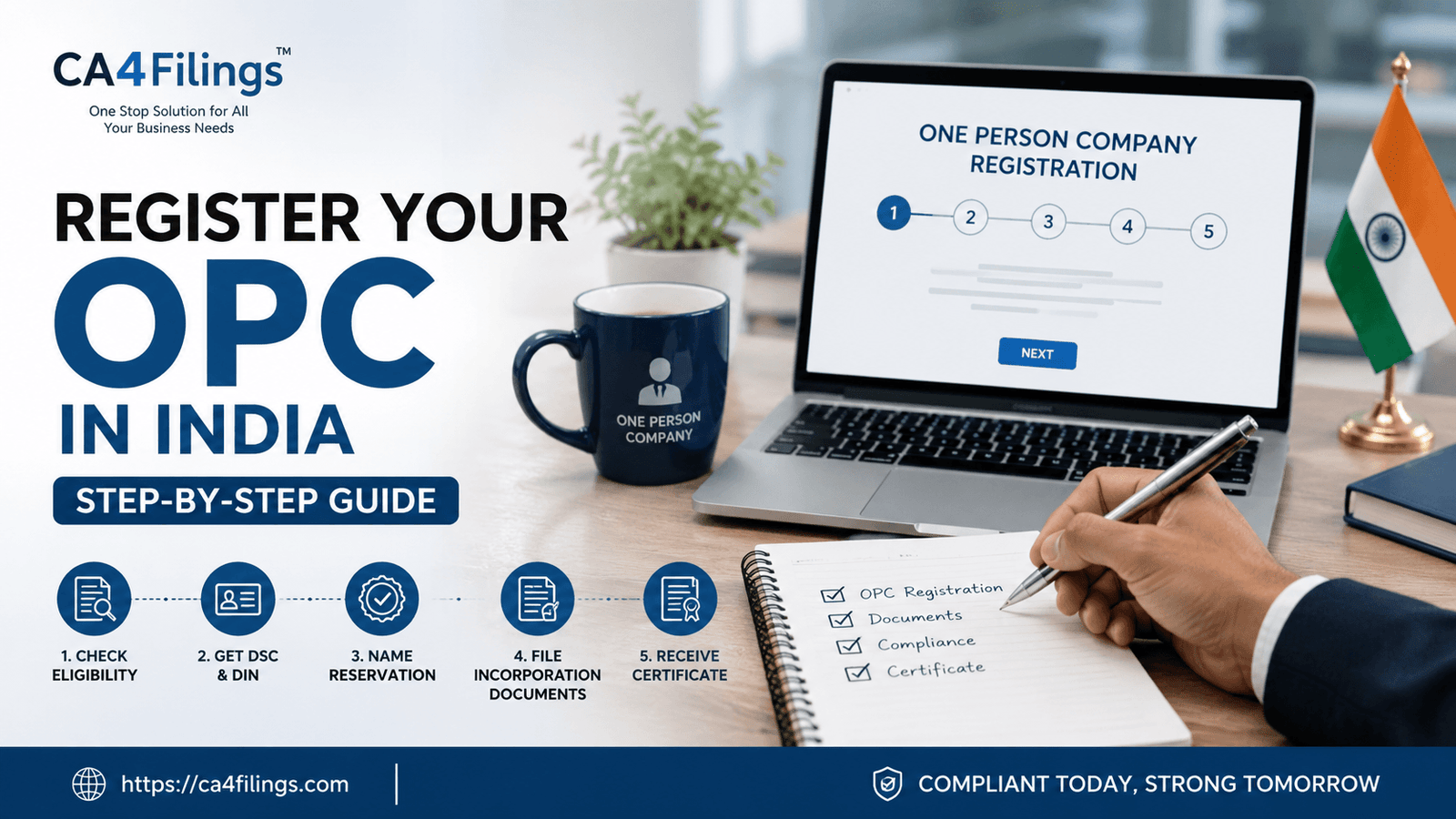
The Ministry of Corporate Affairs has completely digitized the corporate onboarding ecosystem via its advanced MCA V3 portal. The process is centralized through the SPICe+ (Simplified Proforma for Incorporating Company Electronically Plus) web-based application.
Here is the exact layout of the onboarding sequence you need to complete.
1.Obtain a Class 3 Digital Signature Certificate (DSC):Timeline: 1–2 Days.
Because the entire incorporation framework is completely electronic, you cannot physically sign your incorporation paperwork. You must secure a Class 3 Digital Signature Certificate (DSC) from a government-recognized Certifying Authority. This acts as your secure, legally authenticated electronic signature. You will need a DSC for yourself as the primary director, and a separate one for your chosen nominee.
2.Reserve Your Company Name via SPICe+ Part A:Timeline: 2–3 Days.
Your company name is the face of your business. Log in to the MCA V3 portal and access SPICe+ Part A. You can submit up to two unique names in order of preference. The suffix "(OPC) Private Limited" will automatically be appended to your approved title. The Registrar of Companies (ROC) will check your application against existing trademarks and active company names to prevent legal overlaps. Once approved, the name is reserved exclusively for you for 20 days.
3.Draft the MoA, AoA, and Nominee Consent:Timeline: 1–2 Days.
While your name application is being reviewed, you must draft two foundational charters:
Memorandum of Association (MoA): Outlines the core business objectives and financial boundaries.
Articles of Association (AoA): Defines the internal regulations, operational rules, and management bylaws.
Form INC-3 (Nominee Consent): You must obtain written, signed consent from your designated nominee director alongside their identity documentation.
4.File the Integrated SPICe+ Part B Application:Timeline: 3–5 Days.
Once your name is officially locked in, you open SPICe+ Part B. This comprehensive, centralized form is where the actual incorporation happens. It bundles multiple government services into a single workflow. Through this part, you will simultaneously apply for:
Your formal Company Incorporation.
Your Director Identification Number (DIN).
The company's permanent tax credentials (PAN and TAN).
Mandatory statutory registrations (EPFO and ESIC).
A dedicated corporate current bank account.
5.Pay Government Fees and Stamp Duty:Timeline: Instant.
Submit the complete SPICe+ bundle along with the linked electronic forms (e-MoA and e-AoA) signed using your Class 3 DSC. Pay the necessary government registration fees and state-specific stamp duty directly through the portal. To encourage early-stage ventures, the government charges zero incorporation fees for companies with an authorized share capital up to ₹15 Lakhs—though state-level stamp duties still apply.
6.Receive Your Certificate of Incorporation (COI):Timeline: 2–4 Days.
The Central Registration Centre (CRC) reviews your structural filings and digital attachments. If everything perfectly aligns with compliance guidelines, the ROC issues your official Certificate of Incorporation (COI) alongside your unique Corporate Identification Number (CIN), PAN, and TAN. Your business is now officially a recognized legal entity!
Documents Required for OPC Registration
To ensure a smooth, error-free submission process that passes regulatory checks without rejections, gather these valid documents beforehand:
For the Promoter & Nominee
Self-attested copy of PAN Card (Mandatory).
Self-attested copy of Aadhaar Card or Passport.
Current Address Proof: A bank statement, electricity bill, or telephone bill (must strictly be less than 2 months old).
Passport-sized photographs.
For the Registered Business Office
Proof of ownership (Property Deed/Tax Receipt) OR a valid Rent Agreement if the space is leased.
A formal No Objection Certificate (NOC) signed by the property owner granting permission to use the address as the company's registered office.
A utility bill (Electricity or Gas bill) for the premises, not older than 2 months.
Key Post-Incorporation Compliance Checklist
Receiving your Certificate of Incorporation is a major milestone, but your legal obligations do not stop there. To maintain your corporate status cleanly, make sure you address these immediate next steps:
| Timeframe | Statutory Obligation | Operational Significance |
|---|---|---|
| Within 30 Days | Appoint First Statutory Auditor | Mandatory under Section 139(1) to oversee company financials. |
| Within 180 Days | File Form INC-20A | Declaration of Commencement of Business. You cannot start commercial operations or execute contracts without filing this. |
| Annually | File Financials & Returns | Submit Form AOC-4 (Financial Statements) and Form MGT-7A (Abridged Annual Return) to the ROC. |
| Every September 30 | Director KYC Filing | Annual validation of the director's DIN credentials to prevent disqualification. |
Frequently Asked Questions
Can an OPC have more than one director?
Yes. An OPC must have at least one shareholder, but it can legally appoint up to 15 directors if you need additional management support to scale operations.
Is an audit mandatory for a One Person Company?
Yes. Regardless of your turnover or capital size, an OPC is a distinct corporate structure. It must have its books of accounts audited by a practicing Chartered Accountant every financial year.
What happens if the sole member dies?
This is where your nominee steps in. In the event of the death or incapacity of the original member, the nominee automatically assumes full ownership of the shares and takes over the company's responsibilities.
Can an OPC be converted into a Private Limited Company?
Yes. An OPC can voluntarily convert into a regular Private Limited Company at any point by inducting an additional member and director, following the updated provisions of the Companies Act.
Turn Your Vision into Reality with CA4Filings
Setting up a corporate entity is a significant legal step. Minor clerical mismatches, outdated utility bills, or misconfigured business object clauses can lead to repetitive application rejections, causing unexpected project delays.
This Step-by-Step Guide to Registering an OPC in India provides you with the foundational clarity needed to map out your corporate structure. Let our corporate compliance experts handle the actual paperwork. From provisioning your Class 3 DSC to drafting customized, legally sound MoA and AoA documents, CA4Filings delivers an efficient, end-to-end setup experience. Contact us today to officially establish your business footprint!
Latest Updates
ca4filings.com Services



























-registration.png)