How to Draft the Articles of Association (AOA) for OPCs
Learn How to Draft the Articles of Association (AOA) for OPCs with our step-by-step CA guide. Master company regulations and AOA best practices easily.
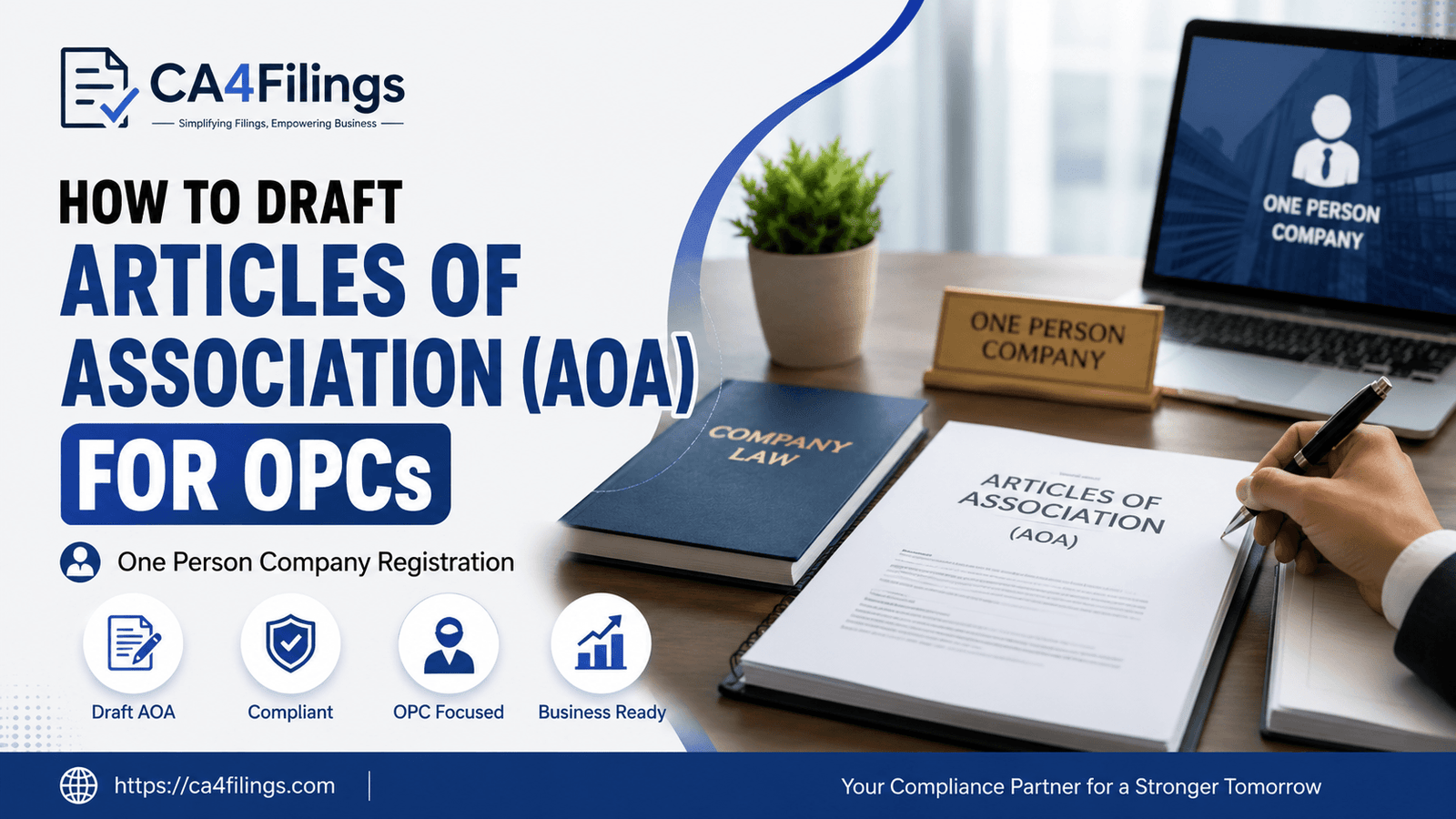
Starting a business all by yourself is an exhilarating journey. In India, the introduction of One Person Companies (OPCs) has been a game-changer for solo entrepreneurs, offering the perfect blend of a corporate structure and limited liability protection. However, setting up a company involves its fair share of legal compliance. One of the most critical steps in this journey is creating the internal constitution of your company. Today, we are going to break down exactly How to Draft the Articles of Association (AOA) for OPCs without getting lost in complex legal jargon.
When you initiate your One Person Company Registration process, you will realize that the Ministry of Corporate Affairs (MCA) requires two foundational documents: the Memorandum of Association (MOA) and the Articles of Association (AOA). While the MOA defines the company's purpose and relationship with the outside world, the AOA acts as the rulebook for your internal management. At CA4Filings, we often see founders rushing through this step, but learning how to draft the Articles of Association (AOA) for OPCs correctly ensures your business runs smoothly without unexpected legal hurdles.
Understanding the Articles of Association (AOA) for One Person Companies (OPCs)
Before we jump into the actual AOA drafting process, let’s demystify what this document actually does. Think of the Articles of Association (AOA) as the internal blueprint of your company. It contains the internal rules and regulations that govern how decisions are made, how shares are managed, and how the company operates day-to-day.
For One Person Companies (OPCs), the AOA is slightly unique compared to a traditional private limited company. Since there is only one shareholder, you might wonder why you need comprehensive company regulations at all. The truth is, even a single-owner business needs structure—especially to handle future growth, share transfers, or unforeseen events like the incapacitation of the founder.
Key Clauses to Include When You Draft AOA for OPCs
The Companies Act, 2013 provides standard templates (known as Table F under Schedule I), but relying solely on a generic template might not serve your specific business goals. When creating AOA for a company, personalization is key. Here are the core clauses that must be included in your OPC AOA guidelines:
1. Definition and Interpretation
Every good piece of legal document drafting starts with clear definitions. This section defines terms like "The Company," "The Act" (referring to the Companies Act, 2013), and specific terms unique to your business operations.
2. Share Capital and Variation of Rights
Even though you are the sole owner, your company needs a defined authorized share capital (the maximum amount of shares the company can issue) and paid-up capital. This section outlines how shares are issued and whether you can alter the capital structure in the future.
3. Nomination Clause (The Most Crucial Part)
The defining feature of One Person Companies (OPCs) is the requirement of a Nominee. Since there is only one member, you must nominate an individual who will take over the company in the event of your death or inability to sign contracts. Your AOA must clearly outline the nominee's details, their consent process, and how a change of nominee can be executed.
4. Transfer and Transmission of Shares
What happens if you want to sell your business or pass it on? The AOA drafting process must clearly specify the rules for transferring shares to another individual, ensuring the company maintains its OPC status or outlines the transition into a private limited company if required.
5. General Meetings and Board Proceedings
In a standard company, general meetings involve dozens of shareholders. In an OPC, a resolution signed by the sole member and entered into the minutes book is considered sufficient. Your AOA should explicitly state these simplified procedures to save you from unnecessary administrative burdens.
Step-by-Step AOA Drafting Process for OPCs
Now that you know what goes into the document, let’s walk through the actual execution strategy. Following these AOA drafting tips will save you time and keep you compliant with the MCA.
Step 1: Analyze Your Business Structure
Determine your initial capital requirements and identify your trusted nominee. Having these details ready makes the initial legal document drafting much cleaner.
Step 2: Adopt and Modify Table F
The MCA provides Table F as a baseline template. However, you need to adapt it. For instance, remove sections that talk about "voting by a show of hands among multiple members" since it doesn't apply to a solo founder.
Step 3: Insert Custom Restrictive Clauses
If you plan to bring in investors later, your company regulations should reflect how new shares will be valued or how the conversion from an OPC to a private limited company will take place.
Step 4: Review Against the Companies Act
Ensure no clause in your custom draft contradicts the Companies Act, 2013. If there is a clash, the Act always overrides your AOA, making your custom clause invalid.
Step 5: Signing and Witnessing
Once the draft is finalized, it must be signed by the subscriber (you) and verified by at least one witness, who typically provides their name, address, and occupation.
AOA Best Practices for Solo Entrepreneurs
To ensure your document stands the test of time, keep these professional AOA best practices in mind:
Keep it Flexible: Do not make the rules so rigid that changing a minor operational feature requires an expensive amendment process through the MCA.
Clarity on Nominee Role: Ensure the nominee clause specifies that the nominee holds no active rights or liabilities while the original member is alive and capable.
Professional Vetting: While online templates are easily accessible, getting your draft reviewed by a practicing Chartered Accountant ensures that local regulatory nuances are fully addressed.
Frequently Asked Questions
Can I change my nominee after the AOA is filed?
Yes, you can change your nominee at any time. You will need to inform the Registrar of Companies (RoC) by filing Form INC-4, and the updated details will be reflected in your company records.
Is Table F mandatory for an OPC?
Table F provides the official model for the Articles of Association. While you don't have to adopt it word-for-word, your customized draft must align with its core legal principles.
What happens to the AOA if my OPC exceeds the turnover limit?
If your OPC grows significantly and crosses specific turnover thresholds defined by the MCA, you may choose or be required to convert it into a Private Limited Company. When this happens, you will need to completely alter and redraft your AOA to accommodate multiple shareholders and directors.
Let CA4Filings Handle the Heavy Lifting
Mastering How to Draft the Articles of Association (AOA) for OPCs is vital to securing the legal integrity of your startup. A well-drafted AOA protects your business identity, simplifies compliance, and paves a clear path for future expansion. However, dealing with legal clauses, clauses modification, and MCA filing portals can take your focus away from what you do best—growing your business.
At CA4Filings, we act as your trusted corporate partners. Our team of experienced Chartered Accountants handles the entire corporate registration and legal drafting process seamlessly, ensuring your company rules are robust, compliant, and perfectly tailored to your vision. Let us manage the paperwork while you build your dream company.
Latest Updates
ca4filings.com Services


























-registration.png)