Eligibility Criteria for Starting an OPC in India
Planning to incorporate your business? Read our expert guide on the Eligibility Criteria for Starting an OPC in India to ensure a smooth registration.
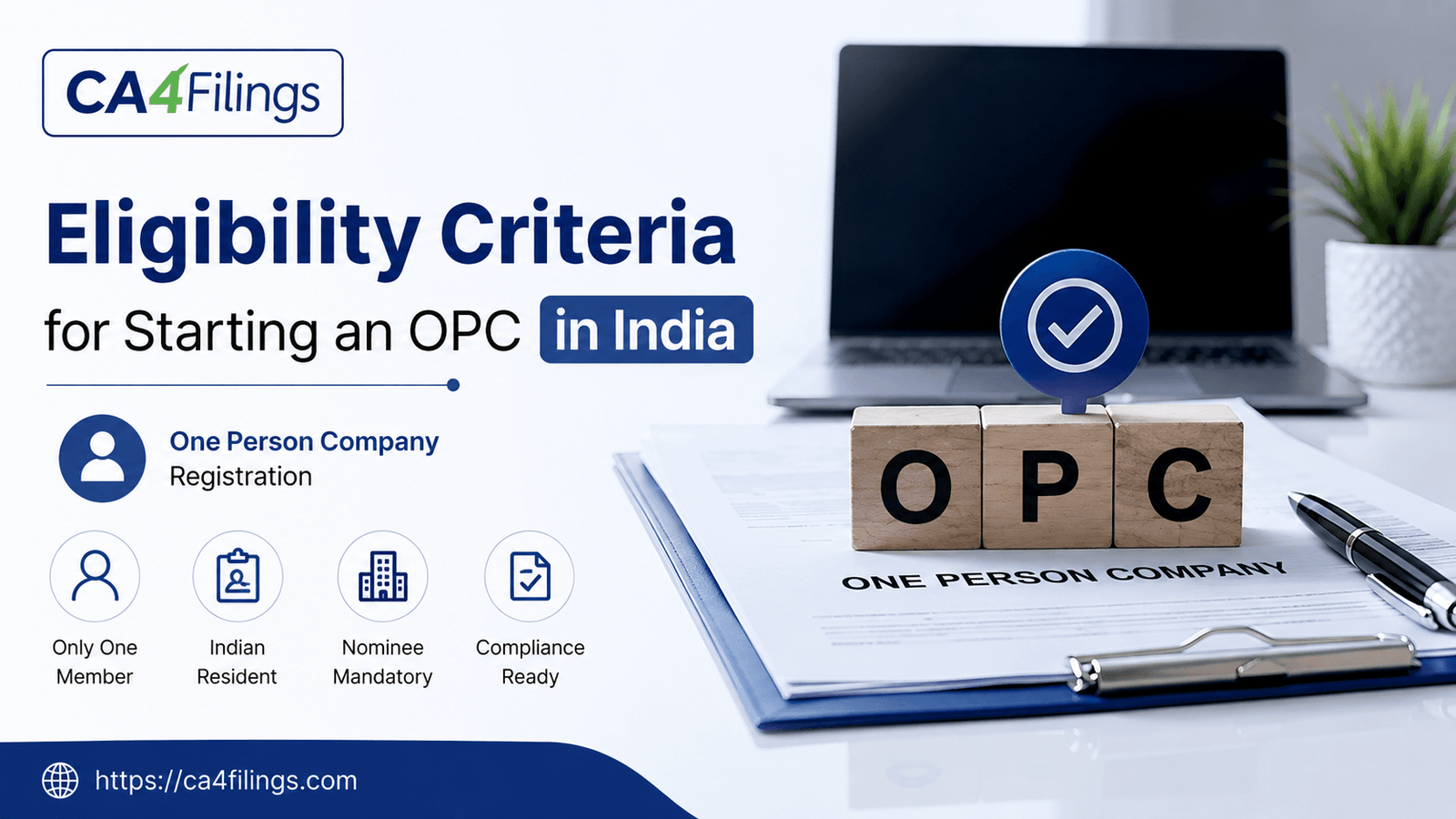
Meta Description: Planning to incorporate your business? Read our expert guide on the Eligibility Criteria for Starting an OPC in India to ensure a smooth registration.
Understanding the One Person Company (OPC) Structure
Starting a business in India used to be a daunting task, usually requiring at least two individuals to form a Private Limited Company. However, the introduction of the One Person Company (OPC) model has been a game-changer for solo entrepreneurs and freelancers. At CA4Filings, we often see clients looking for a formal business structure that provides the benefits of limited liability without the complexities of a partnership. If you are ready to take the leap, our team can help you navigate the One Person Company Registration process with ease.
Before you begin the filing process, it is essential to understand the specific Eligibility Criteria for Starting an OPC in India. Being a solo entity structure, the government has set clear guidelines to ensure that this model is used effectively by genuine business owners. Let’s dive into what you need to qualify.
Key Eligibility Criteria for Starting an OPC in India
The Companies Act, 2013, laid out the legal framework for an OPC. While the process is designed to be streamlined, there are non-negotiable legal requirements you must meet. Here is the breakdown of the Eligibility Criteria for Starting an OPC in India:
1. Residential and Citizenship Status
The most fundamental rule is that the subscriber (the person forming the company) must be an Indian Citizen and a Resident of India.
Definition of Resident: For the purpose of an OPC, a resident is someone who has stayed in India for a period of not less than 182 days during the preceding financial year.
Important Note: Non-Resident Indians (NRIs) or foreign nationals are currently not permitted to incorporate an OPC in India.
2. Natural Person Limitation
An OPC can only be incorporated by a "natural person." This means that only an individual can act as a member of an OPC. Corporate bodies, Hindu Undivided Families (HUFs), or other legal entities cannot register an OPC.
3. One Person, One Company
As the name suggests, one individual can hold a stake in only one OPC. You cannot be the sole member of multiple OPCs simultaneously. This ensures that the benefits of this structure are distributed fairly among individual entrepreneurs rather than being used for shell company setups.
4. Appointment of a Nominee
One of the most unique Eligibility Criteria for Starting an OPC in India is the mandatory appointment of a nominee. Since an OPC is owned by a single person, the law requires a nominee who will take over the business in the event of the owner’s death or incapacity.
The nominee must also be an Indian citizen and a resident.
The written consent of the nominee must be obtained in Form INC-3 during the incorporation process.
Financial and Operational Thresholds
Beyond personal status, there are operational rules that define the life cycle of an OPC. Even after you meet the initial Eligibility Criteria for Starting an OPC in India, you must keep an eye on your company’s growth.
Conversion Rules: An OPC is required to convert itself into a Private Limited Company or a Public Limited Company if its paid-up share capital exceeds ₹50 Lakhs or if its average annual turnover during the relevant three consecutive financial years exceeds ₹2 Crores.
Business Activities: An OPC cannot undertake Non-Banking Financial Investment activities, including investment in securities of any other corporate body.
Why Choose an OPC Over Other Structures?
Many clients ask me, "Why should I bother with the Eligibility Criteria for Starting an OPC in India when I can just run a sole proprietorship" The answer is simple: Limited Liability.
In a sole proprietorship, your personal assets are at risk if the business incurs debt. In an OPC, your liability is limited to the extent of your share capital. Additionally, an OPC enjoys better credibility with banks and vendors, as it is a government-registered entity with a unique Corporate Identity Number (CIN).
Frequently Asked Questions (FAQs)
Can a minor be a member of an OPC?
No, the Eligibility Criteria for Starting an OPC in India strictly prohibit minors from becoming members or nominees of an OPC. You must be at least 18 years of age.
Can an OPC be converted into a Private Limited Company?
Yes, voluntary conversion is permitted at any time, provided the company has completed two years from the date of incorporation.
What documents are required for registration?
You will need your PAN card, Aadhaar card, proof of registered office (utility bill/rent agreement), and the nominee’s identification documents.
How long does the registration process take?
With the right documentation and guidance from CA4Filings, the entire incorporation process typically takes 7 to 10 working days, depending on government processing times.
Embarking on your entrepreneurial journey as a solo founder is an exciting milestone. By understanding the Eligibility Criteria for Starting an OPC in India, you are already ahead of the curve. While the legal requirements might seem technical, having an experienced CA by your side ensures that your documentation is perfect and your filings are timely.
At CA4Filings, we specialize in simplifying company secretarial work so you can focus on growing your revenue. Don’t let paperwork delay your vision. Reach out to our expert team today, and let us handle your incorporation needs with professional precision and care. Your dream business is just one filing away!
Latest Updates
ca4filings.com Services






















-registration.png)