Challenges Faced During NGO Registration and How to Overcome Them
Learn the core Challenges Faced During NGO Registration and How to Overcome Them in India with expert solutions and tips from CA4Filings.
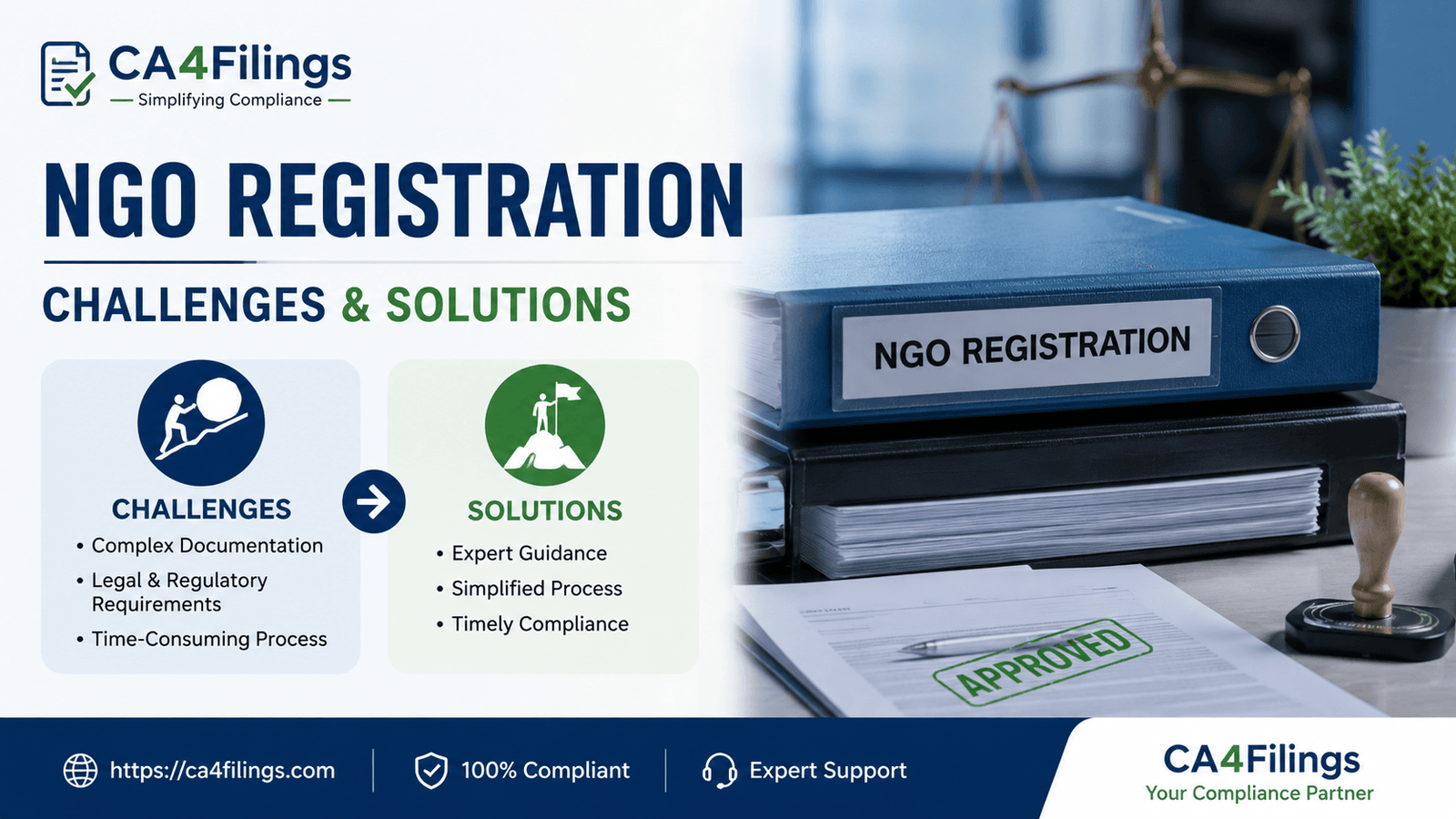
Setting up a non-governmental organization (NGO) in India is one of the most noble ways to drive community development, social equality, and structural change. However, translating your altruistic vision into a legally recognized entity is rarely a straightforward journey. Founders frequently find themselves caught in a web of bureaucratic hurdles, intense documentation, and stringent statutory norms. Understanding the specific Challenges Faced During NGO Registration and How to Overcome Them is vital to ensuring that your organization is built on a solid legal foundation, enabling you to focus on your mission rather than legal tangles.
At CA4Filings, we regularly assist passionate change-makers through the end-to-end legal formalities required to establish a sustainable nonprofit organization. If you are planning to launch your social venture, navigating the initial NGO Registration correctly is paramount to securing future tax exemptions and public funds. In this comprehensive guide, we will unpack the foundational compliance barriers, funding issues, and procedural obstacles that founders encounter, while providing actionable, expert-backed solutions to overcome them efficiently.
Deconstructing the Core Challenges Faced During NGO Registration and How to Overcome Them
The journey of establishing an NGO involves several regulatory pathways. In India, you can register an NGO under three distinct structures: a Trust (under State Trust Acts), a Society (under the Societies Registration Act, 1860), or a Section 8 Company (under the Companies Act, 2013). Each legal framework presents its own unique set of legal requirements and structural bottlenecks. Let us break down the primary challenges faced during NGO registration and how to overcome them.
1. Selecting the Wrong Structural Legal Framework
A frequent error made by founders is rushing into a specific organizational structure without thoroughly analyzing their long-term operational objectives. For instance, while a public charitable trust is highly suited for family-managed funds with minimal regulatory interference, a Section 8 company offers superior global credibility, a robust corporate structure, and much easier access to institutional funding and CSR grants.
The Solution: Before filing a single document, clarify your organization’s long-term vision. Ask yourself: do you want to scale nationally with corporate CSR funding, or operate at a localized, community level with family resources? If you aim to attract international grants and institutional donors, setting up a Section 8 company is the ideal route despite its higher initial compliance requirements. Consulting a qualified professional at the inception stage will help you select the structure best aligned with your goals.
2. Bureaucratic Hurdles and Name Approval Rejections
One of the most immediate administrative obstacles during the registration process is securing name approval from the regulatory authorities, particularly for Section 8 companies via the RUN (Reserve Unique Name) service. The Ministry of Corporate Affairs (MCA) and local registrars enforce incredibly strict guidelines. Names that are deemed too generic, resemble existing organizations, or contain words like "National," "Federal," or "International" without matching criteria are rejected outright, causing lengthy delays.
The Solution: Conduct an exhaustive search on the MCA portal and trademark databases before submitting names. Ensure the name clearly reflects your core social mission while remaining completely unique. Always prepare a shortlist of 3 to 4 distinct name options accompanied by a well-reasoned objective clause explaining the societal impact your NGO intends to deliver.
3. Strict Legal Requirements and Flawed Documentation
Whether drafting a Trust Deed, Rules and Regulations for a Society, or the Memorandum and Articles of Association (MOA/AOA) for a Section 8 company, documentation remains a significant roadblock. Simple errors, such as ambiguous dissolved-asset clauses, loosely defined charitable objectives, or missing clauses required for tax exemptions under Section 12A and 80G of the Income Tax Act, can lead to immediate rejection by the registrar.
The Solution: Treat your founding documents as the permanent legal constitution of your NGO. Ensure that your primary objects clauses explicitly state that the entity operates strictly for non-profit and charitable purposes. Crucially, embed an explicit clause stating that in the event of dissolution, the remaining funds will be transferred to another identical non-profit entity and cannot be distributed among the members or promoters.
Advanced Hurdles: Post-Registration and Funding Clearance
4. Resolving Early-Stage Funding Issues and Tax Benefits
Merely obtaining a registration certificate does not guarantee financial sustainability. Many newly formed organizations run into acute funding issues because corporate donors and institutional grant-makers will not release funds to an NGO that lacks active 12A and 80G tax-exempt certifications. Furthermore, any international funding requires absolute clearance under the Foreign Contribution Regulation Act (FCRA), which has become remarkably stringent in recent years.
The Solution: Adopt a proactive approach by treating tax registration as part of your core setup phase. File for provisional 12A and 80G tax exemptions immediately after your NGO registration is complete. Concurrently, build an impeccable, fully transparent accounting system from day one. Institutional donors look for robust governance; transparent books of accounts will quickly bridge the trust gap with early funding partners.
5. Identity Verification and Office Address Compliance
Registrars rigorously scrutinize the KYC documents of promoters, directors, and trustees. Mismatched names on PAN cards, Aadhaar cards, and bank records are an incredibly common cause of delay. Additionally, providing inadequate proof of the registered office address—such as utility bills that are more than two months old or incomplete No Objection Certificates (NOC) from the property owner—regularly halts the registration process.
The Solution: Implement rigorous internal documentation checks as a primary best practice. Ensure that all promoters' names exactly match across all identity proofs. If the registered office is a rented or shared property, secure a formal, written NOC from the landlord along with a fresh utility bill (electricity or gas) explicitly reflecting the owner’s name and correct address.
Best Practices to Ensure a Seamless NGO Registration Process
To successfully bypass the various structural obstacles and establish your NGO seamlessly, incorporate these expert operational tips:
Map Out Core Objectives: Clearly define your focus areas (e.g., education, healthcare, environmental relief) within your main charter to eliminate ambiguity.
Maintain Transparent Compliance: Appoint a professional corporate legal expert or CA early on to ensure your operational frameworks meet local state laws and central regulations.
Build Digital Trust: Maintain clean records of founding members, board meetings, and initial contributions to simplify subsequent digital verification processes.
Frequently Asked Questions (FAQs)
Q1: What is the main cause of delay when registering a Section 8 Company?
The most frequent delays stem from name rejections due to similarities with existing entities or generic phrasing, alongside incomplete or poorly structured objectives within the MOA and AOA.
Q2: Can an NRI or a foreigner become a board member of an Indian NGO?
Yes, foreigners can join as board members, particularly in Section 8 Companies. However, at least one director or trustee must be an Indian resident, and strict compliance with FCRA regulations is required before accepting international funds.
Q3: Why are 12A and 80G registrations so critical for new NGOs?
Section 12A status exempts your NGO's income from income tax, while Section 80G allows your donors to claim tax deductions on their financial contributions, making your organization highly attractive to corporate CSR donors.
Q4: How long does the entire NGO registration process take in India?
Depending on the structure chosen, a Trust takes about 10 to 15 days, a Society takes 20 to 30 days, and a Section 8 Company generally takes 15 to 25 days, assuming all documentation is completely error-free.
Overcome Every NGO Registration Barrier with CA4Filings
Navigating the complex Challenges Faced During NGO Registration and How to Overcome Them demands deep legal insight, thorough drafting, and continuous engagement with regulatory bodies. You do not have to carry this regulatory weight on your own. Let our experienced legal and financial professionals handle your structural design, documentation, and compliance filings from start to finish.
Latest Updates
ca4filings.com Services























-registration.png)