Online vs. Offline MSME Registration: Which is Better?
Wondering about Online vs. Offline MSME Registration: Which is Better? Read this expert guide by CA4Filings to make the smartest choice for your business.
Starting a new business in India is a journey full of excitement, ambitions, and naturally, compliance checklists. For small and medium scale entrepreneurs, one of the first and most critical legal milestones is obtaining an MSME identity. However, when it comes to formalizing your setup, a classic dilemma always surfaces among promoters: Online vs. Offline MSME Registration: Which is Better? As professional consultants, we often see business owners spending days trying to navigate traditional routes, completely unaware of how the structural paradigm has shifted in recent years. At CA4Filings, we believe that choosing the right path initially saves you from multi-layered administrative gridlocks down the line.
Every small business registration holds the potential to completely transform an unorganized setup into a credible commercial entity. If you are an entrepreneur aiming to secure credit lines, formalize operations, or leverage policy relaxations, understanding the framework of MSME Registration is absolutely vital. Historically, entering the government network meant dealing with heavy paperwork, physical visits to regional centers, and enduring unpredictable wait times. Today, the choice between traditional approaches and modernized portals alters not only the timeline but also the fundamental accuracy of your business credentials. Let us dive deep into a detailed business registration comparison to help you establish your enterprise seamlessly.
The Shift from Traditional to Digital Portals
To evaluate the core argument of Online vs. Offline MSME Registration: Which is Better?, we must first look at how the Ministry of Micro, Small and Medium Enterprises has evolved. Previously, offline MSME registration involved filling out comprehensive physical forms, attaching attested photocopies of identities, and physically submitting them to the District Industries Centre (DIC). This government registration process often led to structural delays, spelling errors on certificates, and repeated follow-ups with local desk officers.
In stark contrast, the contemporary digital registration process relies on a unified portal known as the Udyam Registration system. This interface relies heavily on data synchronization, linking directly with your Aadhaar, PAN, and GSTIN profiles. By evaluating both paths side-by-side, we observe that the transition from physical offices to cloud systems isn't just a matter of tech adoption—it changes the entire registration efficiency dynamic for an emerging business ecosystem.
Evaluating Online MSME Registration
The online ecosystem has re-engineered how public sector portals interact with Indian businessmen. When clients ask us why we lean heavily toward electronic systems, the reasons stretch far beyond just saving transit time.
Key Benefits of the Electronic Framework
Unmatched Registration Efficiency: The digital platform fetches tax parameters, investment figures, and turnover statistics directly from the Income Tax and GST portals. This completely eliminates manual data manipulation and drastically reduces processing time.
Absolute Cost Transparency: The government Udyam portal does not charge an official registration fee. Processing it electronically ensures you do not fall prey to unauthorized agents demanding physical file handling charges.
24/7 Accessibility: You are no longer bound by public office hours or public holidays. The portal allows applications to be processed at any hour, providing maximum business registration convenience.
Instant Certificate Generation: Once data validation clears successfully, the system issues a lifetime valid Udyam Registration Certificate containing a unique QR code.
CA Insight: The integration of Aadhaar with the online portal means that your dynamic enterprise size (Micro, Small, or Medium) updates automatically every fiscal year based on your tax returns. This protects your enterprise from non-compliance or outdated categorizations.
Analyzing Offline MSME Registration
While digital interfaces dominate the market, understanding the offline pathways remains contextually relevant for specific, localized business setups operating under unusual conditions.
The Reality of Paper-Based Documentation
The offline MSME registration process is primarily managed by regional District Industries Centres (DICs). For standard corporate operations, this involves compiling folders containing physical partnership deeds, property ownership papers, equipment investment proofs, and industrial licenses. The files are scrutinized by a desk officer, and clarifications are issued via physical letters or manual call-backs.
Why Some Businesses Still Consider the Physical Path
Overcoming Technical Discrepancies: In rare cases where an entrepreneur's Aadhaar card data does not match their PAN records, digital validation fails. The offline desk acts as an alternative window where physical proofs can be manually verified.
Localized Advisory Access: For rural or semi-urban promoters who lack stable internet infrastructure or struggle with digital forms, speaking directly to a local DIC officer provides basic clarity on regional MSME benefits.
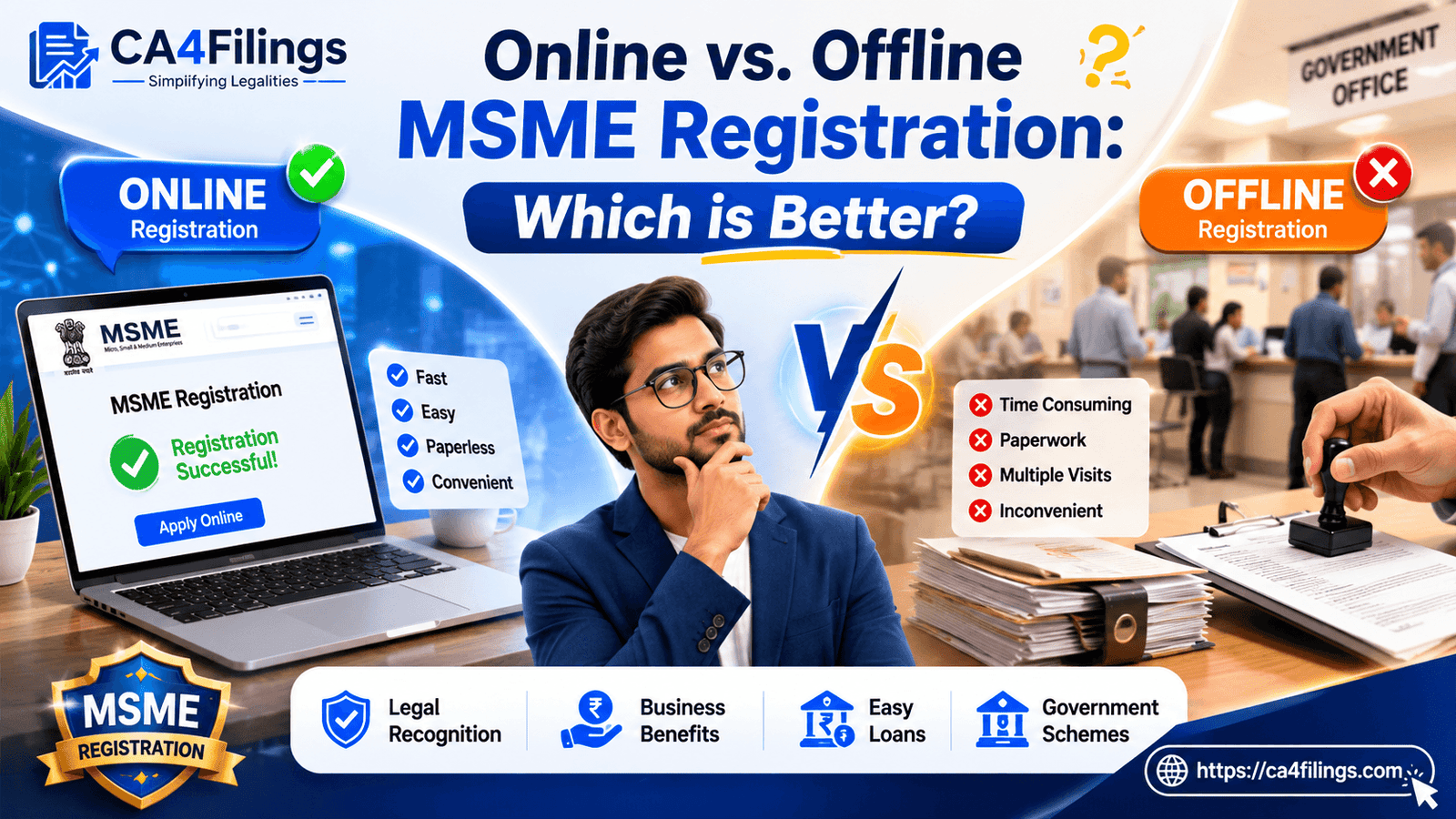
Online vs. Offline MSME Registration: Which is Better? — A Structural Comparison
To help you visualize the core elements of this business registration comparison, we have outlined the operational parameters below:
| Parameters | Online Method (Udyam Portal) | Offline Method (DIC Route) |
|---|---|---|
| Processing Time | Instant to 3 business days | 15 to 30 days depending on desk backlog |
| Paperwork Required | Zero paper; completely paperless data fetching | Extensive copies of PAN, Aadhaar, Deeds, and Bills |
| Physical Visit | Not required at all | Multiple visits to the local DIC office |
| Chances of Error | Minimal (verified via official databases) | High due to manual typing and form handling |
| Official Fee | Nil (Free of cost) | Nil (but involves high printing/travel costs) |
Unlocking Crucial MSME Benefits After Formalization
Regardless of the approach you select, completing the protocol grants your organization access to powerful MSME advantages designed by the government to foster industrial growth. These structural privileges include:
Collateral-Free Corporate Loans: Under the CGTMSE scheme, eligible small enterprises can secure credit lines without providing property collateral to banking institutions.
Protection Against Delayed Payments: The MSMED Act legally binds buyers to clear your invoices within 45 days. If they fail to comply, they are liable to pay compound interest at three times the bank rate.
Subsidies and Tender Preferences: Registered businesses get exclusive exemptions on tender earnest money deposits (EMD) and receive significant concessions on patent and trademark filings.
Step-by-Step Guide to Online Registration
Given the immense operational ease, we strongly recommend navigating through the official online portals. Here is a brief look at the digital process:
Visit the official Udyam Registration portal.
Provide your 12-digit Aadhaar number and complete the OTP authentication.
Enter your corporate PAN card details for system validation.
Fill in operational details such as bank accounts, factory address, and worker strength.
Select appropriate National Industrial Classification (NIC) codes matching your core services or manufacturing lines.
Submit the final form via OTP verification to instantly generate your registration tracking ID.
The Verdict: Online vs. Offline MSME Registration: Which is Better?
When we weigh all modern commercial factors, the definitive answer to Online vs. Offline MSME Registration: Which is Better? is undeniably the Online Method. The absolute transparency, zero fees, and remarkable processing velocity make the digital registration process the superior alternative for every forward-thinking entrepreneur in India. Offline paths should only be treated as an extreme emergency backup when intense document data mismatches occur.
Frequently Asked Questions (FAQs)
Q1: Can I convert my old physical SSI or EM-II certificate to online Udyam?
Yes, all older registrations (SSI, EM-I, EM-II, or UAM) must be migrated to the online Udyam portal. The old physical certificates are no longer valid for claiming current banking benefits.
Q2: Is an Aadhaar card mandatory for online registration?
Yes, Aadhaar is mandatory. For proprietorships, it must be the proprietor's Aadhaar; for partnerships, the managing partner's; and for private limited companies, the authorized director's Aadhaar is required.
Q3: How much money does CA4Filings charge for the government registration fee?
The government portal itself charges zero application fees. Professional fees charged by CA4Filings cover expert document validation, correct NIC code classification, and smooth end-to-end processing.
Q4: Does my MSME certificate expire over time?
No, the Udyam certificate issued online is valid for a lifetime, provided your business files its annual IT and GST returns continuously.
Let CA4Filings Simplify Your Business Setup
While the online layout is straightforward, picking incorrect industrial codes or putting in wrong investment numbers can get your application blocked or audited. Don't let compliance hurdles slow your momentum down. Reach out to the expert team at CA4Filings today, and let us handle your legal setup perfectly while you stay focused on growing your brand!
Latest Updates
ca4filings.com Services



















-registration.png)