Comparing MSME Registration with Other Business Registrations
Struggling to choose the right business entity? Our guide on Comparing MSME Registration with Other Business Registrations helps you make the right choice.
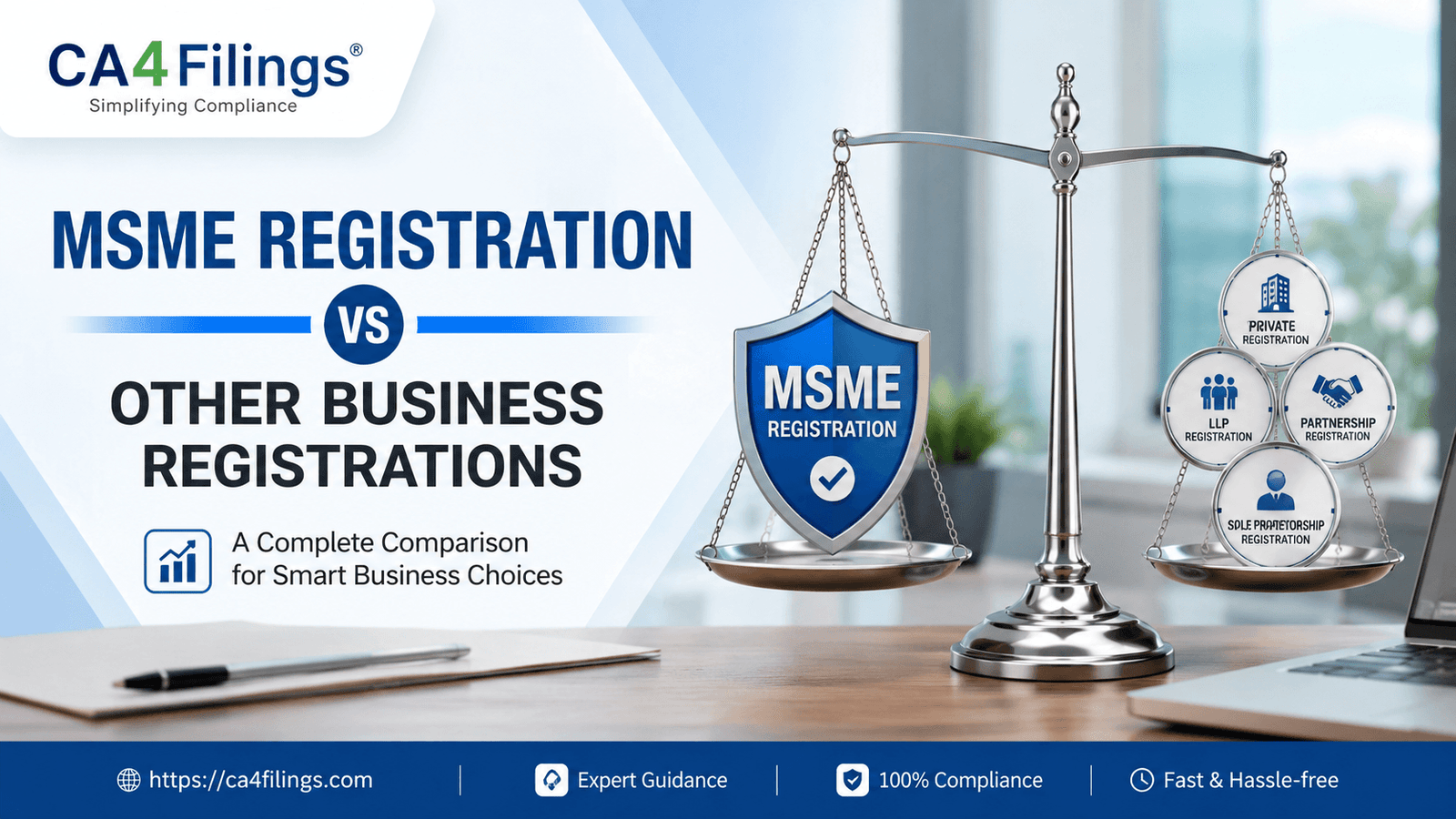
Selecting the right legal structure is often the first, and perhaps most critical, hurdle for any entrepreneur in India. When you begin your entrepreneurial journey, you will find yourself comparing MSME registration with other business registrations to determine what best suits your growth trajectory. It is common to feel overwhelmed by the alphabet soup of legal entities, but at CA4Filings, we simplify this process. Whether you are launching a startup or formalizing a family business, obtaining your MSME Registration is an excellent step toward accessing government schemes, priority sector lending, and various subsidies. Understanding the nuances of different business structures and legal structures is essential for long-term compliance and tax efficiency.
Understanding the Landscape of Business Registrations
Before diving into comparing MSME registration with other business registrations, it is important to clarify a common misconception: MSME (Micro, Small, and Medium Enterprises) registration is not necessarily a replacement for other business types; it is a government recognition certificate that can be layered on top of almost any business model.
When you look at choosing registration type, you are essentially looking at how your business will be governed, how it will be taxed, and the extent of your personal liability. From a simple sole proprietorship registration to a complex private limited company registration, each path offers different levels of protection and administrative requirements.
Comparative Analysis: Which Path is Right for You?
When we conduct a comparative analysis for our clients at CA4Filings, we look at the specific business needs and the long-term vision of the founders. Let’s break down the primary options:
Sole Proprietorship Registration
This is the simplest form of doing business. It is ideal for freelancers, local shops, or small consultants.
Pros: Minimal compliance, low cost, and full control.
Cons: Unlimited personal liability. If the business incurs debt, your personal assets are at risk.
Best for: Someone testing an idea or working solo.
Partnership Firm Registration
If you are starting a business with one or more partners, this is a traditional route.
Pros: Shared responsibility and capital.
Cons: Partners have joint and several liability, and the firm’s existence is tied to the partners.
Best for: Small-scale family businesses or professional services.
LLP Registration
An LLP registration offers a hybrid approach, combining the flexibility of a partnership with the benefit of limited liability.
Pros: Limited liability protection; no requirement for audits unless turnover exceeds a certain threshold.
Cons: Higher compliance than a proprietorship.
Best for: Professionals like architects, lawyers, or small-to-medium enterprises.
Private Limited Company Registration
The gold standard for startups and scalable businesses.
Pros: Separate legal entity, limited liability, and high credibility with investors.
Cons: Higher compliance, statutory audit requirements, and more rigorous annual filings.
Best for: Founders looking for venture capital, scaling operations, or building a brand.
Evaluating Registration Benefits and Business Requirements
The reason so many clients focus on comparing MSME registration with other business registrations is that MSME status acts as a catalyst. Regardless of whether you choose an LLP or a private limited company registration, an MSME certificate can unlock:
Interest rate subsidies on bank loans.
Protection against delayed payments from buyers.
Easier access to government tenders.
Lower costs for trademark and patent filings.
When evaluating your business requirements, consider your exit strategy. If you plan to sell the company or take it public, the structural rigor of a company is necessary. If you prefer low overheads and absolute simplicity, a proprietorship or partnership might suffice.
Key Considerations for Choosing Registration Type
As you weigh your options, keep these three factors at the forefront:
Liability: How much personal risk are you willing to take? If you are handling large contracts or high-risk ventures, limited liability entities are non-negotiable.
Scalability: Will you need external funding? Investors generally prefer investing in companies (Private Limited) rather than proprietorships.
Compliance: Are you prepared for the annual filings, board meetings, and audit requirements that come with formal corporate structures?
Frequently Asked Questions
Is MSME registration mandatory for all businesses?
No, it is not mandatory. However, it is highly recommended because it provides significant financial and legal advantages that can help small businesses compete with larger corporations.
Can I change my business structure later?
Yes, you can transition from a proprietorship to an LLP or a company as your business grows. While this involves legal processes, it is a common progression for successful Indian businesses.
Does MSME registration replace the need for a trade license?
No. An MSME certificate is for government recognition and benefits, while a trade license is a municipal requirement to operate a business in a specific location.
How does liability differ in an LLP versus a Partnership?
In a traditional partnership, you are personally liable for the firm’s debts. In an LLP, your liability is limited to your agreed contribution to the LLP, protecting your personal property.
What is the most cost-effective way to start?
For most, a proprietorship is the cheapest to register, but it offers the least protection. Many choose an LLP as a balanced starting point.
Partner with CA4Filings for Your Success
The process of comparing MSME registration with other business registrations is just the beginning of your compliance journey. Whether you decide on a sole proprietorship, an LLP, or a private limited company, the goal remains the same: building a solid, legal, and growth-oriented enterprise.
At CA4Filings, we take the stress out of your business documentation. From entity selection to filing your annual returns and securing your MSME benefits, we provide end-to-end guidance tailored to the Indian regulatory landscape. Don’t navigate the complexities of corporate law alone—let our experts handle the paperwork so you can focus on scaling your business.
Latest Updates
ca4filings.com Services



















-registration.png)