How to Maintain Books of Accounts for an LLP
Learn how to maintain books of accounts for an LLP in India. Discover legal requirements, step-by-step methods, and expert tips from CA4Filings.
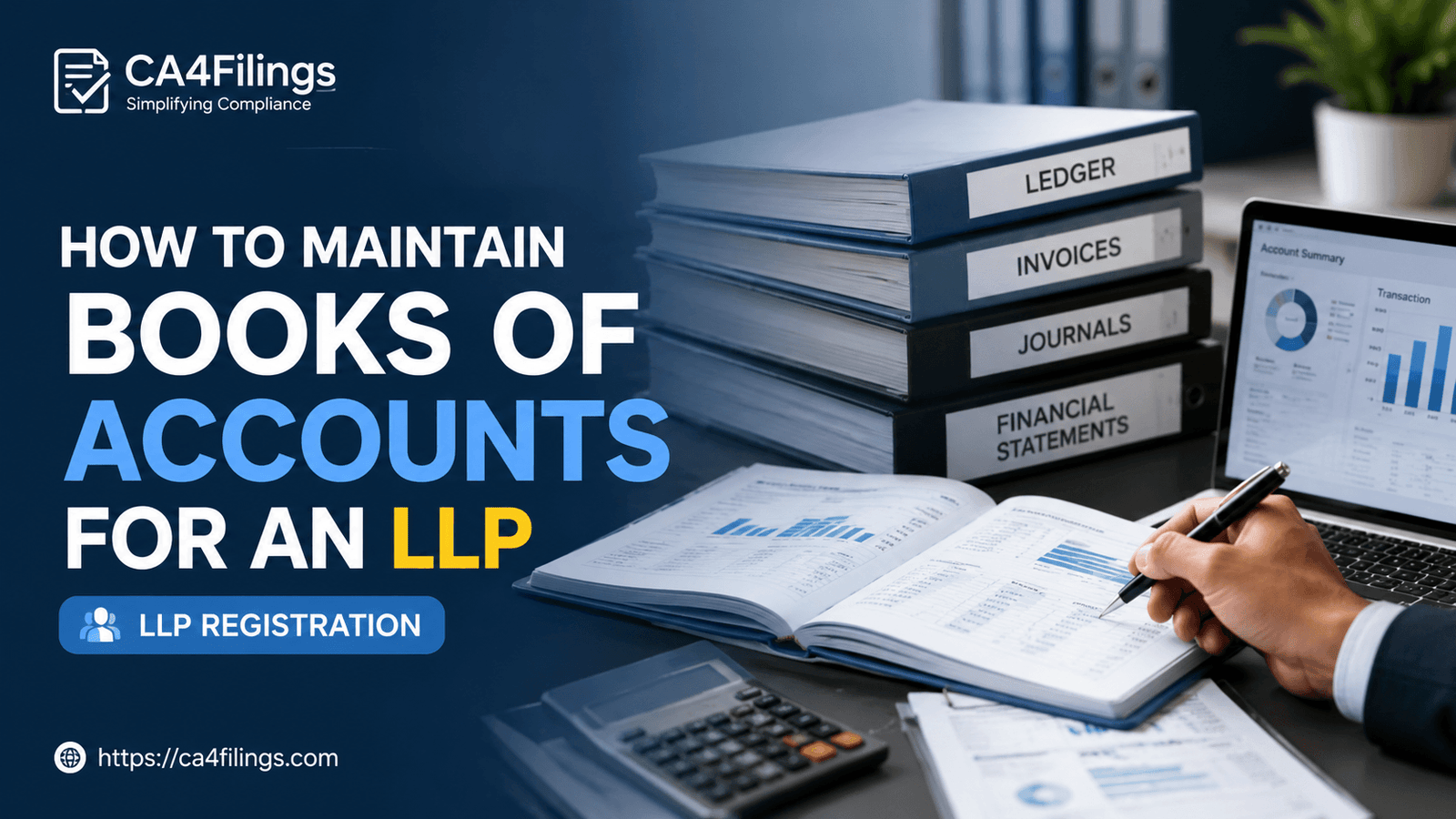
Starting a Limited Liability Partnership (LLP) is an exciting milestone for any entrepreneur in India. It gives you the best of both worlds: the flexibility of a partnership firm and the limited liability protection of a private limited company. However, once the initial excitement of setting up your business settles down, the core operational responsibilities kick in. Among these, compliance and financial tracking top the list. A question we frequently encounter from new business owners at CA4Filings is: How to Maintain Books of Accounts for an LLP efficiently and legally?
Maintaining accurate financial records is not just a good business practice; it is a strict statutory requirement under Indian law. If you are a new entrepreneur navigating this journey, it helps to understand the foundational steps, starting right from your LLP Registration process. Once your partnership is officially registered, setting up a robust accounting mechanism immediately ensures you avoid heavy penalties from the Ministry of Corporate Affairs (MCA) and the Income Tax Department down the road. Let’s dive straight into the step-by-step process of handling your LLP's finances like a pro.
Legal Requirements Under the LLP Act, 2008
Before looking at the "how," let’s understand the "why" and the legal framework governing LLP accounts in India.
Section 34 of the LLP Act, 2008 mandates that every limited liability partnership must maintain proper books of accounts relating to its affairs for each year. The law gives you the flexibility to maintain these records on either a cash basis or an accrual basis. Furthermore, you must follow the double-entry system of accounting.
The law specifies that your books must contain:
Details of all sums of money received and expended by the LLP, along with the matters in respect of which the receipt and expenditure take place.
A record of the assets and liabilities of the LLP.
Statements of cost of goods purchased, inventories, work-in-progress, finished goods, and cost of goods sold.
These books must be preserved for a minimum period of 8 years from the date they are made. Failing to maintain these records can attract a fine ranging from ₹25,000 to ₹5,00,000 for the LLP, and designated partners can face personal penalties between ₹10,000 and ₹1,00,000.
Step-by-Step Guide: How to Maintain Books of Accounts for an LLP
Managing your books doesn't have to be overwhelming. At CA4Filings, we advise our clients to break the process down into manageable, daily habits and structured monthly routines. Here is a clear workflow to implement in your business.
1. Separate Personal and Business Finances
The very first thing you must do after registration is open a dedicated current bank account in the name of your LLP. Never mix personal expenses with business transactions. Every single rupee entering or leaving the business must flow through this official current account.
2. Choose Your Accounting Method and Software
You need to decide whether your business will follow the Cash System (recording transactions only when cash changes hands) or the Accrual System (recording income and expenses when they are earned or incurred). Most growing LLPs prefer the accrual system because it offers a truer picture of financial health.
Next, ditch the physical registers and invest in reliable cloud-based accounting software like Tally Prime, Zoho Books, or QuickBooks. This makes tracking, invoicing, and reporting incredibly streamlined.
3. Record Daily Transactions Chronologically
Every financial event must be recorded systematically. Your accounting workflow should capture:
Sales/Invoices: All invoices raised for clients, tracking received payments and outstanding dues.
Purchases & Expenses: Vendor invoices, utility bills, office rent, and travel expenses. Always ensure you collect a valid tax invoice to claim Input Tax Credit (ITC) under GST.
Bank/Cash Vouchers: Regular reconciliation of bank statements with your accounting software entries to catch discrepancies early.
4. Maintain Essential Ledgers and Registers
To master how to maintain books of accounts for an LLP, your software configuration should automatically generate the following core ledgers:
Cash Book and Bank Book: Tracking real-time liquidity.
General Ledger: Categorized accounts for assets, liabilities, equity, revenue, and expenses.
Fixed Asset Register: Tracking company property, machinery, or laptops, along with calculated depreciation.
Inventory/Stock Register: Crucial for trading and manufacturing LLPs to evaluate closing stock at the end of the financial year.
Key Statutory Filings and Deadlines for an LLP
Maintaining your books perfectly is half the battle won; the other half is presenting this data to the government on time. An LLP has three major annual compliance milestones:
| Form / Filing | Purpose | Due Date |
|---|---|---|
| MCA Form 11 | Annual Return containing partner details and contributions. | May 30th (60 days from the close of the financial year) |
| MCA Form 8 | Statement of Account & Solvency (derived directly from your books). | October 30th (30 days from the end of 6 months of the financial year) |
| Income Tax Return (ITR-5) | Filing annual income tax details. | July 31st (Non-Audit cases) or October 31st (Audit cases) |
When is an LLP Audit Mandatory?
Unlike private limited companies, small LLPs enjoy an exemption from mandatory audits. An LLP is required to get its accounts audited by a practicing Chartered Accountant only if it meets either of these thresholds in any financial year:
The total turnover of the LLP exceeds ₹40 Lakhs, OR
The total capital contribution from partners exceeds ₹25 Lakhs.
Expert Practical Insights from CA4Filings
Over the years, we have seen many businesses face avoidable stress during tax season due to simple accounting oversights. Here is some expert advice to keep your LLP's finances clean:
Reconcile Weekly: Don't leave bank reconciliation for March 31st. Dedicate 30 minutes every Friday to match your bank balance with your software balance. It eliminates a massive headache at year-end.
Digitize Your Vouchers: Physical bills fade over time. Make it a habit to scan or photograph receipts and attach them directly to the transaction entry inside your accounting cloud software.
Keep Regular Track of GST Compliance: If your LLP is GST-registered, your books of accounts must perfectly match your GSTR-1, GSTR-3B, and GSTR-2B data. Mismatches frequently trigger automated tax notices.
Frequently Asked Questions (FAQs)
Can partners manage the LLP books themselves without a CA?
Yes, for daily data entry and recording transactions, partners or an in-house accountant can maintain the books using modern software. However, finalization of accounts, tax filing, and statutory audits (if applicable) require professional expertise to ensure complete legal compliance.
What happens if an LLP fails to maintain its books of accounts?
Failing to maintain proper financial records is a punishable offense. The MCA can levy heavy financial penalties on both the LLP entity and its designated partners. It also increases the risk of getting tax assessment notices and penalties from the Income Tax Department.
Can an LLP change its accounting method mid-year?
An LLP must follow a consistent accounting method (either cash or accrual) throughout the financial year. While you can technically shift your method for a new financial year with proper disclosure and justification, changing it mid-year is generally not permitted and creates immense compliance confusion.
Are physical bills mandatory if we use cloud accounting software?
While digital records are widely accepted, the Income Tax Department can ask for original proof during an assessment. It is highly recommended to store physical copies of major purchase bills, asset invoices, and agreements securely alongside your digital backups.
Let CA4Filings Handle Your Compliance
Understanding How to Maintain Books of Accounts for an LLP is vital to securing your business's financial foundation and ensuring uninterrupted growth. Clean financial records do more than satisfy government regulators; they provide you with deep, data-driven insights into your profit margins, operational leakages, and overall business health. They also make your business highly credible when approaching banks for business loans or pitching to prospective investors.
However, as a business owner, your primary focus should be on scaling operations, managing teams, and acquiring clients—not getting buried under a mountain of debits, credits, and compliance deadlines.
That is where we come in. At CA4Filings, our team of experienced Chartered Accountants handles everything from day-to-day bookkeeping and GST management to final statutory filings and MCA compliances for your LLP. Let us take care of the numbers so you can focus entirely on building your empire. Reach out to CA4Filings today for a seamless, stress-free accounting experience!
Latest Updates
ca4filings.com Services

























-registration.png)