How to Convert an Existing Partnership Firm into an LLP
Learn how to convert an existing partnership firm into an LLP with our comprehensive guide covering benefits, eligibility, and expert CA insights.
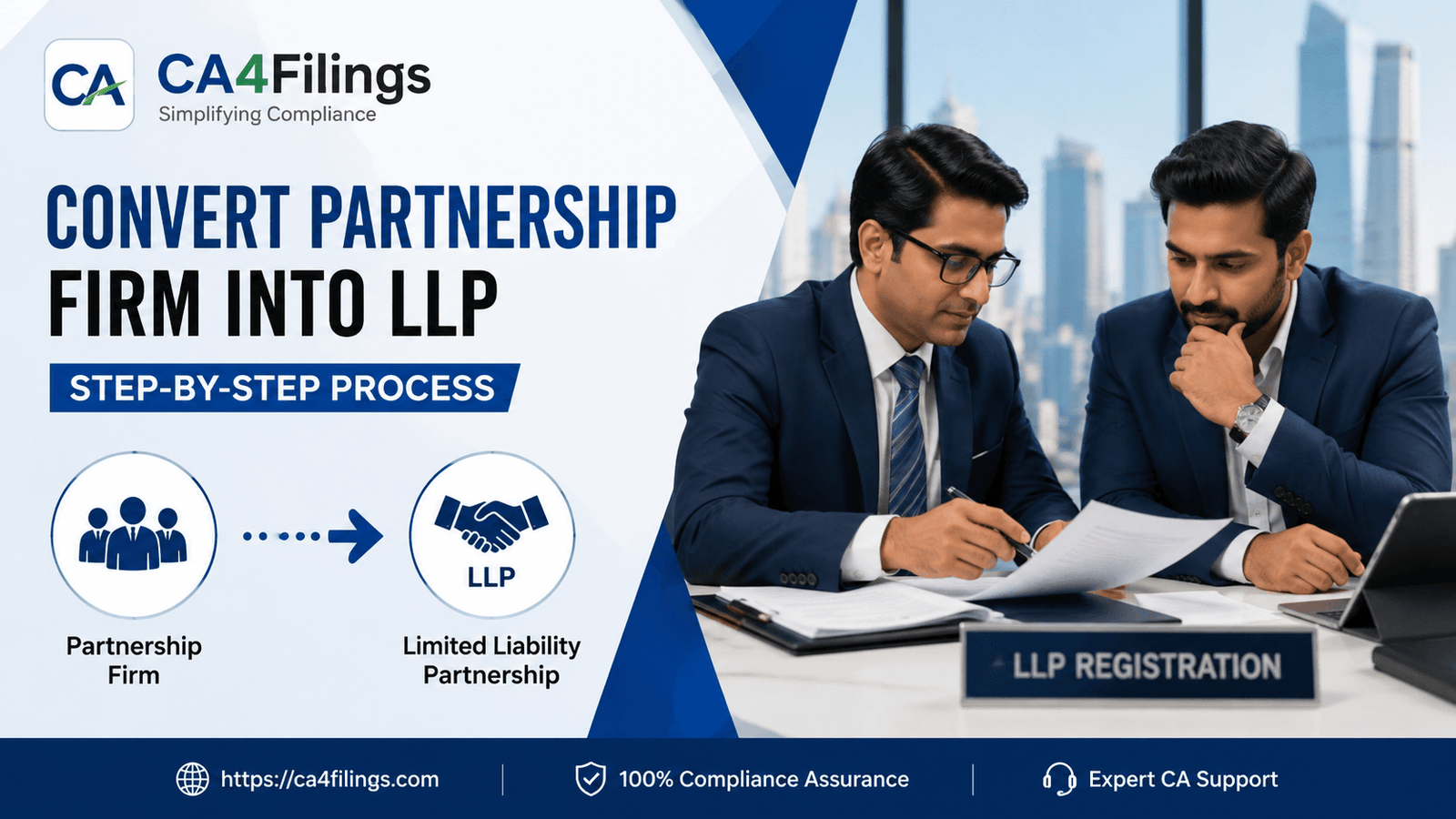
Running a traditional business in India comes with its own set of trials, especially when growth starts testing the boundaries of your current legal framework. Many traditional business owners eventually realize that while a partnership firm is incredibly easy to set up, the burden of unlimited personal liability hangs like a sword over their heads. If your business is expanding and you want to protect your personal assets while keeping operational flexibility intact, it is time to upgrade.
Knowing how to convert an existing partnership firm into an LLP is the first step toward securing your business's future. This strategic business conversion transitions your traditional setup into a modern corporate structure, introducing a layer of protection that shielding your personal wealth. When transitioning, managing the regulatory steps smoothly is critical. For instance, obtaining professional assistance for LLP Registration ensures that your foundational drafting and portal applications comply fully with the Ministry of Corporate Affairs (MCA) guidelines. Let’s break down exactly how this business transition works and how CA4Filings can help you navigate the legal procedure seamlessly.
Why Switch? Benefits of LLP Conversion
Before diving into the paperwork, it is essential to understand why making this change is highly beneficial for your business ownership. A Limited Liability Partnership (LLP) combines the operational flexibility of a traditional partnership firm with the structural advantages of a private limited company.
Here are the primary reasons Indian businesses are opting for this business entity conversion:
Limited Liability Protection: In a standard partnership, partners are personally liable for the firm's total debts. If the business defaults, your personal house, savings, and assets can be attached to settle claims. In an LLP, your liability is strictly limited to your agreed capital contribution.
Perpetual Succession: A partnership firm can legally dissolve upon the death, retirement, or insolvency of a partner. Conversely, an LLP enjoys continuous existence. Changes in partners do not affect its legal identity.
No Maximum Partner Limit: Traditional partnerships are restricted to a maximum of 50 partners. An LLP removes this bottleneck entirely, allowing you to bring in unlimited partners as you scale.
Tax Neutrality: Under Section 47(xiii) of the Income Tax Act, converting a firm into an LLP does not attract capital gains tax, provided the profit-sharing ratios and capital proportions remain identical post-conversion.
Eligibility Criteria for the Conversion
The MCA outlines specific rules under the Second Schedule of the LLP Act, 2008, regarding how to convert an existing partnership firm into an LLP. Your business must satisfy the following conditions before filing:
1. Mirror Match of Partners
The composition of the partners must remain exactly the same during the transition. Every single partner of the existing traditional firm must become a partner of the new LLP. You cannot introduce a brand-new partner or remove an existing one during the conversion process itself. Any structural changes can only be executed after the LLP is fully incorporated.
2. Unanimous Written Consent
Unlike everyday business decisions that might rely on a majority vote, converting the business structure requires 100% written consent from every single partner. A single dissenting voice can pause the entire legal procedure.
3. Up-to-Date Financial Cleanliness
The partnership firm must have filed its latest Income Tax Returns (ITR). Furthermore, you must prepare a statement of assets and liabilities that is certified by a practicing Chartered Accountant, ensuring the financial records are completely transparent before the corporate transition.
Step-by-Step Legal Procedure: Partnership to LLP
The entire process is handled digitally via the MCA V3 portal. Here is a step-by-step breakdown of how to convert an existing partnership firm into an LLP safely and legally.
Step 1: Obtain DSC and DPIN
Since all filings on the MCA V3 portal are completely paperless, every partner must obtain a Class 3 Digital Signature Certificate (DSC). Simultaneously, the partners who will take on managerial roles will apply for a Designated Partner Identification Number (DPIN).
Step 2: Name Reservation via RUN-LLP
You must file the RUN-LLP (Reserve Unique Name) web-form on the MCA portal. When filling this, select the option "Conversion of Firm into LLP". Ideally, you should maintain the original name of your traditional firm, simply changing the suffix to "LLP" or "Limited Liability Partnership" to keep your brand equity intact.
Step 3: Prepare the Statement of Assets and Liabilities
You will need a fresh statement of the partnership's assets and liabilities, which must be certified by a practicing Chartered Accountant. This financial snapshot must not be older than 30 days from the date you submit the conversion application.
Step 4: Simultaneous Filing of Form 17 and Form FiLLiP
This is the core of the conversion process. You must submit two critical web-forms together:
Form 17 (Application for Conversion): This contains the official conversion request, partner consents, structural details of the firm, and the CA-certified financial statement.
Form FiLLiP (Incorporation Form): This acts as the standard registration form for the Limited Liability Partnership, detailing the registered office address and partner credentials.
Step 5: Receive the Certificate of Registration
The Registrar of Companies (ROC) will scrutinize your application. If all data matches and complies with the rules, the ROC will issue a fresh Certificate of Incorporation (COI). From this specific date, your partnership firm is officially dissolved, and all assets, liabilities, and running contracts automatically vest into the new LLP.
Step 6: File the LLP Agreement (Form 3)
Within 30 days of receiving your COI, you must draft a comprehensive LLP Agreement on stamp paper of appropriate state value, sign it, and file it using Form 3 on the MCA portal. This document establishes the internal governance, capital distribution, and specific rights of the business ownership.
Vital Post-Conversion Steps to Keep in Mind
Getting your COI is a major milestone, but the business transition isn’t entirely complete until you update your ancillary statutory records.
Intimate the Registrar of Firms (ROF): Within 15 days of your incorporation, you must file Form 14 with the state Registrar of Firms to formally notify them that your old partnership has been converted and dissolved.
PAN and TAN Update: While the underlying tax structure remains similar, you must apply for a new PAN and TAN under the new LLP name.
GST Migration: You must update your GSTIN. This involves migrating your old registration to the new corporate entity and transferring any unutilized Input Tax Credit (ITC) cleanly.
Bank Accounts and Licenses: Your current bank accounts, existing vendor contracts, brand intellectual properties, and statutory licenses (like FSSAI or MSME registrations) must be updated to reflect the LLP status.
Frequently Asked Questions (FAQs)
Can an unregistered partnership firm convert directly into an LLP?
Yes, under the Second Schedule of the LLP Act, both registered and unregistered partnership firms can convert into an LLP. The core requirement remains that all partners of the existing firm must transition to the new LLP.
Is an audit mandatory for an LLP immediately after conversion?
No, an LLP does not require a mandatory statutory audit unless its total turnover cross ₹40 Lakhs or its total capital contribution exceeds ₹25 Lakhs in a given financial year.
What happens to the existing debts and liabilities of the old firm?
All liabilities, debts, and contractual obligations incurred by the partnership firm prior to the conversion are automatically transferred to the LLP. The partners remain jointly liable for pre-conversion liabilities, but all future liabilities are safely limited to the LLP framework.
Secure Your Business Future with CA4Filings
Transitioning your company structure from an ordinary partnership into a formal Limited Liability Partnership is one of the smartest scaling decisions you can make. However, drafting the correct consent forms, ensuring tax-neutral transitions, and navigating the digital quirks of the MCA V3 portal can get complex quickly.
At CA4Filings, our team of experienced Chartered Accountants manages the entire conversion pipeline for you. From securing digital signatures and verifying financial balances to drafting a watertight LLP agreement tailored to your long-term goals, we handle the legal heavy lifting. Let us guide your business transition seamlessly so you can focus entirely on growing your enterprise. Reach out to CA4Filings today to start your conversion process smoothly!
Latest Updates
ca4filings.com Services
























-registration.png)