ISO Certification vs. Other Certifications: What Sets It Apart?
Wondering about ISO Certification vs. Other Certifications: What Sets It Apart? Get expert insights from CA4Filings on why ISO stands out for your business.
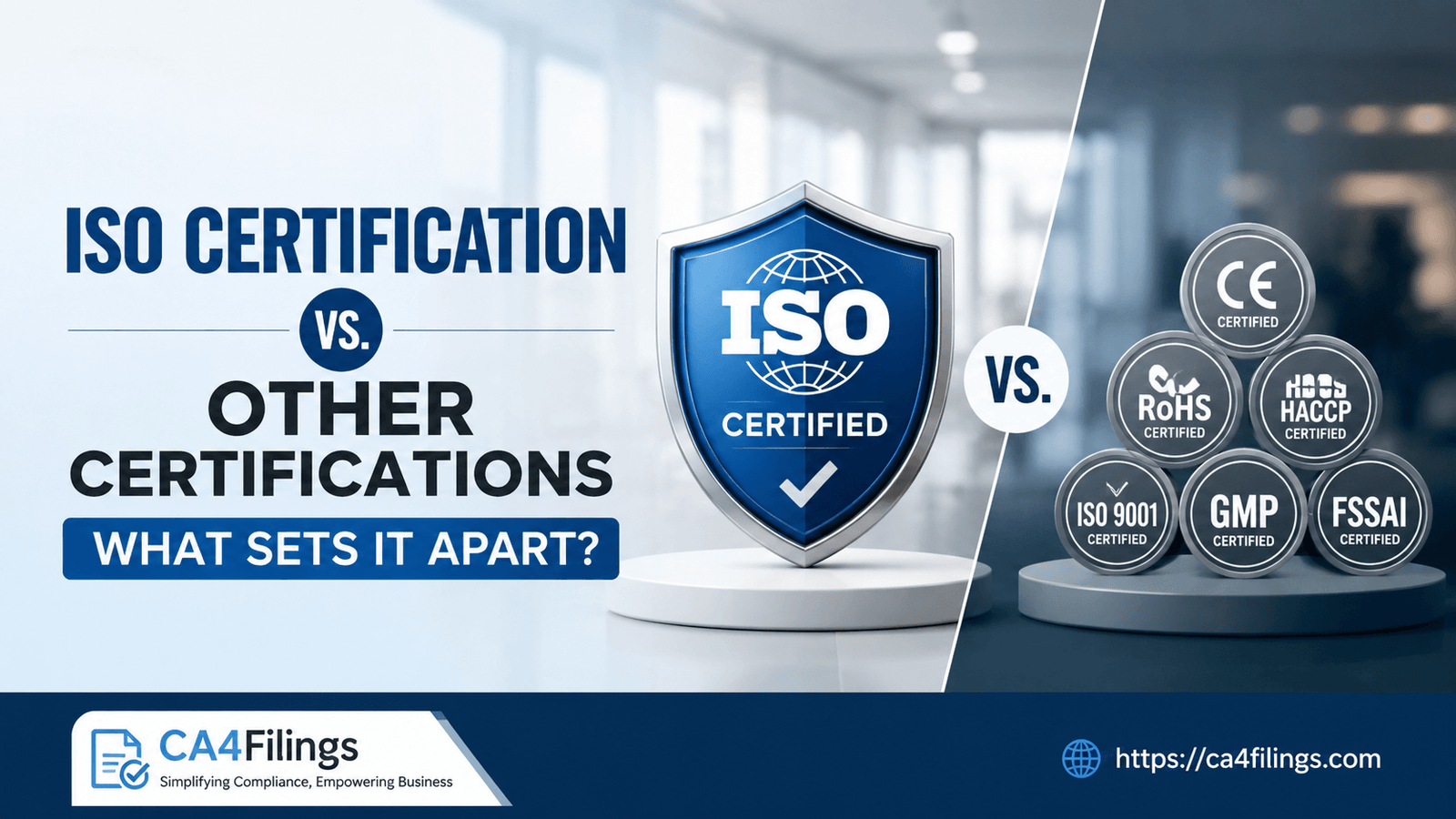
In the fast-paced Indian business landscape, entrepreneurs often find themselves drowning in a sea of acronyms and compliance requirements. One question I frequently hear at CA4Filings is whether an organization truly needs to prioritize international standards. When evaluating ISO Certification vs. Other Certifications: What Sets It Apart?, business owners must look beyond the badge and understand the operational value. Whether you are a manufacturing unit or a service provider, obtaining ISO Certification is often the missing piece in your scaling strategy, providing a structured framework that many localized or industry-specific certifications simply lack.
Understanding the Global Dominance of ISO Standards
When we talk about ISO standards, we are talking about a globally recognized language of business. Unlike many niche or regional certifications that focus solely on a specific product feature or a localized regulation, ISO (International Organization for Standardization) focuses on processes.
The primary difference lies in the holistic approach to quality management. While a local industry certification might tell you that your product is "safe" to sell in a specific market, ISO standards force you to look at your entire supply chain, management leadership, and continuous improvement protocols. This is why ISO is considered the gold standard for businesses looking to compete on a global scale.
ISO Certification vs. Other Certifications: What Sets It Apart?
The core distinction between ISO and other certifications comes down to quality assurance and universal applicability. Many "other" certifications are industry-specific, such as FSSAI for food or BIS for specific consumer goods in India. These are essential for market entry, but they are often prescriptive—meaning they tell you exactly what to do.
ISO, however, is performance-based. It provides a framework that allows you to design your quality control systems to fit your unique business model. Here is a breakdown of why this matters:
Process-Oriented: ISO isn't just about the final output; it’s about how you manage your resources, people, and risks.
Universal Recognition: An ISO 9001 certificate is understood in New Delhi just as well as it is in London or New York.
Scalability: Because ISO focuses on management systems, it grows with your company.
The Role of Popular ISO Frameworks
To understand the advantages of ISO certification, we should look at the most common standards we help our clients implement at CA4Filings:
ISO 9001: The backbone of quality management. It ensures your customers get consistent, good-quality products and services.
ISO 14001: Focuses on environmental management systems. It helps businesses reduce their ecological footprint—a major selling point for modern investors.
ISO 27001: Critical for our IT and fintech clients, this deals with information security management.
ISO 45001: Dedicated to occupational health and safety, essential for construction and manufacturing sectors in India.
Why ISO Outperforms Niche Industry Standards
When comparing ISO vs other certifications, many clients ask if they can skip ISO if they already have an industry license. My advice as a CA is always the same: do not confuse compliance with excellence.
A license allows you to operate; ISO allows you to thrive. The benefits of ISO certification include improved operational efficiency, reduced waste, and a significant boost in brand credibility. When a potential vendor or international partner sees that you are ISO-certified, it removes the need for them to conduct extensive, costly audits of your facility. They know you have met a rigorous, documented benchmark.
Navigating the Certification Process
The certification process can seem daunting, but it is highly systematic. It involves:
Gap Analysis: Assessing where your current processes fall short of the standard.
Documentation: Creating the mandatory records that prove your system works.
Implementation: Putting the system into daily practice.
Internal Audit: Checking your own work before the final assessment.
External Audit: A third-party registrar verifies your compliance.
While other certifications might require a one-time product test, the ISO journey is one of continuous improvement. You aren't just "certified"—you are committed to a cycle of monitoring and refining your business.
Frequently Asked Questions
Is ISO certification mandatory for all businesses in India?
Generally, no. However, many government tenders and large corporate contracts now mandate it as a prerequisite.
How long does it take to get certified?
Depending on your company size and current systems, the process typically takes anywhere from 3 to 6 months.
What are the main advantages of ISO certification?
Key advantages include better brand reputation, reduced operational costs through waste reduction, and the ability to win larger, international contracts.
How do I choose the right standard for my business?
It depends on your sector. If you are in manufacturing, start with ISO 9001. If you handle sensitive data, look at ISO 27001.
At the end of the day, when you weigh ISO Certification vs. Other Certifications: What Sets It Apart?, the answer is clear: ISO is about institutionalizing excellence. While niche certifications keep you legal, ISO builds a foundation for long-term growth and trust.
If you are ready to elevate your business standards and want a professional team to handle the technical heavy lifting, CA4Filings is here to guide you. From gap analysis to final audit support, we make the journey toward certification seamless and stress-free. Contact CA4Filings today and let’s get your business on the global map!
Latest Updates
ca4filings.com Services

























-registration.png)