ISO Certification Process: A Step-by-Step Guide for Indian Companies
Simplify the ISO Certification Process: A Step-by-Step Guide for Indian Companies. Learn how CA4Filings helps you achieve compliance and boost trust.
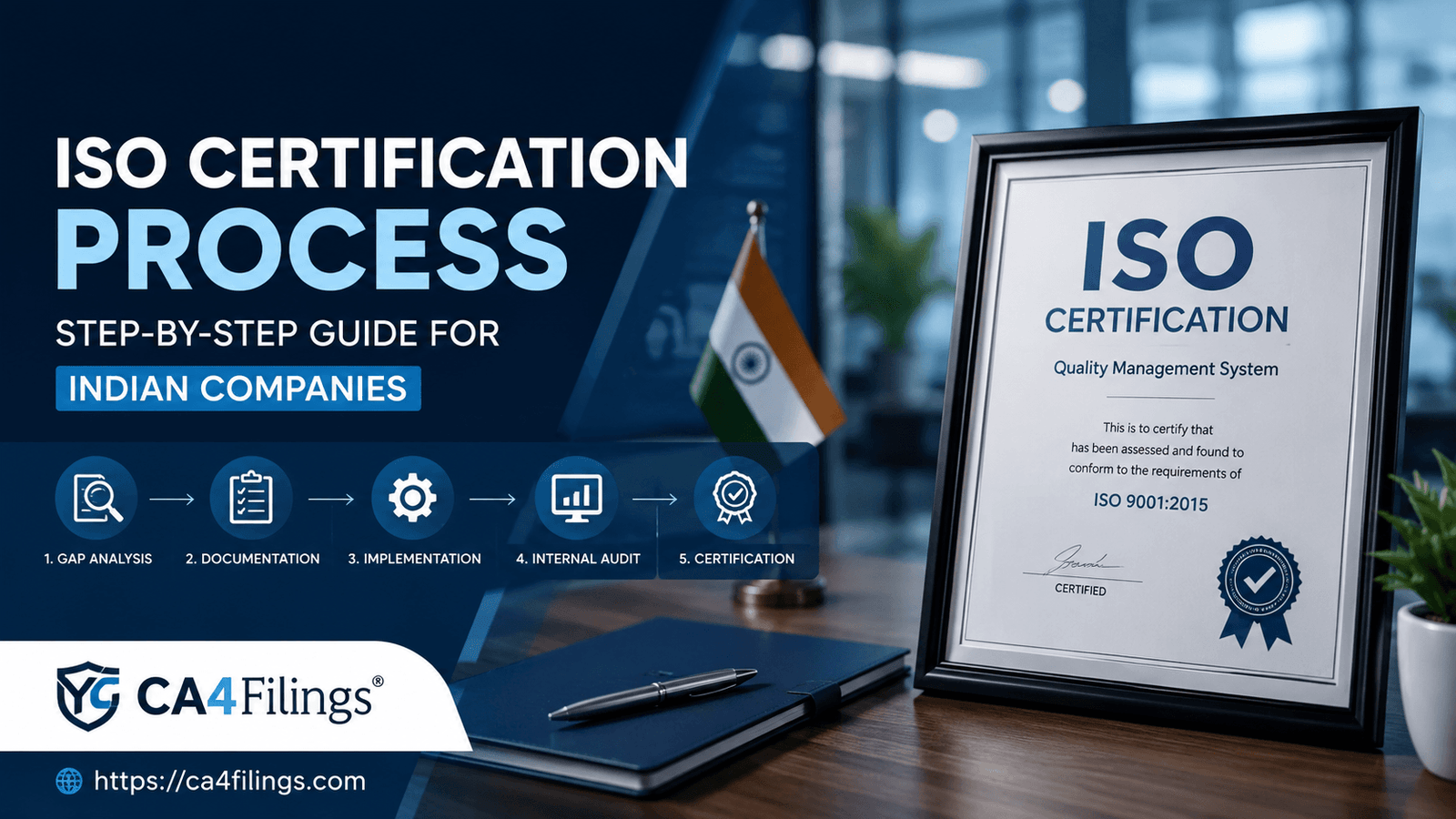
Achieving international standards is a significant milestone for any growing business in India. Whether you are aiming to build trust with global clients or streamline your internal operations, the ISO Certification Process: A Step-by-Step Guide for Indian Companies is your roadmap to excellence. At CA4Filings, we often see businesses struggle with the complexities of compliance, which is why we simplify the path to obtaining your ISO Certification to help you stay ahead of the competition.
Understanding the ISO Certification Process: A Step-by-Step Guide for Indian Companies isn’t just about getting a paper certificate; it is about adopting a culture of continuous improvement. Let’s break down how you can navigate this journey successfully.
Why Indian Businesses Need ISO Certification
In today’s competitive market, credibility is everything. An ISO certificate acts as a third-party validation that your processes meet international quality and safety benchmarks. For Indian MSMEs and larger enterprises alike, this certification can open doors to government tenders, improve operational efficiency, and significantly boost customer trust.
The ISO Certification Process: A Step-by-Step Guide for Indian Companies
While the process might seem daunting, it is highly structured. Here is the typical flow an organization should follow to ensure a smooth certification journey.
Step 1: Identifying the Right Standard
The first phase of the ISO Certification Process: A Step-by-Step Guide for Indian Companies is choosing the correct standard. Common examples include:
ISO 9001: Quality Management System (QMS).
ISO 14001: Environmental Management.
ISO 27001: Information Security Management.
Step 2: Gap Analysis
Before you change your systems, you need to know where you stand. A "Gap Analysis" compares your current operational practices against the requirements of the chosen ISO standard. This helps in identifying what is missing—be it documentation, process controls, or employee awareness.
Step 3: Documentation and Implementation
This is the core of the ISO Certification Process: A Step-by-Step Guide for Indian Companies. You must document your policies, standard operating procedures (SOPs), and work instructions. Once documented, these must be implemented across your organization. Training your staff to follow these new protocols is critical here.
Step 4: Internal Audit
You must conduct an internal audit to verify that your management system is functioning as planned. This acts as a "dress rehearsal" before the final external audit. Any non-conformities found during this stage should be corrected immediately.
Step 5: Management Review
Top management must review the findings of the internal audit and the overall performance of the management system. This ensures that the system is aligned with your business objectives and remains effective.
Step 6: External Certification Audit
The certification body (registrar) will conduct an audit in two stages:
Stage 1 (Documentation Review): The auditor reviews your documents to ensure they meet the standard.
Stage 2 (On-site Audit): The auditor visits your facility to verify that your processes align with your documents and the standard’s requirements.
How to Maintain Your Certification
Obtaining the certificate is not the end. The ISO Certification Process: A Step-by-Step Guide for Indian Companies includes a commitment to maintenance. You will undergo annual surveillance audits during your three-year certification cycle to prove that you are still complying with the standards.
Frequently Asked Questions (FAQs)
How long does the ISO certification take?
The timeline depends on the size and complexity of your organization. Generally, it can take anywhere from 3 to 9 months.
Is ISO certification mandatory in India?
For most private businesses, it is voluntary but highly recommended for market credibility. However, some specific government tenders or international trade contracts may mandate it.
How much does the certification cost?
Costs vary based on the number of employees, the nature of your business processes, and the certification body you choose.
Can a small business get certified?
Absolutely. ISO standards are designed to be scalable, meaning they are just as effective for small startups as they are for large corporations.
What is the validity of the certificate?
An ISO certificate is typically valid for three years, subject to annual surveillance audits.
Get Expert Guidance with CA4Filings
Navigating the ISO Certification Process: A Step-by-Step Guide for Indian Companies can be time-consuming, but you don't have to do it alone. At CA4Filings, we provide end-to-end support to ensure your business meets all compliance requirements seamlessly. Don’t let administrative hurdles hold back your growth.
Latest Updates
ca4filings.com Services


























-registration.png)