How ISO Certification Impacts Global Trade for Indian Businesses
Discover how ISO certification impacts global trade for Indian businesses, boosting credibility, competitiveness, and international market access.
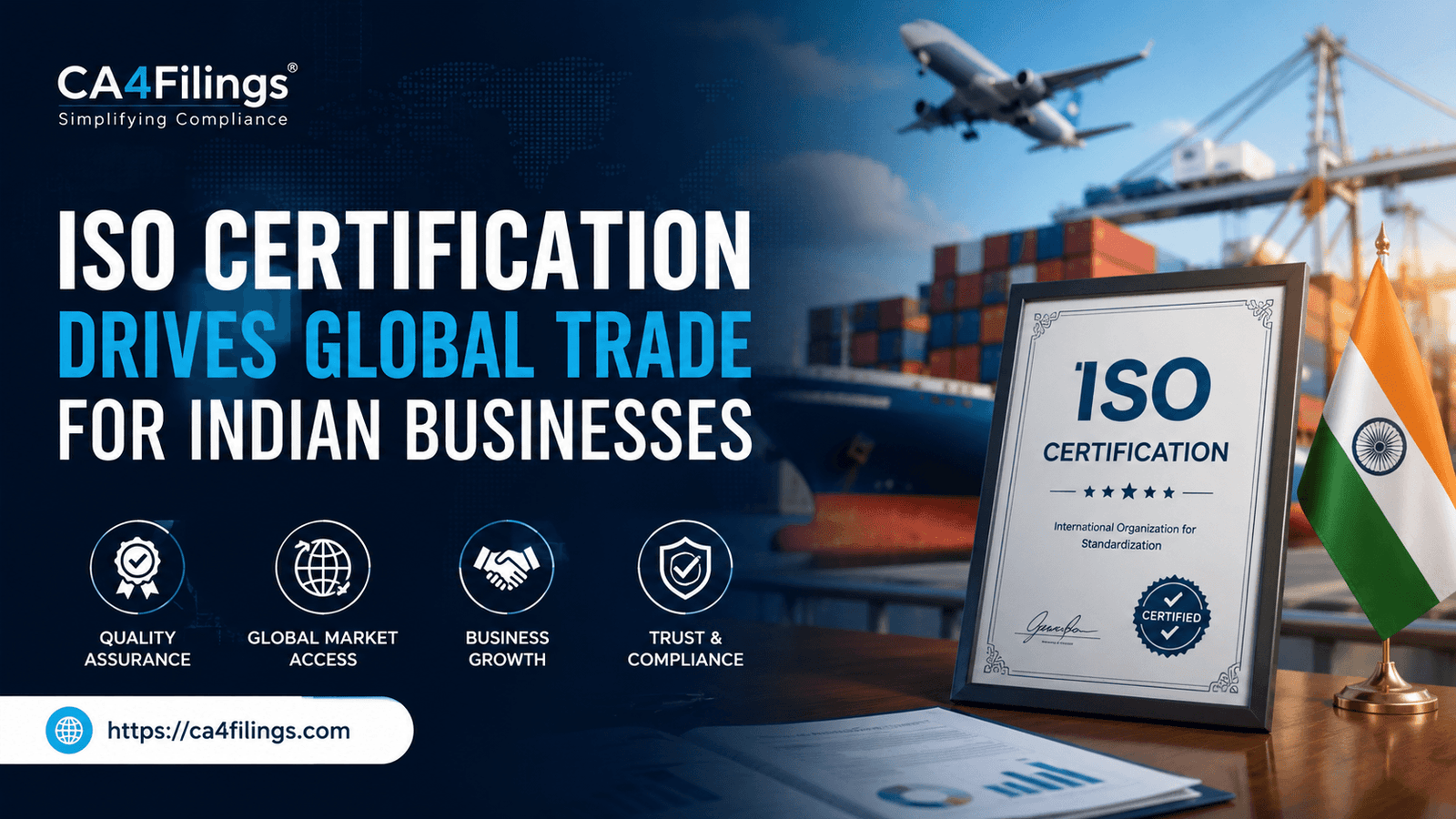
The landscape of international commerce is shifting rapidly. For Indian entrepreneurs, the post-pandemic global economic order presents unprecedented opportunities. Whether you are an auto-component manufacturer in Pune, a software exporter in Bengaluru, or an organic textile producer in Coimbatore, the world is your marketplace. However, stepping onto the global stage comes with a strict prerequisite: proving that your products and processes meet international benchmarks. If you want to know how ISO certification impacts global trade for Indian businesses, you have come to the right place. At CA4Filings, we assist hundreds of exporters annually, and we consistently see that businesses equipped with international standards scale faster and face fewer trade barriers.
Securing an ISO Certification is often the defining factor between winning a lucrative international contract or losing it to a global competitor. When Indian businesses align their operational frameworks with recognized international frameworks, they signal to foreign buyers that they prioritize quality assurance and consistency. Let’s dive deep into how these standards function as a catalyst for business growth and a passport to new trade opportunities.
Understanding the Relationship: How ISO Certification Impacts Global Trade for Indian Businesses
To truly grasp how ISO certification impacts global trade for Indian businesses, one must look at how international supply chains operate today. Large multi-national corporations (MNCs) in the US, Europe, and Japan do not have the time to audit every single tier-2 or tier-3 supplier located thousands of miles away. Instead, they rely on standardized quality management systems as a filtering mechanism.
When an Indian MSME applies for a global tender, the very first compliance checkbox is usually an ISO credential. The impact of ISO certification on global trade is visible in how it reduces transactional friction. It acts as a universal business language. An ISO 9001 or ISO 14001 certificate tells a buyer in Germany or Australia that your business follows systematic processes, minimizing their risk of importing sub-standard or non-compliant goods.
Breaking Down Technical Barriers to Trade (TBT)
One of the greatest hurdles in global trade is navigating the Technical Barriers to Trade (TBT) imposed by different nations. Every country has its own safety, environmental, and quality regulations. This is where the power of ISO standards becomes evident.
Harmonization of Standards: ISO (International Organization for Standardization) bridges the gap between domestic and foreign regulatory requirements. By implementing these globally accepted trade standards, Indian businesses ensure their products are automatically compliant with the broad baseline regulations of target export countries.
Reduced Product Rejections: Customs departments and international border authorities are less likely to flag or hold shipments from companies that demonstrate stringent compliance with international safety and quality rules.
Streamlined Testing and Certification: Often, being ISO-certified reduces the need for redundant product testing in destination markets, saving exporters substantial time and money.
Enhancing Competitiveness and Credibility on the World Stage
The global marketplace is hyper-competitive. Indian exporters don’t just compete on price; they compete against highly efficient automated facilities across Europe and Southeast Asia.
Building Unshakeable Credibility
Foreign buyers are naturally cautious when dealing with overseas suppliers for the first time. They worry about delivery timelines, material defects, and operational stability. An ISO stamp provides immediate credibility. It proves that a third-party registrar has audited your operations and verified your commitment to sustained quality assurance.
Boosting Operational Competitiveness
The benefits of certification extend far beyond marketing. The certification process forces an organization to optimize its internal processes. By adopting standard operating procedures (SOPs), businesses experience less wastage, lower operational errors, and higher productivity. This structural efficiency allows Indian businesses to offer competitive pricing globally without eroding their profit margins, fostering sustainable business growth.
Expanding Market Access and Improved Market Presence
If your growth strategy relies solely on the domestic Indian market, you are missing out on premium margins available abroad. However, entering high-value jurisdictions like the European Union (EU) or North America requires strict adherence to environmental and data security benchmarks.
Accessing Restricted Sectors: Industries like aerospace, medical devices, automotive, and defense supply chains strictly prohibit non-certified vendors. For instance, AS9100 (built on ISO 9001) is mandatory for aerospace exporters.
Improved Market Presence: Having these certifications helps Indian brands position themselves as premium, reliable partners rather than low-cost, budget alternatives. This shifts the consumer perception of 'Made in India' toward high-value precision and dependability.
Unlocking Government Tenders: Many foreign governments and institutional buyers specify ISO compliance as a mandatory eligibility criterion in their global procurement notices.
Key ISO Standards Driving Global Trade for Indian Exporters
Depending on your industry sector, different ISO standards will unlock specific trade opportunities. Here are the most prominent ones driving growth for Indian businesses:
ISO 9001 (Quality Management System - QMS): The foundational standard applicable to every industry. It focuses on customer satisfaction and process-driven consistency.
ISO 14001 (Environmental Management System - EMS): Vital for exporters targeting western markets, where carbon footprint, sustainability, and green supply chains are heavily scrutinized.
ISO 22000 (Food Safety Management System): A must-have for India's massive agricultural and processed food export sector to comply with global food safety laws.
ISO/IEC 27001 (Information Security Management System): Crucial for our IT, SaaS, and BPM exporters handling sensitive international client data.
Step-by-Step Guide: Navigating the Certification Process with CA4Filings
Achieving certification might seem overwhelming, but breaking it down into structured phases makes it straightforward. Here is how the certification process unfolds:
Phase 1: Gap Analysis and Planning
Analyze your existing workflows against the chosen ISO framework. Identify areas where your current processes fall short of global trade standards.
Phase 2: Documentation and Implementation
Develop the required documentation, including standard quality manuals, operational procedures, and record-keeping formats. Train your workforce to adopt these new standardized practices daily.
Phase 3: Internal Auditing
Conduct internal audits to test the newly implemented systems. This ensures that any operational loopholes are identified and corrected before the final assessment.
Phase 4: Final External Audit and Issuance
An independent, accredited certification body conducts a comprehensive audit of your business. Upon successful verification, they issue your certification, setting you up for rapid global expansion.
How ISO Certification Impacts Global Trade for Indian Businesses
In summary, understanding how ISO certification impacts global trade for Indian businesses is essential for anyone looking to scale past geographical borders. It transforms a local enterprise into a globally respected brand, removing trade friction and opening doors to premium market segments.
Don't let compliance paperwork hold your business back from exploring global trade opportunities. At CA4Filings, we act as your dedicated corporate advisory partners, smoothing out the entire application and audit process so you can focus on building world-class products. Get in touch with the CA4Filings team today, and let’s take your business global!
Frequently Asked Questions (FAQs)
How long does it take for Indian businesses to get an ISO certification?
The timeline varies based on the size and complexity of the business. For small to medium enterprises (SMEs), it typically takes anywhere from 3 to 6 weeks to complete the documentation, implementation, and final audit process.
Is ISO certification mandatory for exporting goods from India?
Legally, the Indian government may not mandate it for all products, but practically, foreign buyers, overseas customs, and global tenders frequently make it a mandatory contractual condition. Without it, your market access is severely restricted.
Can an ISO certificate help reduce insurance and shipping liabilities in global trade?
Yes. Many international marine insurers and logistics providers view ISO-certified businesses as low-risk clients. Demonstrating structured quality management systems can often help negotiate better insurance premiums and freight terms.
What is the validity of an ISO certificate, and how do we renew it?
An ISO certificate is generally valid for 3 years. However, to maintain its validity, the business must undergo annual surveillance audits conducted by the certification body to ensure ongoing compliance with the standards.
Latest Updates
ca4filings.com Services
























-registration.png)