GST Registration for E-commerce Businesses
Looking to sell online? Here is a complete guide on GST Registration for E-commerce Businesses, including rules, documents, and step-by-step process.
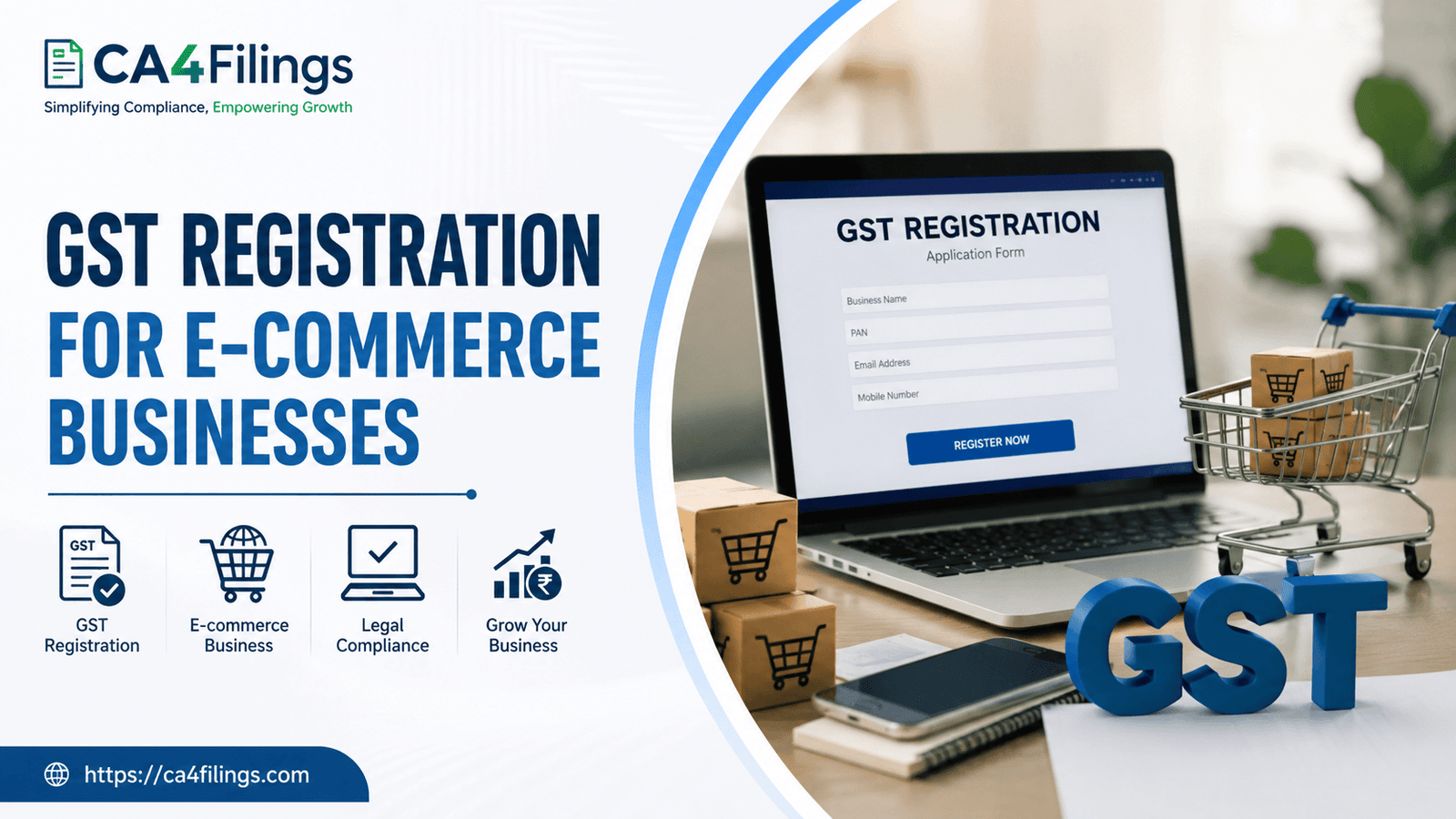
The digital revolution in India has opened massive doors for small shopkeepers, home-grown brands, and budding entrepreneurs. Selling on Amazon, Flipkart, Myntra, or through your own Shopify store sounds incredibly exciting. But as an experienced Chartered Accountant, let me give you a quick reality check before you upload your first product catalog: you cannot skip the taxman. Navigating the world of indirect taxes can seem daunting, but securing a GST Registration for E-commerce Businesses is your very first passport to the online marketplace.
At CA4Filings, we encounter dozens of enthusiastic sellers every week who ask us if they really need a GSTIN for their startup. The short answer for most online sellers is a resounding Yes. While traditional offline businesses enjoy a threshold exemption of up to ₹20 lakhs or ₹40 lakhs before needing a registration, the rules change drastically when you enter the digital space. If you want to expand your reach across India, understanding the exact nuances of E-commerce GST registration in India is absolutely non-negotiable. If you need any assistance with your basic tax onboarding, you can seamlessly complete your GST Registration through our experts to ensure absolute legal compliance right from day one.
E-commerce GST Registration Eligibility Criteria: Who Mandatorily Needs It?
Let’s clear the air around the E-commerce GST registration eligibility criteria. Under Section 24 of the CGST Act, certain categories of suppliers are mandatorily required to register for GST, completely irrespective of their annual turnover. Knowing these rules ensures you remain fully compliant while setting up your online venture.
E-commerce Operators (ECOs): If you run a platform where other people sell goods or services (like Amazon or Swiggy), you are an E-commerce Operator. You must apply for a GST Registration for E-commerce Businesses from day one.
Online Sellers of Goods: If you are selling physical goods across states through platforms like Flipkart or Amazon, you must register for GST as an E-commerce seller immediately. There is no ₹40 lakh relaxation for interstate supply of goods online.
Exemption for Service Providers: If you are providing services online (such as online tutoring or consulting) via an e-commerce platform, you are exempt from mandatory registration until your total pan-India aggregate turnover crosses ₹20 lakhs.
GST registration for online sellers in India: It is crucial to note that recent micro-taxpayer exemptions allow certain intra-state sellers to sell without GST, but major marketplaces still mandate it during their internal onboarding processes.
Key GST Registration Requirements for Online Businesses
Before jumping into the portal, you must understand the basic framework governing an online business GST registration. The structural setup of your business dictates how your taxes will be assessed. Whether you operate as a Sole Proprietorship, a Partnership firm, or a Private Limited Company, your entity must have a designated "Principal Place of Business".
For many home-grown e-commerce entrepreneurs, their residential address serves as their primary office. This is legally acceptable under the GST registration requirements for online businesses, provided you have the right documentation. Furthermore, if you store your goods in Amazon's fulfillment centers (FBA) or Flipkart's warehouses, those locations must be officially declared as your "Additional Place of Business" in your GST certificate to maintain robust E-commerce GST compliance.
Mandatory GST Registration Documents for E-commerce
To ensure a smooth, rejection-free application, you must keep your paperwork flawless. The tax department scrutinizes e-commerce applications quite carefully to avoid dummy entities. Gathering all the mandatory GST registration documents for E-commerce beforehand saves significant processing time.
Here is the quick checklist of essential documents that you must assemble:
For Sole Proprietorship: PAN Card, Aadhaar Card, Passport photo, and proof of address (like a recent electricity bill along with a No Objection Certificate if the property is owned by a family member).
For Partnerships / LLPs: Partnership Deed, LLP Incorporation Certificate, and PAN cards of all active partners.
For Private Limited Companies: Company PAN Card, Certificate of Incorporation (COI), MOA, AOA, and a Board Resolution authorizing the signing director.
Bank Proof: A cancelled cheque or recent bank statement showcasing the registered business name.
Step-by-Step Guide for GST Registration in E-commerce
The actual application process is digital, but it requires extreme precision. A single typo in your address or an unclear document upload can result in a "Clarification" notice, delaying your business launch by weeks. Here is a simplified step-by-step guide for GST registration in E-commerce followed by our team at CA4Filings:
Step 1: Generation of Temporary Reference Number (TRN)
Go to the official GST Portal, navigate to Services and select New Registration. Input your legal business name, PAN card details, primary email, and mobile number to generate your 15-digit Temporary Reference Number (TRN).
Step 2: Filling out the Detailed Application
Log back into the portal using your TRN. Fill out the application tabs including Business Details, Promoter info, and Principal Place of Business. Ensure you select the appropriate HSN codes for the products you intend to sell.
Step 3: Uploading Documents and Adding Warehouses
Carefully upload clear copies of all the required GST registration documents for E-commerce. If you are enrolling in Amazon FBA, make sure you add their specific warehouse address under the "Additional Place of Business" section.
Step 4: Verification and ARN Generation
Sign the application digitally using an Electronic Verification Code (EVC) sent to your registered mobile number or via a Digital Signature Certificate (DSC). Upon submission, an Application Reference Number (ARN) will be generated to track your final approval.
Understanding Crucial E-commerce GST Compliance
Getting your GSTIN is just the beginning of your journey; the real task is maintaining regular tax filings. The Indian tax structure has laid down stringent guidelines for online portals and sellers to prevent tax evasion.
When you sell through marketplaces, these platforms are legally mandated to deduct Tax Collected at Source (TCS) at a rate of 1% from your net online sales before remitting the money to your bank account. To manage your accounts properly, understanding the complete GST registration process for E-commerce and subsequent filing rules is vital. You will typically need to file GSTR-1 for outward sales and GSTR-3B for monthly tax summaries. Even if you have made zero sales in a particular month, filing a "Nil Return" remains legally mandatory.
Why Professional Intervention Matters
While the online system looks straightforward on paper, real-world execution frequently hits roadblocks. Picking the wrong HSN codes or misconfiguring your corporate authorization letters are the top reasons why applications get flagged.
By trusting CA4Filings with your GST Registration for E-commerce Businesses, you get a dedicated team of experienced Chartered Accountants who manage everything—from document validation to the final filing. We let you focus entirely on your inventory, sourcing, and digital marketing, while we manage the complex backend legalities.
Frequently Asked Questions (FAQs)
Q1. Can I sell online without getting a GST Registration for E-commerce Businesses?
If you are selling physical goods through third-party marketplaces across states, you cannot sell without a GST registration. Major marketplaces demand a valid GSTIN during seller onboarding to comply with federal tax structures.
Q2. Can I use my rented residential home address for online business GST registration?
Yes, you can use a rented residential address as your principal place of business. You will need to upload a copy of the rent agreement, a recent utility bill under the owner's name, and a signed No Objection Certificate (NOC) from the landlord.
Q3. What is TCS in e-commerce, and will I get that money back?
TCS stands for Tax Collected at Source. E-commerce platforms deduct 1% from your taxable sales value before paying you. This deducted amount reflects in your GST portal under the TCS cash ledger, which you can easily claim back monthly to offset your regular tax liabilities.
Q4. What happens if I forget to file my e-commerce GST returns on time?
Failing to file your returns on time attracts a daily late fee penalty along with 18% per annum interest on any unpaid tax liabilities. Continuous non-compliance can also lead to the suspension or cancellation of your GSTIN.
Launch Your Online Business Confidently with CA4Filings
Stepping into the digital marketplace is a fantastic business decision, but building it on a shaky legal foundation can derail your growth. Securing your GST Registration for E-commerce Businesses correctly ensures that your seller accounts remain active, your transit goods face no legal hassles, and you smoothly claim all eligible input tax credits on your purchases, logistics, and packing materials.
Latest Updates
ca4filings.com Services
























-registration.png)