Consequences of Not Registering for GST
Discover the legal, financial, and business Consequences of Not Registering for GST. Learn about GST penalties, and how to stay compliant with CA4Filings.
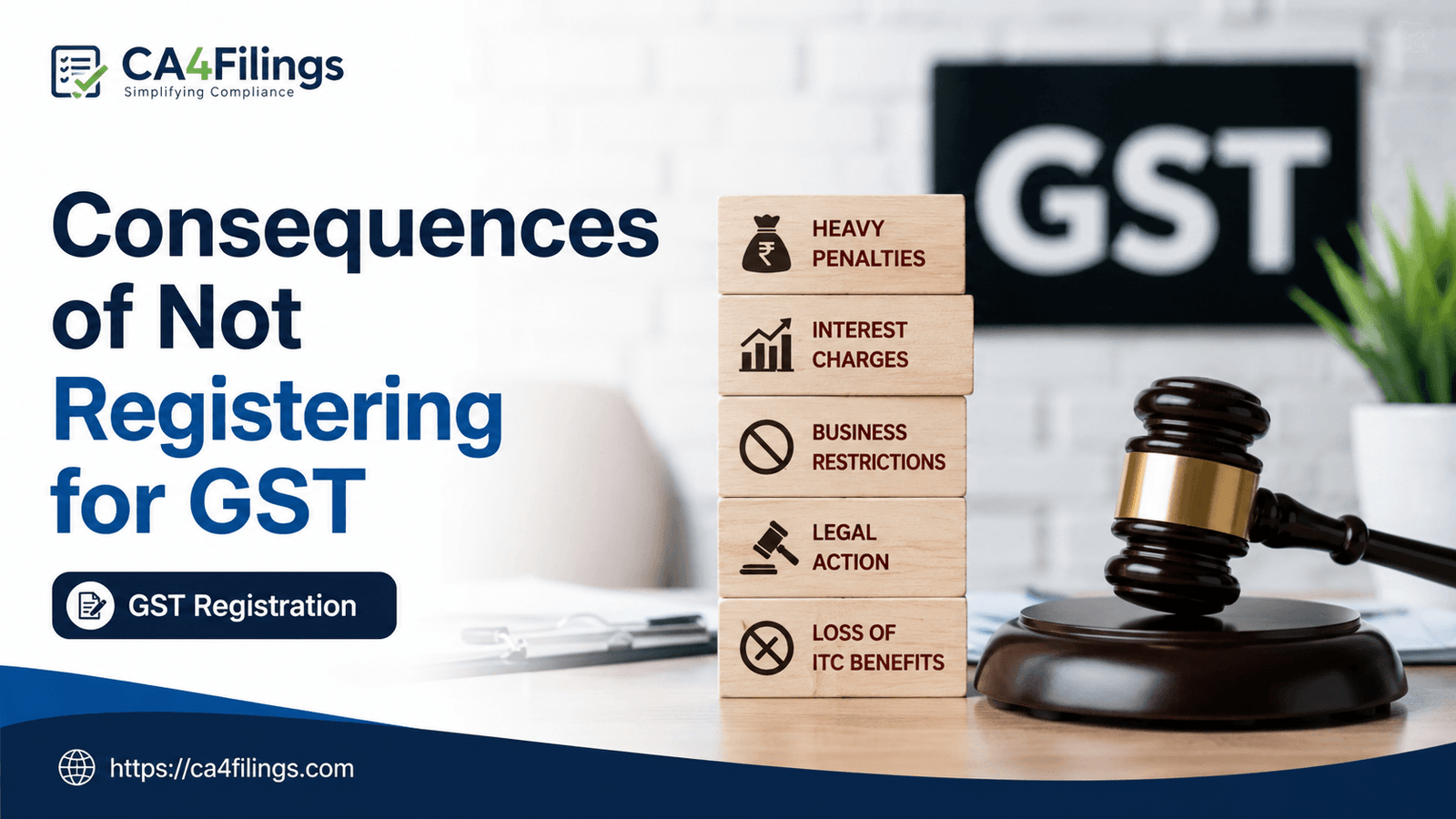
Running a business in India is an exciting journey, but it comes with a bundle of legal responsibilities. As your business grows, tracking your turnover becomes crucial to ensure you stay on the right side of the law. One of the most critical milestones for any growing business is stepping into the realm of indirect taxation. Many business owners often ask us, "Can we just delay it" or "What really happens if we don’t sign up" Ignoring your tax obligations can severely damage your hard-earned business. In this detailed guide, we will break down the severe legal, financial, and operational consequences of not registering for GST so you can protect your business from unnecessary roadblocks.
When your business aggregate turnover crosses the government-prescribed threshold, obtaining a GST Registration becomes mandatory under the law. For most states, this threshold stands at ₹40 lakh for businesses exclusively supplying goods and ₹20 lakh for service providers. However, for special category states in the Northeast and hill regions, these limits drop to ₹20 lakh and ₹10 lakh respectively. Waiting until the tax department catches up with you is a risky strategy. Failing to comply with these GST regulations doesn't just invite hefty fines; it can completely paralyze your daily operations and ruin your market reputation.
Understanding Your Mandatory GST Obligations
Before we look at the penalties, let's understand who is legally required to register. Under Indian tax laws, GST compliance is mandatory not just when you cross the turnover threshold, but also in specific scenarios regardless of your turnover.
You must register for GST immediately if you:
Make inter-state supplies of goods (selling from one state to another).
Sell products through e-commerce platforms like Amazon, Flipkart, or Myntree.
Operate as a casual taxable person or a non-resident taxable person.
Are required to pay tax under the Reverse Charge Mechanism (RCM).
Failing to meet these tax obligations means you are operating illegally in the eyes of the law. The tax department uses advanced data analytics to track banking transactions, e-commerce sales, and income tax filings, making it virtually impossible for unregistered businesses to stay under the radar.
Financial Consequences of Not Registering for GST
The most immediate blow of avoiding registration is financial. The government takes tax evasion and non-compliance very seriously.
Heavy GST Penalties and Fines
Under Section 122 of the CGST Act, if you fail to obtain registration despite being legally liable, you face severe GST penalties. The law prescribes a specific penalty structure for this offense:
| Offense Type | Penalty Amount |
|---|---|
| Unintentional Lapes / Genuine Delay | 10% of the tax due or ₹10,000 (Whichever is higher) |
| Deliberate Evasion / Wilful Suppression | 100% of the tax due or ₹10,000 (Whichever is higher) |
For instance, if the tax department finds that you evaded ₹2 lakh worth of taxes while operating unregistered, you will be hit with a fines for not registering for GST equal to another ₹2 lakh in case of deliberate evasion.
Accumulation of Interest Charges
The financial damage does not stop at the flat penalty. You will also have to pay interest on the unpaid tax amount. Under current tax compliance rules, interest is charged at 18% per annum. This interest is calculated from the exact date you became liable to register until the day you finally pay the total tax due. Over months or years, these tax penalties and interest charges can easily dwarf your original tax liability.
Operational and Business Impacts
While tax fines hurt your bank account, the operational consequences of not registering for GST can permanently break your business growth.
1. Complete Loss of Input Tax Credit (ITC)
As an unregistered business, you cannot claim Input Tax Credit (ITC) on your business purchases. Think about it: when you buy raw materials, office laptops, or rent commercial property, you pay anywhere from 5% to 28% GST to your suppliers. If you are registered, you can offset this tax against your output liability. If you aren't registered, that tax becomes a direct expense, inflating your operational costs and making your products uncompetitive in the market.
2. Isolation from B2B and Corporate Clients
Large companies and registered businesses avoid dealing with unregistered vendors. Why? Because if they buy from you, they cannot claim ITC on those purchases, or they might have to handle complex compliance under the Reverse Charge Mechanism. To keep their own chains clean, corporate clients will simply stop buying from you, restricting your business strictly to small, local retail customers.
3. Restriction on E-Commerce and Global Sales
If you plan to scale by selling online or exporting goods, a GSTIN is your entry ticket. E-commerce platforms are legally barred from onboarding sellers who do not have a valid registration (except for specific hyper-local exemptions for very small traders). Without it, you are locked out of the digital economy.
Serious Legal Actions and Prosecution
If a business continuously ignores its tax compliance and actively suppresses its turnover to evade taxes, the consequences upgrade from monetary fines to criminal liabilities.
Confiscation of Goods and Vehicles: Tax authorities have the power to intercept your goods in transit. If the goods are being transported without a valid GST invoice or e-way bill because you aren't registered, the entire consignment and the vehicle transporting it can be seized.
Jail Time for High-Value Evasion: If the total tax evaded crosses ₹1 crore, the offense becomes punishable with imprisonment. Depending on the amount hidden, jail terms can range from 1 to 5 years along with hefty personal fines.
How to Become Compliant: Step-by-Step
Avoiding the consequences of not registering for GST is straightforward. If your business is approaching the threshold or falls under compulsory registration criteria, you should take action immediately.
1.Gather Your Documents:Step 1.
Collect your PAN card, Aadhaar card, proof of business address (like electricity bills or rent agreement), and bank account details.
2.File Application on GST Portal:Step 2.
Submit Form GST REG-01 online. Ensure all your business details and business structures match your core legal documents exactly.
3.Verification by Tax Officers:Step 3.
The tax department reviews your application. If they require clarifications, they will issue a notice, which must be answered within 7 working days.
4.Receive GSTIN & Start Compliance:Step 4.
Once approved, your 15-digit GSTIN is generated. You can then legally issue tax invoices, collect tax, and safely pass on ITC to your clients.
Frequently Asked Questions (FAQs)
1. Can I operate without GST if my turnover is less than ₹20 lakh?
Yes. If your business turnover is below the prescribed limits (₹40 lakh for goods / ₹20 lakh for services in most states) and you do not engage in inter-state sales or e-commerce, you are legally exempt from registration.
2. Is there a time limit to apply for GST once I cross the threshold?
Yes, you must apply for registration within 30 days from the exact date your aggregate turnover crosses the mandatory threshold limit.
3. Can the tax department penalize me retroactively?
Absolutely. If the department discovers you crossed the threshold months ago, they will calculate your tax liability from that past date, demand 100% of that tax, add 18% annual interest, and levy standard penalties.
4. What is a casual taxable person registration?
This is a temporary registration valid for 90 days, meant for businesses setting up temporary stalls in exhibitions or trade fairs in a state where they don't have a fixed place of business.
Protect Your Business with CA4Filings
In the modern Indian economy, transparency is no longer optional. The financial and legal consequences of not registering for GST can break your business momentum, drain your cash reserves through GST penalties, and close doors to profitable B2B contracts. Registering on time is an investment in your business’s credibility and future scale.
At CA4Filings, we understand that navigating tax laws, keeping up with changing thresholds, and managing monthly returns can feel overwhelming while you are busy running a business. Our team of experienced tax professionals handles your entire setup smoothly, ensuring you never miss a deadline or face unexpected legal notices. Let us handle the legal paperwork while you focus entirely on growing your brand.
Latest Updates
ca4filings.com Services

























-registration.png)