How to Prepare for GST Cancellation Audits
Learn how to prepare for GST cancellation audits with expert tips from CA4Filings. Master your GST record keeping, checklist, and compliance strategy today.
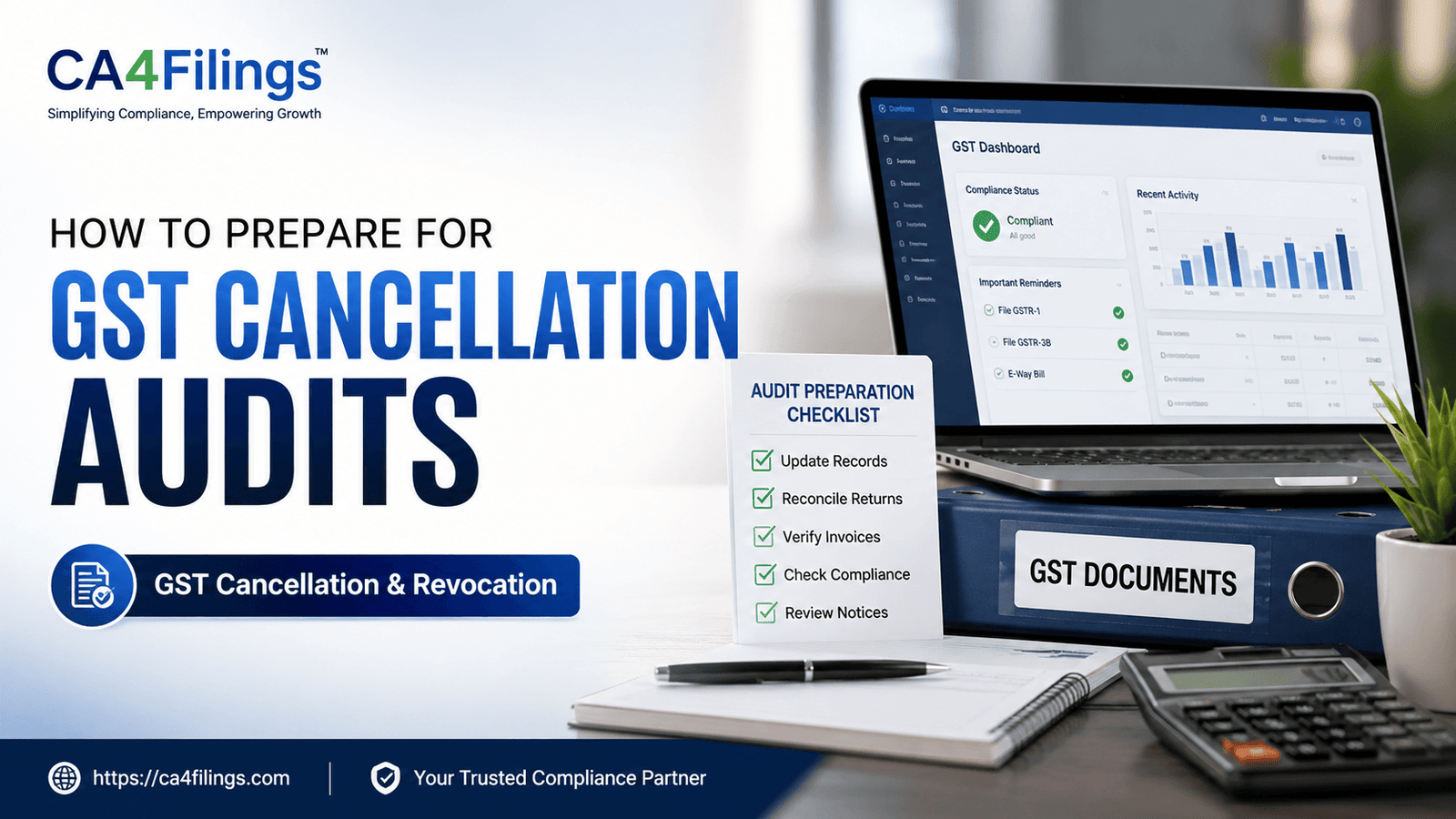
Running a business in India comes with its fair share of compliance milestones. Among them, shutting down a business vertical or winding up an entity requires careful handling of tax closures. However, many entrepreneurs mistakenly believe that submitting a cancellation application is the end of the road. In reality, the tax department often initiates a rigorous review to ensure no revenue is lost. Knowing how to prepare for GST cancellation audits is absolutely critical to avoid unexpected tax demands, penalties, and prolonged legal disputes. At CA4Filings, we routinely see businesses face intense scrutiny during this final phase simply because they lacked a proactive strategy.
When a taxpayer applies for closure, or when the department initiates a cancellation due to non-compliance, a formal review usually follows. Navigating this final hurdle smoothly requires a deep understanding of the GST Cancellation & Revocation procedures to ensure all past liabilities are cleanly settled. If your registration is being cancelled, you must treat the subsequent department review with the same rigor as a standard annual business tax audit.
Why the Department Initiates a GST Cancellation Audit
The primary objective of a GST cancellation audit is to ensure that the taxpayer has accurately declared all liabilities and reversed any ineligible Input Tax Credit (ITC) before exiting the system.
The tax authorities look closely at your transition periods, final stock valuations, and pending returns. Under Indian tax law, a registered person whose registration is cancelled must pay an amount equivalent to the credit of input tax in respect of inputs held in stock, or semi-finished or finished goods held in stock, or capital goods or plant and machinery on the day immediately preceding the date of such cancellation.
The department uses data analytics to flags mismatches between your GSTR-1, GSTR-3B, and GSTR-2B over the lifecycle of your business. Therefore, understanding how to prepare for GST cancellation audits involves looking back at your historical data to catch these discrepancies before the tax inspector does.
Step-by-Step Guide on How to Prepare for GST Cancellation Audits
Approaching a department review without a clear structure can lead to panic. Here is a practical roadmap designed by our experts at CA4Filings to streamline your audit preparation.
1. Conduct a Comprehensive Internal Data Reconciliation
Before the tax authorities knock on your door, you need to run an extensive internal audit. This is the foundation of tax audit preparation.
GSTR-1 vs. GSTR-3B: Ensure that the outward supplies declared in GSTR-1 perfectly match the tax paid in GSTR-3B.
GSTR-2B vs. GSTR-3B: Reconcile the ITC claimed in your monthly returns with the auto-populated GSTR-2B. If you have claimed excess ITC, it is wiser to reverse it voluntarily with interest under Section 50 rather than waiting for an audit note.
Financial Statements vs. GST Returns: Cross-verify your total turnover reported in your audited Profit & Loss statement with your annual GST filings.
2. Evaluate and Reverse ITC on Closing Stock
This is the single biggest area where business owners trip up during the GST cancellation process.
Identify all inputs held in stock, inputs contained in semi-finished goods, and finished goods in stock on the day prior to cancellation.
Calculate the exact ITC embedded in these stocks. You must pay an amount equal to this credit or the output tax payable on such goods, whichever is higher.
For capital goods, calculate the pro-rata ITC reversal based on the useful life of the asset (treated as 5 years or 60 months under the rules), or pay tax on the transaction value of the sale of such capital goods, whichever is higher.
3. Organize Your Audit Documentation
A successful business tax audit relies heavily on organized record keeping. You should assemble a dedicated file containing:
Copies of all GST registration certificates and cancellation orders.
Month-wise GSTR-1, GSTR-3B, and annual GSTR-9/9C returns.
A robust ledger of all purchases, sales, and inventory records.
Invoices matching all ITC claims, along with proof of payment to suppliers within the statutory 180-day window.
The Ultimate GST Cancellation Checklist
To make your compliance journey easier, our team at CA4Filings has curated this essential checklist. Use this to track your readiness before submitting files to the tax officer.
[ ] Final Return Filing: Ensure GSTR-10 (Final Return) is filed within three months of the date of cancellation or date of the cancellation order, whichever is later.
[ ] Reverse Charge Mechanism (RCM): Verify that all liabilities under RCM (such as GTA services, legal fees, or imports) have been fully paid and declared.
[ ] Vendor Compliance Check: Confirm that your suppliers have uploaded their invoices and paid their taxes; otherwise, your historical ITC might be blocked or demanded back.
[ ] Zero Pending Dues: Clear all pending tax liabilities, late fees, interest, and penalties in the electronic liability register.
[ ] Reconciliation Statement: Keep a signed, certified reconciliation statement explaining any variances between your book turnover and GST turnover ready for the auditor.
Tax Audit Strategies for a Smooth Process
When handling a department officer, communication and presentation matter just as much as the numbers. Implementing strategic tax audit tips can significantly reduce friction.
Be Proactive, Not Reactive
Do not wait for the department to issue a formal notice showing discrepancies. By knowing how to prepare for GST cancellation audits early, you can file a voluntary payment via Form DRC-03 for minor calculation errors or omissions found during your internal review. Showing that you have self-corrected anomalies builds immense credibility with the auditing officer.
Maintain Clear Trails for Exemptions
If your business claimed any zero-rated supplies, exports, or tax exemptions, ensure that the supporting documents—such as Letters of Undertaking (LUT), Bills of Export, and Foreign Inward Remittance Certificates (FIRC)—are structurally tied to the specific sales invoices. Loose paperwork is the easiest target for an auditor looking to disallow a tax benefit.
Frequently Asked Questions
What happens if I fail to file the final return after GST cancellation?
If you do not file Form GSTR-10 (Final Return) within the mandated three months, the department will issue a notice giving you 15 days to comply. Continuous failure leads to best-judgment assessment by the officer, hefty late fees, and potential recovery actions.
Can the department audit my records even after my GST is successfully cancelled?
Yes. The cancellation of your registration does not absolve you from liabilities incurred while the registration was active. The proper officer holds the legal authority to audit your past books and issue notices for up to several years post-cancellation under the statutory limitation periods.
What is the most common mistake during audit preparation?
The most frequent mistake is poor GST record keeping, especially failing to retain copies of physical invoices or losing track of digital records once a business stops operating. Another major issue is failing to calculate the proper tax reversal required on remaining inventory and capital machinery.
Let CA4Filings Simplify Your Exit Strategy
Closing a business or cancelling a tax registration should mark a clean transition to your next venture, not the start of endless legal headaches. Knowing how to prepare for GST cancellation audits is essentially about meticulous record keeping, precise reconciliations, and strict adherence to timelines. By treating this closure review with the strategic gravity of a comprehensive tax audit, you save your enterprise from debilitating penalties and stressful litigation.
You don't have to navigate these complex tax laws alone. At CA4Filings, our team of experienced Chartered Accountants specializes in end-to-end GST compliance, data reconciliation, and audit management. We will help you review your closing stock, reconcile your filings, construct a foolproof audit defense file, and represent you cleanly before the tax authorities. Reach out to CA4Filings today, and let our experts ensure your business exit is completely seamless, legally compliant, and stress-free.
Latest Updates
ca4filings.com Services


























-registration.png)