How GST Cancellation Affects Small and Medium Enterprises (SMEs)
Learn How GST Cancellation Affects Small and Medium Enterprises (SMEs), its impact on business operations, tax implications, and how to resolve it quickly.
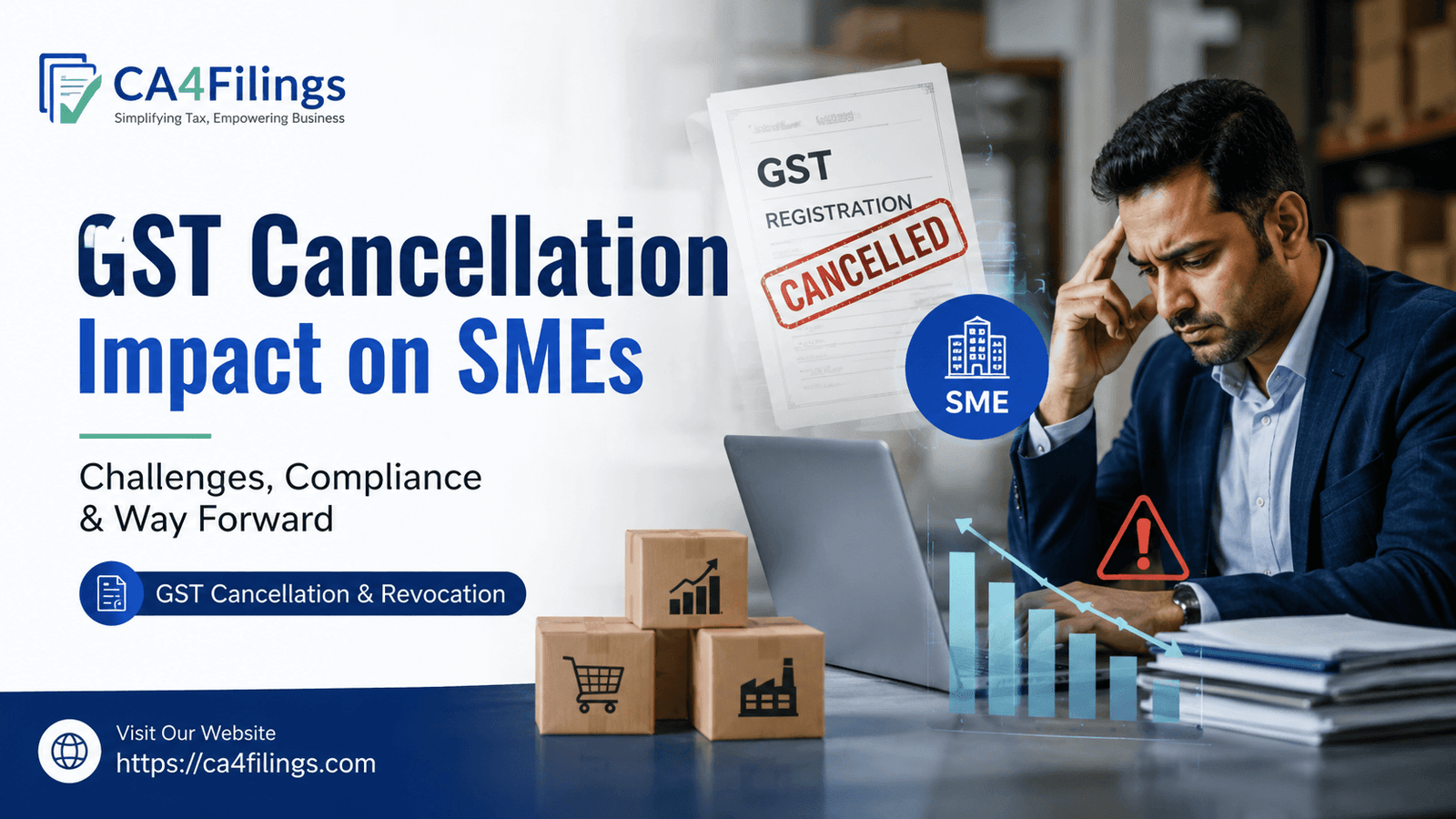
Running a business in India is a journey full of milestones, but it also comes with its fair share of regulatory compliance. For small and medium enterprises, staying compliant with the Goods and Services Tax (GST) framework is absolutely critical to keeping the wheels turning. Yet, many business owners wake up to a sudden shock: their GST registration has been canceled. Understanding How GST Cancellation Affects Small and Medium Enterprises (SMEs) is vital because a single cancellation order can bring your daily operations to a grinding halt. Whether the cancellation is voluntary because you are closing a business line, or initiated by the tax department due to a missed deadline, the ripple effects can severely damage your enterprise.
At CA4Filings, we regularly assist business owners who find themselves trapped in legal complications due to sudden tax notices. If your business registration is suspended or canceled, you need immediate remedial action. Navigating the legalities of GST Cancellation & Revocation is the only way to restore your active tax status, protect your business reputation, and resume normal commercial transactions before the damage becomes irreversible.
Why Does GST Cancellation Happen to SMEs?
Before analyzing the GST cancellation effects, it is important to understand why the tax authorities take such a drastic step. For most small and medium enterprises, cancellation by a tax officer is rarely a surprise; it is usually the result of prolonged non-compliance.
Continuous Non-Filing of Returns: If a regular taxpayer fails to file GST returns for a continuous period of six months (or three consecutive quarters for QRMP scheme taxpayers), the system automatically flags the account for cancellation.
Conducting Business from an Unregistered Location: If a tax officer conducts a physical verification and finds that the business is not operating from the registered principal place of business, they can initiate cancellation.
Unlawful Input Tax Credit (ITC) Claims: Claiming Input Tax Credit using fake invoices or utilizing ITC without actual receipt of goods or services is a severe offense that leads to immediate suspension.
Voluntary Closure: Sometimes, business changes or restructuring lead owners to apply for cancellation on their own accord.
How GST Cancellation Affects Small and Medium Enterprises (SMEs)
When your GSTIN becomes inactive, the consequences are immediate and widespread. Here is an honest breakdown of the severe GST impact on businesses when their registration is taken away.
1. Complete Halt of SME Business Operations
The most immediate answer to How GST Cancellation Affects Small and Medium Enterprises (SMEs) is that you legally lose the right to conduct inter-state and intra-state trade. You cannot issue a valid tax invoice. If you cannot issue an invoice, you cannot legally sell your goods or services. For an active SME, this means zero revenue generation while your fixed costs, like rent and salaries, keep piling up.
2. Disruption of the Supply Chain and Loss of Clients
In the B2B ecosystem, your GST status directly affects your clients. If your GST registration is canceled, your buyers cannot claim Input Tax Credit on the goods they purchased from you. No corporate client or large buyer will purchase from a vendor whose GST is canceled because it directly increases their tax liability. Your existing clients will quickly migrate to your competitors to protect their own financial interests.
3. Severe SME Financial Impact and Trapped Capital
When a cancellation occurs, any electronic cash ledger or credit ledger balance you hold gets blocked. Furthermore, you cannot claim any fresh ITC on inputs or raw materials purchased during the suspension or cancellation period. This creates a massive cash crunch, leading to significant small business challenges in managing day-to-day working capital.
Tax Implications for SMEs After Cancellation
The tax implications for SMEs do not vanish just because a registration is canceled. In fact, your liabilities often become more complicated to manage.
Final Return Filing (Form GSTR-10): Every businessman must file a final return within three months of the date of the cancellation order. Failure to file this return attracts heavy late fees and penalties.
Output Tax Liability on Stocks: On the date of cancellation, if you have any stock of raw materials, semi-finished goods, or finished goods in hand, you must pay an amount equal to the ITC availed on those goods or the output tax payable on them—whichever is higher.
Accumulation of Interest and Penalties: The tax liability does not stop accruing interest. Any unpaid tax continues to attract interest at 18% per annum until the outstanding amount is fully cleared.
Step-by-Step Recovery: What Should an SME Do Next?
If your business is facing these severe SME taxation consequences, panic is not the solution—swift legal action is. You must follow a structured approach to restore your business operations.
Analyze the Cancellation Order: Review the Show Cause Notice (SCN) or the final cancellation order inside the GST portal to understand the exact grounds of cancellation.
Clear All Outstanding Liabilities: If the cancellation was due to non-filing, you must calculate and pay all pending taxes, late fees, and accrued interest immediately.
File Pending Returns: Ensure all outstanding returns up to the date of cancellation are accurately submitted on the portal.
Apply for Revocation: File Form GST REG-21 to apply for the revocation of cancellation. This application must generally be submitted within 90 days from the date of the service of the cancellation order (extendable under specific conditions by tax authorities).
Frequently Asked Questions
Can I clear my old inventory after my GST is canceled?
No. You cannot issue a tax invoice or transport goods commercially once your registration is canceled. To sell your remaining stock legally, you must first apply for revocation and restore your GSTIN status.
How long does it take to restore a canceled GST registration?
Once you file the revocation application (Form GST REG-21) along with all pending returns and taxes, the tax officer is required to pass an order within 30 days either revoking the cancellation or rejecting the application via a notice.
Can I apply for a fresh GST registration if my old one is canceled?
Applying for a new GST registration while an older one is canceled due to non-compliance is highly discouraged. The tax department matches PAN data, and your new application will likely be rejected or flagged until the past liabilities on the old GSTIN are cleared.
Will GST cancellation affect my business credit score or bank accounts?
Yes. Banks regularly monitor the business tax changes and active registrations of their current account holders. An inactive or canceled GSTIN can lead to the temporary freezing of your business bank account and negatively impact your credibility with lenders.
Protect Your Business with CA4Filings
The business tax changes introduced in recent years leave very little room for compliance errors. Now that you understand How GST Cancellation Affects Small and Medium Enterprises (SMEs), it is clear that preventive maintenance is far better than dealing with a broken supply chain.
If your business is currently facing a GST shutdown, or if you have received a notice from the tax department, don't handle the bureaucratic hurdles alone. Let our legal team at CA4Filings clean up your tax track record, file your pending returns accurately, and handle the revocation process on your behalf.
Latest Updates
ca4filings.com Services





















-registration.png)