GST Revocation: What Happens After Your Application is Approved?
Confused about the process after your GST registration is back? Learn about GST Revocation: What Happens After Your Application is Approved? with CA4Filings.
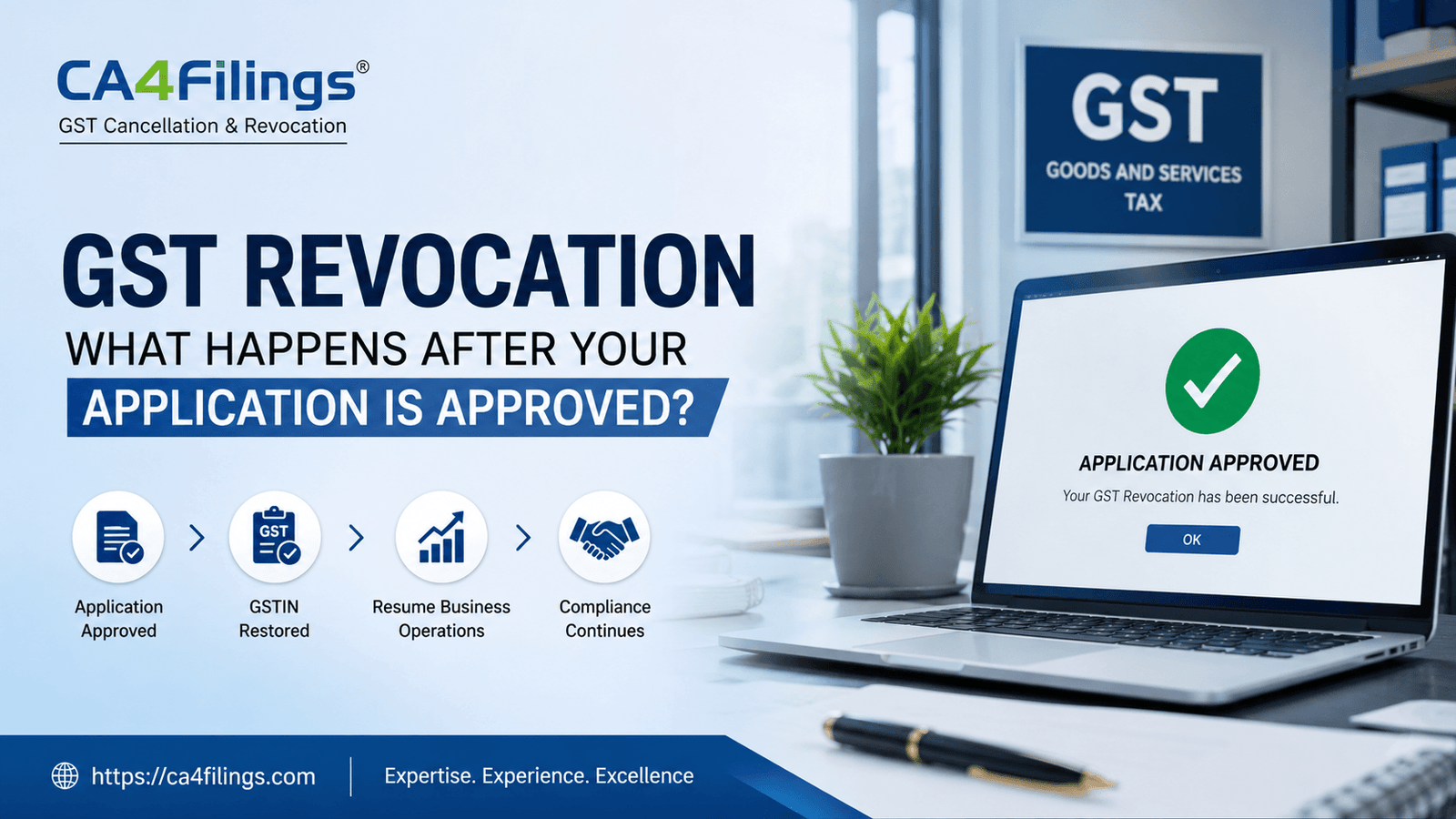
Dealing with the cancellation of a GST registration is every business owner's nightmare. It disrupts cash flow, halts input tax credit, and stops you from issuing tax invoices. If you have been through this ordeal and finally received the approval order for your application, take a deep breath—you are back in the game. However, many clients ask us at CA4Filings, "GST Revocation: What Happens After Your Application is Approved" It is not just about getting the status changed; it is about ensuring your compliance record is spotless moving forward. If you are struggling with the complexities of GST Cancellation & Revocation, our team is here to simplify the journey and get your business operational again.
Restoring Your GST Status: The Immediate Next Steps
Once the proper officer approves your application for revocation, the system automatically updates your status on the GST portal from 'Cancelled' to 'Active.' But do not assume the work ends there. GST Revocation: What Happens After Your Application is Approved? largely involves immediate reconciliations.
The first thing you must do is log in to the GST portal and download the 'Order of Revocation of Cancellation of Registration' (Form GST REG-22). Keep this document saved securely. It is your proof that your registration has been restored retrospectively or prospectively, depending on the order.
Next, you need to check the status of your electronic ledger. In many cases, if your registration was cancelled due to non-filing of returns, you would have already filed those returns as part of the revocation application process. Ensure that all the taxes paid, interest accrued, and penalties (if any) are correctly reflected in your electronic cash and liability ledgers.
Compliance Cleanup: Filing Pending Returns
The most critical aspect of "GST Revocation: What Happens After Your Application is Approved" is catching up on your filings. If your registration was cancelled, there might be a gap in your GSTR-1, GSTR-3B, or GSTR-9 filings.
Verify the Period: Check exactly which return periods were considered 'pending' at the time of cancellation.
File Immediately: If any returns were left out during the revocation process, file them immediately to avoid fresh interest or late fees.
Reconcile Input Tax Credit (ITC): Once active, you may notice discrepancies in your GSTR-2B. Your suppliers might have stopped reporting invoices under your GSTIN while it was cancelled. Reach out to your vendors and ensure they update the invoices to reflect your active status so you can claim your rightful ITC.
Updating Business Records and Invoicing
Your business operations must pivot back to full compliance. When someone asks a CA about "GST Revocation: What Happens After Your Application is Approved", we always emphasize the importance of invoices.
During the period your registration was cancelled, you were technically not allowed to issue tax invoices or collect GST. Now that you are active, you must update your invoicing software. Ensure your serial numbers are correct and that you are once again displaying your GSTIN prominently on all invoices, signboards, and business communications. If you had issued any 'Bill of Supply' during the cancellation period, check with your tax advisor whether those need to be converted into tax invoices (if the revocation order covers the retrospective period).
Why Monitoring Your Electronic Ledger is Vital
Even after your status is restored, you are under the scanner. The tax authorities expect a perfect record after a revocation.
Monitor the Electronic Liability Register: Ensure that the system hasn't erroneously calculated interest for the period when the registration was technically inactive.
Review E-Way Bills: If you are into the movement of goods, your ability to generate E-Way bills should be restored automatically. Test this immediately by generating a dummy or a small-value E-Way bill to ensure the system is fully synchronized.
Frequently Asked Questions (FAQs)
Q1: Does the revocation order cover the entire period of cancellation? Yes, generally, the revocation order restores your registration from the effective date of cancellation. This means your GSTIN is treated as 'Active' throughout the period it was marked as cancelled.
Q2: Do I have to pay late fees for returns filed after the revocation? If the revocation application was contingent upon filing pending returns, you would have already paid the necessary late fees to file those returns. However, ensure no new penalties have been added for the interim period.
Q3: What if my portal still shows 'Cancelled' after the approval? It takes a few hours for the system to sync. If it remains 'Cancelled' for more than 24 hours, contact the jurisdictional officer or raise a ticket on the GST portal.
Q4: Can I claim ITC for the period my registration was cancelled? Yes, since the revocation order treats the cancellation as null and void, you are generally eligible to claim ITC for that period, provided the conditions under Section 16 of the CGST Act are met.
Expert Guidance with CA4Filings
Understanding "GST Revocation: What Happens After Your Application is Approved" is only half the battle; maintaining compliance is the other. At CA4Filings, we have helped countless businesses navigate the technicalities of GST, ensuring that a single registration issue doesn't derail your long-term growth.
Do not leave your business compliance to chance. If you have just received your revocation order or are struggling to manage your filings, reach out to the experts at CA4Filings. We take care of your tax compliance so you can focus on what you do best—growing your business. Contact us today for a consultation!
Latest Updates
ca4filings.com Services



















-registration.png)