Why DIR-3 KYC Is Essential for Company Directors
Discover why DIR-3 KYC Is Essential for Company Directors. Learn about MCA compliance, penalties, and how to keep your directorship active in India.
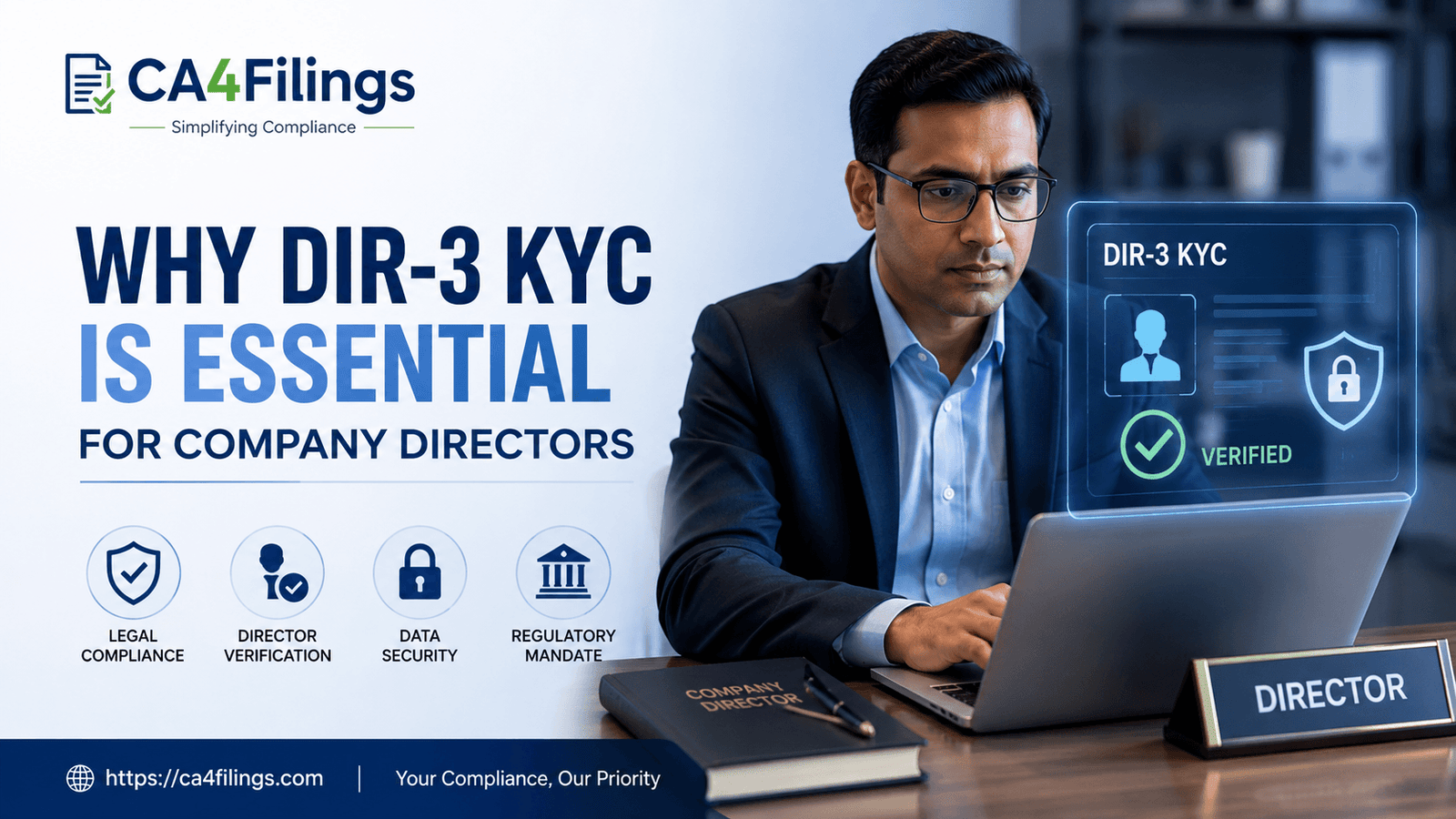
As a Chartered Accountant, I often encounter company directors who are confused about the various regulatory filings required in India. Among the most critical, yet frequently overlooked, compliance requirements is the annual verification of director details. Understanding Why DIR-3 KYC Is Essential for Company Directors is not just about ticking a box; it is about maintaining your professional standing in the corporate world. If you are looking for professional assistance to ensure your records are up to date, our DIR-3 KYC service is designed to simplify this entire process for you.
The Ministry of Corporate Affairs (MCA) introduced this mandate to maintain an accurate database of all individuals holding a Director Identification Number (DIN). With the evolving regulatory landscape in India, keeping your information current is the only way to ensure your directorship status remains active and compliant.
What Exactly is the DIR-3 KYC Process?
In simple terms, the KYC process is a periodic update mechanism. Every individual who has been allotted a DIN must inform the MCA about their latest contact details, residential address, and identity proof. Think of it as a mandatory "check-in" with the government.
The objective behind this move was to curb shell companies and ensure that the government has a reliable, real-time database of every person authorized to run a business. When you hold a DIN, you are essentially a public official in the eyes of company law. Therefore, the MCA needs to know that you are a real person reachable at the details provided.
Why DIR-3 KYC Is Essential for Company Directors: The Core Reasons
Many directors ask me, "If my details haven't changed, why do I still need to file" The answer lies in the stringent regulations set by the MCA. Let’s break down the primary reasons why this filing is non-negotiable.
1. Maintaining Active Status
Your director identification number (DIN) is the backbone of your corporate identity. If you fail to file your KYC, the status of your DIN will be marked as "Deactivated" on the MCA portal. Once deactivated, you cannot sign any company documents, board resolutions, or annual returns. This effectively freezes your ability to participate in company governance.
2. Avoiding Heavy Penalties
Ignorance of the law is never a valid excuse in the eyes of the Registrar of Companies (ROC). If you miss the annual filing deadline, the penalty is a flat fee of ₹5,000. While the amount might seem manageable, the process to reactivate a deactivated DIN is time-consuming and tedious. You are essentially inviting unnecessary administrative headaches that could have been avoided with a simple, timely filing.
3. Ensuring Transparency and Corporate Governance
The government uses this data to track the number of directorships held by an individual. By verifying your details, you contribute to the integrity of the corporate ecosystem in India. It prevents fraud and ensures that the person listed as a director is indeed the person managing the company’s affairs.
How the Compliance Process Works
Staying compliant doesn't have to be a nightmare. The process involves verifying your mobile number and email ID through an OTP (One-Time Password) system. Here is the typical workflow we follow:
Document Collection: We gather your latest photograph, PAN card, Aadhaar card, and proof of residence.
Verification: We ensure that the details match your records on the income tax database.
Digital Signature: As per the rules, the form must be digitally signed by a practicing professional (like a CA, CS, or CMA).
Submission: Once the form is filed, the MCA processes the update, and your DIN remains active.
Real-World Consequences of Non-Compliance
I have seen directors struggle because they ignored this filing. Imagine a scenario where a company is in the middle of a bank loan application or a major contract signing, and suddenly, the director’s DIN shows as "Deactivated." The bank will refuse to process the loan, and the business operations will come to a screeching halt.
Updating your director details annually ensures that you are never caught off guard. It is a proactive step that protects your professional reputation and keeps your business running smoothly.
Frequently Asked Questions
Is DIR-3 KYC mandatory even if I am not currently a director in any company?
Yes. If you have been allotted a DIN, you are required to file the KYC annually, regardless of whether you are currently holding a directorship in any company.
What happens if I miss the due date?
If the due date is missed, your DIN will be marked as "Deactivated." To reactivate it, you will need to file the form with a late fee of ₹5,000, which is mandatory regardless of your justification.
Can I file the form myself?
While the form is available on the MCA portal, the declaration must be digitally signed by a practicing professional. Therefore, you will need the assistance of a CA or another qualified professional to complete the submission.
How often should I update my details?
The DIR-3 KYC is an annual requirement. You must file it every financial year to ensure your data remains valid.
Understanding Why DIR-3 KYC Is Essential for Company Directors is the first step toward stress-free corporate compliance. It is a simple, straightforward procedure that safeguards your directorship and ensures you stay on the right side of the law. Do not wait for the last-minute rush or the penalty notification to act.
At CA4Filings, we specialize in handling these regulatory filings with precision and speed. We take the burden off your shoulders, ensuring your documentation is perfect and filed well before the deadline. Reach out to our expert team today, and let us help you maintain your active directorship status without the hassle.
Latest Updates
ca4filings.com Services























-registration.png)