How to Prepare for a DIR-3 KYC Audit
Learn how to prepare for a DIR-3 KYC audit with our step-by-step compliance checklist. Ensure smooth director identification number verification today.
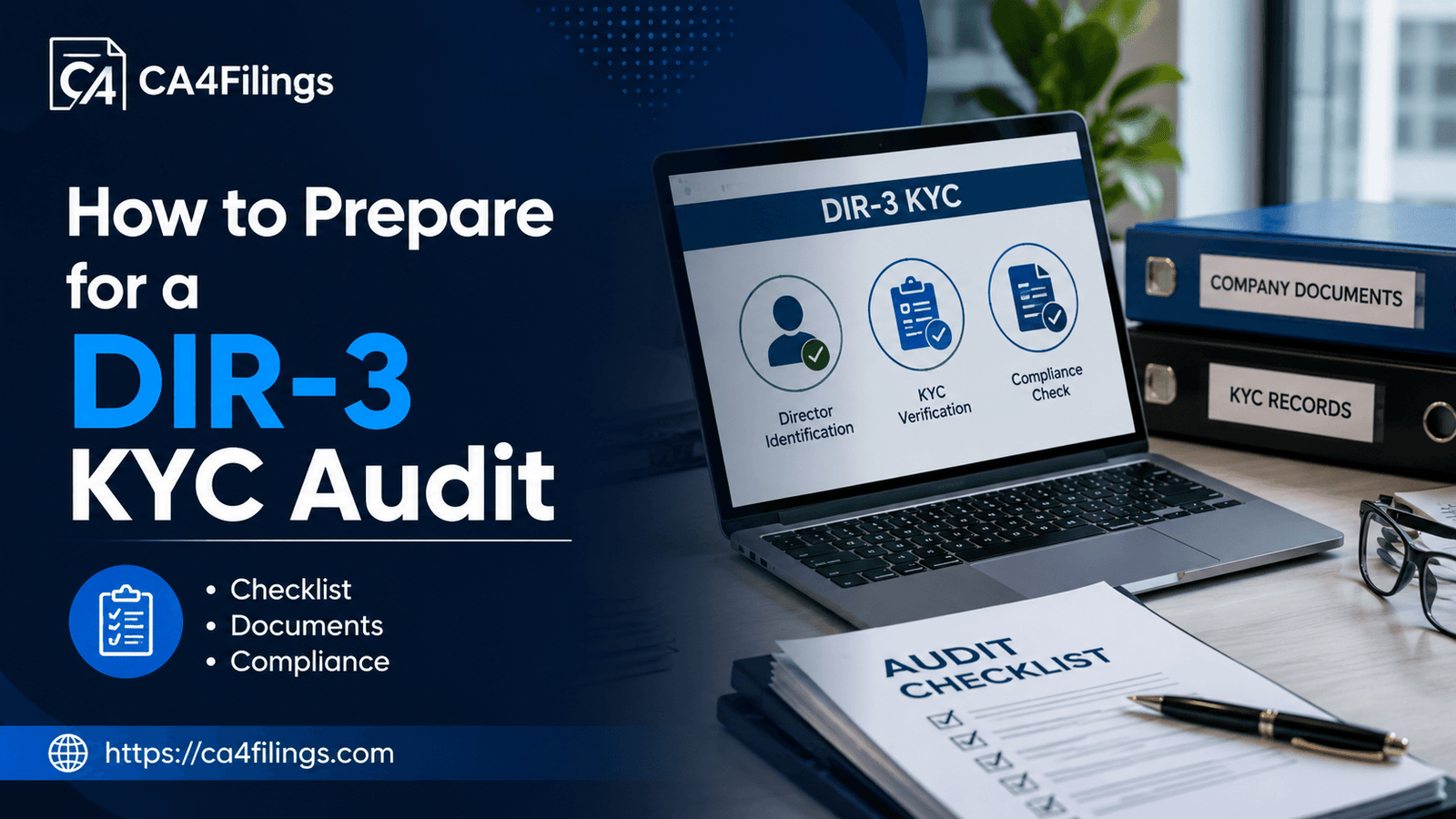
If you hold a Director Identification Number (DIN) in India, you already know that compliance isn’t a one-time event—it’s an annual commitment. Every year, the Ministry of Corporate Affairs (MCA) requires directors to update their credentials. While filing the routine form seems straightforward, the regulatory landscape has tightened significantly. Today, many companies are implementing internal and external reviews to ensure their board remains compliant. If your company is tightening its governance, learning How to Prepare for a DIR-3 KYC Audit is essential to avoid hefty penalties and deactivated DINs.
At CA4Filings, we routinely assist business owners and corporate leaders in navigating these exact compliance hurdles. The annual verification isn't just about uploading a passport photo and an electricity bill anymore; it is about establishing a flawless audit trail. To help you stay ahead of the regulatory curve, we have put together this comprehensive guide on how to streamline your DIR-3 KYC updates, double-check your documentation, and ensure your business sails through any internal or statutory review without a hitch.
Understanding the Regulatory Requirements for KYC Audit
Before diving into the actual preparation, let’s clear up what the MCA expects from a director. Under Rule 12A of the Companies (Appointment and Qualification of Directors) Rules, 2014, every individual who holds a DIN as of 31st March of a financial year must submit their KYC details to the Central Government.
When an internal auditor or a statutory auditor reviews your company’s compliance health, they look at the regulatory requirements for KYC audit to ensure no director is operating with a disqualified or deactivated DIN. The KYC audit process essentially verifies that the data sitting on the MCA portal perfectly mirrors the physical, legal identity of the director. If there is a mismatch—even a minor spelling error between an Aadhaar card and a PAN card—the system flags it, leading to compliance friction.
Why Director KYC Compliance is a Top Priority
As practicing Chartered Accountants, we often see businesses treat director compliance as a secondary task. That is a risky approach. Failing to maintain director KYC compliance triggers an immediate penalty of ₹5,000 per director once the deadline passes.
More importantly, the MCA automatically changes the status of the non-compliant DIN to "Deactivated due to non-filing of DIR-3 KYC." A director with a deactivated DIN cannot sign any official company documents, file annual returns, or execute board resolutions. For an active business, this can bring daily operations to a grinding halt. Therefore, a proactive director identification number audit preparation plan saves your company from sudden operational blockades.
Steps on How to Prepare for a DIR-3 KYC Audit
When you begin to prepare for DIR-3 KYC audit protocols, breaking the process down into structured phases ensures nothing slips through the cracks. Here is the exact step-by-step approach we use at CA4Filings to get our clients audit-ready.
Step 1: Establish a Compliance Checklist for KYC Audit
The foundation of a smooth audit is a robust internal checklist. Your compliance checklist for KYC audit should verify:
Whether all active directors have filed their previous year's KYC.
If any new directors were appointed during the financial year who need fresh director identification number verification.
Whether any director’s personal details (like residential address or passport validity) changed during the year.
Step 2: Gather and Verify Vital KYC Documentation for Directors
The core of the audit lies in the paperwork. Gathering the correct KYC documentation for directors early prevents last-minute panics. Ensure you have the following documents ready, self-attested by the director:
Permanent Account Number (PAN): This is the mandatory primary identifier for Indian nationals. The name on the PAN card must exactly match the name on the MCA portal.
Identity Proof: Aadhaar Card, Voter ID, or Driving License.
Address Proof: Bank statement, electricity bill, or telephone bill. Crucially, these documents must not be older than two months.
Passport: Mandatory if the director is a foreign national, and highly recommended for Indian nationals to verify name consistency.
Step 3: Verify Digital Signatures (DSC)
You cannot complete the verification without a valid Class 3 Digital Signature Certificate (DSC). Part of your director identification number audit preparation must include checking the validity of each director's DSC. If a DSC has expired, it needs immediate renewal before the audit or filing process begins.
Essential Guidelines for Passing KYC Audit Successfully
To ensure you face no hurdles during the verification process, keep these practical guidelines for passing KYC audit workflows in mind:
Watch Out for Spelling and Name Discrepancies
The MCA portal utilizes automated matching algorithms. If a director's name is "Ramesh Kumar Sharma" on their PAN card but written as "Ramesh K. Sharma" on their Aadhaar card, the system will reject the filing. Ensure all identity proofs are aligned before uploading.
Ensure Live Mobile and Email Authentication
The DIR-3 KYC process relies heavily on real-time One-Time Passwords (OTPs). Both the unique mobile number and the personal email address of the director will receive separate OTPs that expire quickly. Ensure the directors are accessible during the filing window to share these codes immediately.
Foreign Directors Require Attestation
If your board includes foreign nationals, their KYC documentation must be apostilled or legalized by the Indian Embassy in their respective home countries. Factor in this extra transit time when planning your schedule.
Frequently Asked Questions
1. What is the deadline for filing the DIR-3 KYC form?
The standard annual deadline set by the Ministry of Corporate Affairs is 30th September of the succeeding financial year.
2. What happens if we miss the filing deadline?
If a director fails to file by the due date, their DIN status is marked as "Deactivated." To reactivate the DIN, the director must file the form along with a late fee penalty of ₹5,000.
3. Can a director file DIR-3 KYC-WEB instead of the regular form?
Yes. If a director has already submitted a comprehensive DIR-3 KYC form in a previous year and there are absolutely no changes to their personal details (like phone number, email, or address), they can perform a quick web-based verification via the DIR-3 KYC-WEB service on the MCA portal without uploading fresh documents.
4. Who is authorized to certify the DIR-3 KYC form?
The form must be digitally signed by the director themselves and must be strictly co-signed and certified by a practicing professional—such as a Chartered Accountant (CA), Company Secretary (CS), or Cost Accountant (CMA).
Let CA4Filings Handle Your Compliance Burden
Mastering How to Prepare for a DIR-3 KYC Audit comes down to meticulous documentation, proactive timeline management, and a clear understanding of MCA guidelines. While it might look like a simple administrative task on paper, a single mismatched detail can trigger DIN deactivation and disrupt your corporate operations.
Why split your focus between growing your business and tracking shifting regulatory requirements? At CA4Filings, our team of experienced Chartered Accountants manages the entire DIR-3 KYC audit and filing pipeline for you. From verifying your digital signatures to ensuring your KYC documentation for directors is completely error-free, we handle the heavy lifting so your board remains fully compliant all year round. Reach out to CA4Filings today, and let us streamline your corporate compliance securely and efficiently.
Latest Updates
ca4filings.com Services
























-registration.png)