The Role of 12A and 80G Registration in Building Trust with Donors
Understand The Role of 12A and 80G Registration in Building Trust with Donors. Learn how these tax registrations boost donor confidence and funding.
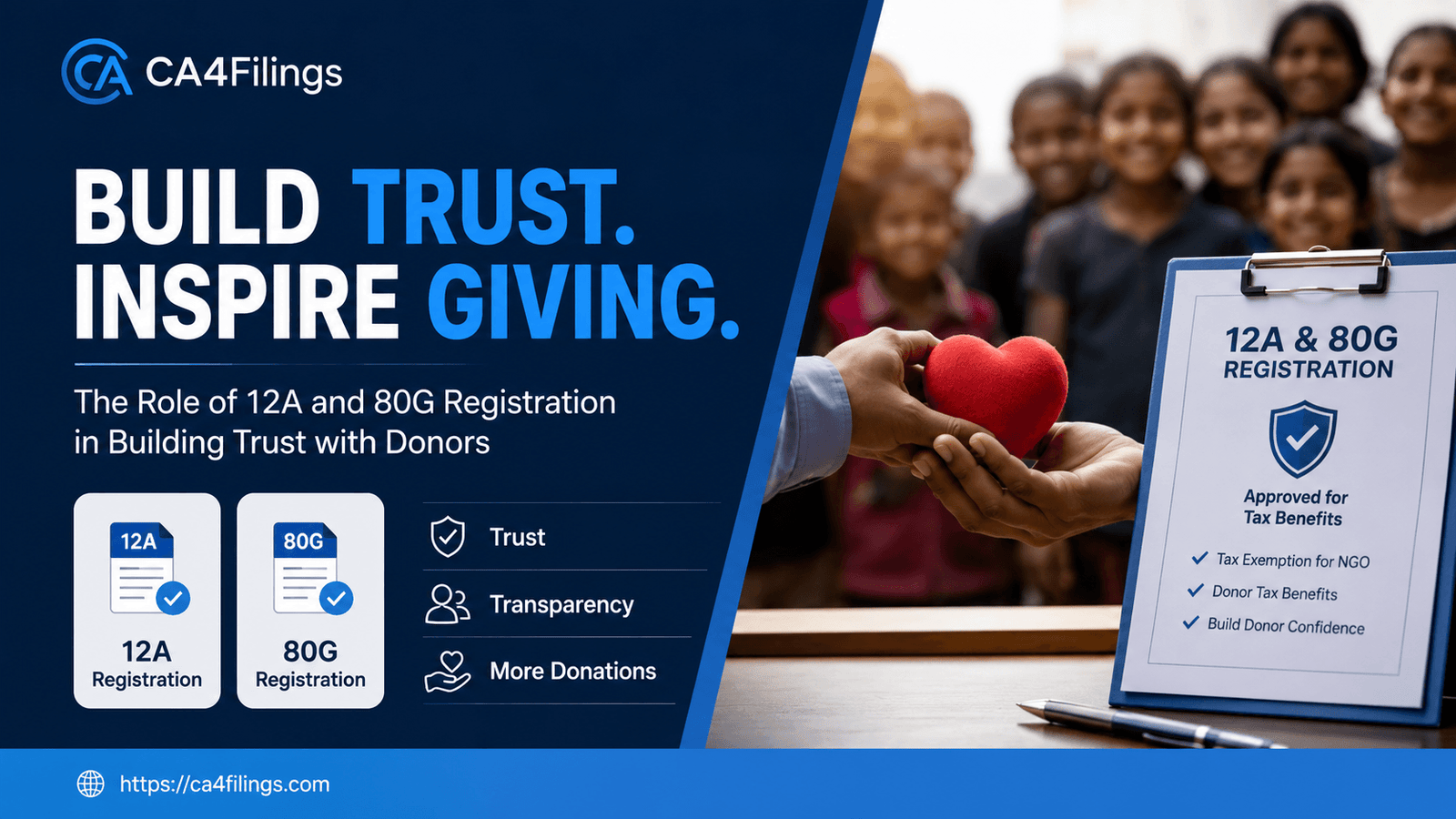
Imagine setting up a non-profit organization with a powerful vision to educate underprivileged children, provide healthcare to rural communities, or protect our environment. You have the passion, a dedicated team, and a clear roadmap for social impact. However, as you step into the real world to generate funds, you run into a recurring hurdle: donors hesitate. They ask questions about your tax status, your legal compliance, and your financial accountability. This is where you realize that pure intent, while beautiful, isn't completely enough in the nonprofit sector. To scale your fundraising and channel substantial philanthropy into your cause, you must understand The Role of 12A and 80G Registration in Building Trust with Donors.
In India, running a charitable entity requires more than just passion; it demands absolute compliance. When a corporate house or a high-net-worth individual decides to make charitable contributions, they look for legal validation. At CA4Filings, we often tell founders that securing your 12A and 80G Registration is the single most definitive step toward establishing that validation. These twin registrations act as a badge of honor, proving to the world that your NGO operates with complete transparency and under the strict scrutiny of the Income Tax Department. Let us take a deep dive into how these registrations fundamentally transform your organization's trustworthiness and unlock institutional donations.
Decoding the Essentials: What are 12A and 80G Registrations?
Before exploring their impact on donor relationships, let us briefly break down what these terms actually mean in the vocabulary of a Chartered Accountant.
12A Registration: This is a one-time exemption granted by the Income Tax Department to NGOs, trusts, and Section 8 companies. Under Section 12A, the surplus income earned by your non-profit organization is exempted from income tax. Without this, your NGO would be taxed like a commercial business entity, severely shrinking the funds available for your social work.
80G Registration: While 12A saves your NGO from paying tax, Section 80G provides a direct tax exemption to your donors. When an individual or a company makes a donation to an 80G-certified NGO, they can claim a deduction of up to 50% (or in some cases 100%) of the donated amount from their taxable income.
Together, these registrations shift your organization from an unverified group of well-intentioned individuals to a legally recognized vehicle for social change.
The Role of 12A and 80G Registration in Building Trust with Donors
When we look closely at the mechanics of modern fundraising, trust is the primary currency. Donors are not just giving away money; they are investing in a vision. Therefore, The Role of 12A and 80G Registration in Building Trust with Donors cannot be overstated because it directly addresses the donor's need for security and recognition.
1. Verification by a Higher Authority
When your NGO holds these certificates, it tells a donor that the Government of India has thoroughly vetted your constitutional documents, your bank accounts, and your objectives. This external validation instantly elevates your trustworthiness. The donor knows that their hard-earned money isn't disappearing into an unverified pool but is entering a structured framework monitored by tax authorities.
2. A Guarantee of Financial Accountability
To maintain 12A and 80G status, an NGO must file regular returns, maintain meticulous books of accounts, and undergo annual audits. When you communicate this to your corporate partners, it amplifies donor confidence. They realize that your organization practices strict financial accountability, reducing the risk of fund mismanagement.
3. Incentivizing Philanthropy Through Tax Benefits
Let’s speak practically—while philanthropy comes from the heart, a tax break makes the decision much easier for the mind. By offering an 80G receipt, you allow donors to participate in social causes without bearing the full financial brunt due to tax deductions. It creates a win-win scenario where their desire for social impact aligns perfectly with financial prudence.
Why Corporate Donors and Institutional Foundations Demand These Registrations
If you are aiming to secure Corporate Social Responsibility (CSR) grants, holding these registrations is non-negotiable. Indian companies are highly cautious about compliance. Under the Companies Act, corporate entities have specific targets for CSR spending, but their legal teams will completely block any payouts to a non-profit organization that lacks valid tax exemption statuses.
Through our years of practice at CA4Filings, we have observed that corporate boards prioritize compliance over every other metric. They need to ensure that their donations are accounted for and that they receive valid tax certificates to submit during their own corporate audits. Thus, understanding The Role of 12A and 80G Registration in Building Trust with Donors is the key that opens the doors to corporate boardrooms and massive corporate CSR funds.
Step-by-Step Guide to Securing Your Registrations
To help your organization build this trustworthiness, here is a simplified roadmap of how the registration process flows under the current online ecosystem:
Preparation of Documentation: Gather your trust deed or Memorandum of Association (MoA), PAN card of the NGO, electricity bills of the registered office, and a detailed note on the activities conducted over the past three years (or since inception).
Filing Form 10A / 10AB: The application is submitted digitally on the Income Tax e-filing portal. Initially, the department grants a provisional registration valid for three years.
Verification by the Commissioner: The tax authorities review the application, inspect the nature of your charitable contributions, and check if the activities align with the definition of "charitable purpose" under the law.
Grant of Regular Registration: Before the expiry of the provisional period, or once active operations commence, you must apply for a regular registration, which is valid for five years and requires timely renewals.
While the process looks straightforward on paper, any minor discrepancy in your documentation or objects clause can lead to a rejection, which severely dampens donor confidence. Seeking professional help ensures your applications pass through smoothly.
Best Practices to Maintain Donor Trust Post-Registration
Securing the certificates is only half the battle won; preserving The Role of 12A and 80G Registration in Building Trust with Donors requires consistent efforts toward transparency. Here is what CA4Filings recommends for every growing NGO:
Timely Filing of Form 10BD: Every year, NGOs must file a statement of donations in Form 10BD before May 31st. This enables your donors to see their certificates automatically pre-filled in their income tax portals. Failing to do this destroys trust instantly.
Publish Annual Impact Reports: Show your donors exactly where their money went. Share real stories, audited balance sheets, and measurable metrics of your social impact.
Maintain an Open-Door Policy for Financials: Make your audited financial statements accessible on your website. High transparency directly translates into high fundraising potential.
Frequently Asked Questions (FAQs)
Q1. Can a newly formed NGO apply for 12A and 80G registration immediately?
Yes, absolutely. Under the current income tax rules, a newly established non-profit organization can apply for provisional 12A and 80G registrations right after incorporation. This allows new organizations to start building trust with donors from day one.
Q2. Do these registrations remain valid forever?
No. Provisional registrations are valid for 3 years, while regular registrations are granted for 5 years. You must apply for renewal at least six months before the expiry of your current validity to maintain uninterrupted tax exemption benefits for your donors.
Q3. What happens if an NGO fails to file its annual returns?
If an NGO defaults on filing its annual IT returns or its statement of donations (Form 10BD), it risks losing its exemptions. This can severely hurt your trustworthiness, as your donors will no longer be able to claim tax benefits on their charitable contributions.
Q4. Is 80G applicable to all types of donations, including cash?
Tax deductions under Section 80G are strictly limited for cash donations. Currently, cash donations exceeding ₹2,000 do not qualify for tax deductions for the donor. It is always advisable to encourage donors to use digital channels, bank transfers, or cheques to maintain transparent financial accountability.
`Partner with CA4Filings to Supercharge Your NGO’s Credibility
In the competitive landscape of the nonprofit sector, credibility is your strongest asset. As we have explored throughout this guide, The Role of 12A and 80G Registration in Building Trust with Donors goes far beyond mere legal compliance—it is the foundation of your organization’s reputation, financial stability, and long-term viability.
Navigating the bureaucratic maze of tax portals, documentation clauses, and timely renewals can feel overwhelming when you want to focus 100% of your energy on creating a real social impact. Let us handle the legal heavy lifting for you. At CA4Filings, our team of experienced professionals specializes in end-to-end NGO compliance, helping you secure and maintain your registrations seamlessly.
Latest Updates
ca4filings.com Services
























-registration.png)