Overcoming Barriers: How to Tackle Common Issues in 80G Registration
Learn how your NGO can secure donor trust. This guide on Overcoming Barriers: How to Tackle Common Issues in 80G Registration simplifies the process.
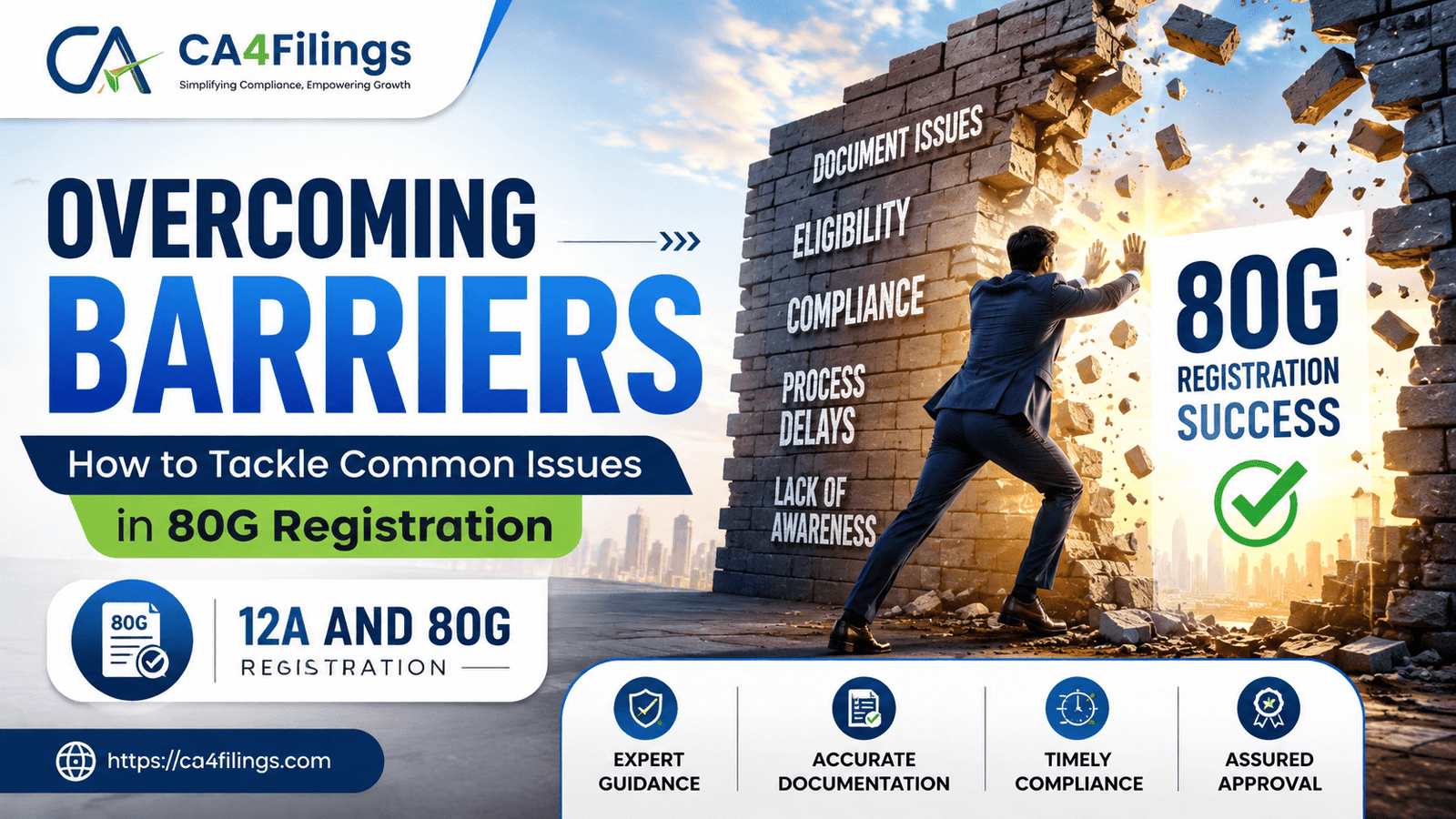
Running a nonprofit organization in India is one of the most fulfilling yet challenging journeys you can take. Every day, you work tirelessly to drive real change, whether it is teaching underprivileged kids, funding medical camps, or protecting the environment. But let’s be honest—passion alone doesn’t keep the lights on. To scale your impact, you need steady fundraising. This is exactly where the Income Tax Department plays a pivotal role through tax exemption certificates. If you are struggling to attract big donors, the secret usually lies in Overcoming Barriers: How to Tackle Common Issues in 80G Registration. Securing this registration is a massive trust signal that allows your donors to claim tax benefits on their philanthropy, making them far more likely to support your cause.
At CA4Filings, we regularly meet brilliant changemakers who face immense legal hurdles just trying to get their paperwork in order. The truth is, navigating the world of NGO registration, trust registration, and the accompanying tax laws can feel overwhelming. Many founders get caught up in the complex web of government regulations, leading to delayed approvals or outright rejections. If you want to streamline this journey, pairing your 80G application with a 12A and 80G Registration approach is the most effective way to secure both tax-free income for your trust and tax deductions for your donors simultaneously. Let’s break down the most common roadblocks and look at how you can bypass them like a pro.
Why 80G Registration Fails: The Hidden Barriers
The nonprofit sector has seen a lot of regulatory tightening over the last few years. The days of submitting a few basic forms and getting a lifetime approval are gone. Today, the process requires absolute precision. Here are the primary reasons applications hit a wall.
1. Incomplete or Mismatched Documentation
This is the single biggest reason for rejection. When you apply for 80G, the tax department scrutinizes your core structure. If your trust deed or society’s memorandum of association (MOA) contains ambiguous clauses, or if the names of the trustees don’t match their PAN cards perfectly, a rejection notice is almost guaranteed.
2. Failure to Prove Financial Transparency
The government wants to see exactly where every single rupee goes. If your charity registration is a couple of years old but you haven’t maintained proper books of accounts, or if you lack audit reports, the tax authorities will question your credibility.
3. Mixing Commercial Activities with Charity
While an NGO can generate minor income from trade or services to support its goals, the primary objective must remain purely charitable. If your financial statements show heavy commercial receipts without clear alignment to your social cause, your 80G application will face serious legal hurdles.
Overcoming Barriers: How to Tackle Common Issues in 80G Registration
Now that we know what goes wrong, let's look at the proactive steps you can take to ensure your application sails through smoothly. Successfully Overcoming Barriers: How to Tackle Common Issues in 80G Registration requires a strategic mix of compliance and clear communication with tax authorities.
Step-by-Step Strategy for a Flawless Application
Review and Align Your Constitutional Documents: Before uploading Form 10G, read through your trust deed or rules. Ensure there is a specific clause stating that the trust’s funds will only be used for charitable purposes and will not be distributed among trustees or members.
Establish Strong Financial Transparency: Maintain a pristine digital record of all income and expenses. If you receive cash donations, ensure they stay within the legal limits specified by tax laws. Track every single donation against a verified PAN or Aadhaar card of the donor.
Organize Your Activity Reports: Don't just show numbers; show impact. The income tax officer reviewing your file wants to see actual proof of your work. Create a comprehensive activity report featuring photographs, event details, media coverage, and participant testimonials.
The New Era of Compliances: Provisional vs. Permanent Registration
The government has introduced a two-tier system to weed out inactive organizations. Understanding this distinction is vital for Overcoming Barriers: How to Tackle Common Issues in 80G Registration.
Provisional Registration (Form 10A)
New organizations that haven't started their activities yet can apply for a provisional 80G registration. This is valid for 3 years and is granted relatively quickly based on your constitutional documents. It allows you to start your fundraising efforts with a basic tax-deduction promise to your donors.
Permanent Registration (Form 10G)
Before your provisional registration expires, or within 6 months of starting your charitable activities (whichever is earlier), you must apply for permanent registration. This is valid for 5 years and involves a deep-dive assessment of your actual work and financial transparency by the tax department.
Frequently Asked Questions
Can a religious trust get an 80G registration?
Generally, no. If your trust deed states that your activities are exclusively for the benefit of a specific religious community or caste, you will not qualify for 80G benefits. The charity must be open to all citizens regardless of caste, creed, or religion.
What is Form 10BD, and why does it matter for 80G?
Form 10BD is an annual statement that every 80G-registered NGO must file. It lists all the donation receipts issued during the financial year. If you fail to file this form on time, your donors will not see the deduction pre-filled in their tax returns, which can severely damage your organization’s reputation.
How long does it take to get the 80G approval?
Once submitted online, the law requires the Income Tax Commissioner to pass an order within 3 to 6 months. If they require clarifications, they will issue a digital notice, which must be answered promptly to avoid rejection.
Securing Your Trust's Future
Navigating the path of Overcoming Barriers: How to Tackle Common Issues in 80G Registration doesn't have to feel like a battle against bureaucracy. Think of these government regulations not as roadblocks, but as a framework designed to validate your hard work and protect honest philanthropy. When your paperwork is flawless and your financial transparency is clear, the tax department becomes an enabler of your vision, not an obstacle.
If you want to save time, avoid the stress of responding to complicated tax notices, and ensure your application is processed perfectly the first time, let our team of experienced professionals help you. At CA4Filings, we handle the entire legal compliance burden—from deep deed analysis to final submission—so you can stay focused on what matters most: making a difference in the world.
Latest Updates
ca4filings.com Services
























-registration.png)